All species › Passerines › Tyrant flycatchers and allies › Western Wood-Pewee
Western Wood-Pewee | Contopus sordidulus
Westelijke bospiewie | Pibí Occidental
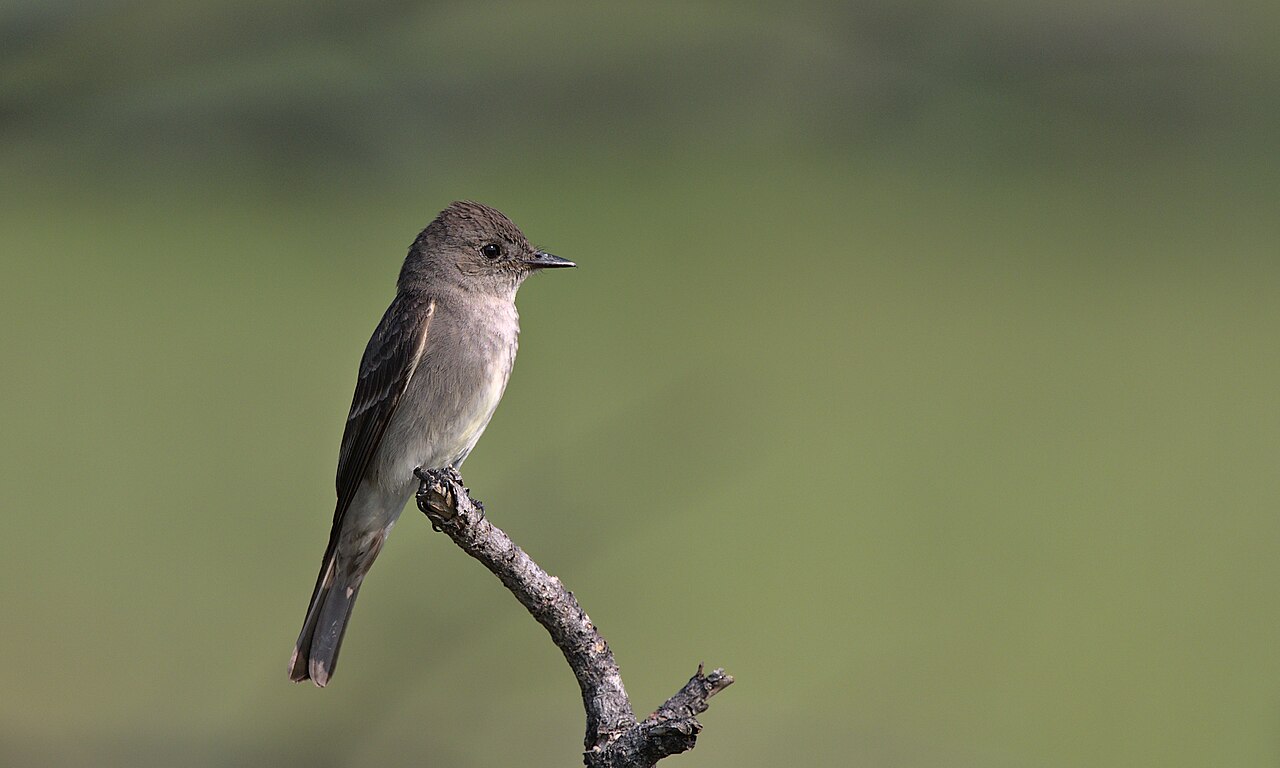
The Western Wood-Pewee is the common small pewee of western North America: greyish brown, with long wings, a peaked crown and two faint wingbars. In appearance it is all but inseparable from Eastern Wood-Pewee; the distinction rests almost entirely on song. It breeds from Alaska to Central America and winters in South America.
Voice
The song is a harsh, nasal, thoroughly burry brzheeer, beginning as one tone and descending from start to finish, as though something vibrates within the note; it is often repeated every few seconds, including in half-light before sunrise and after sunset. The dawn song adds a three-part introduction, roughly tswee-tee-teet, followed by the same descending peeer. It never whistles the clear, syllable-separated pee-a-wee of the eastern bird. The call is a dry chip.
Recording: Jonathon Jongsma — CC BY-SA 4.0 · Prairie Trail, Custer State Park, South Dakota, United States · xeno-canto
Identification
A medium-sized flycatcher with a peaked, angular crown, long wings whose tips reach well over the base of the tail, and a straight tail held still. The upperparts are greyish brown, the underparts dingy white with grey smudging on breast and sides that reads as a half-buttoned waistcoat. The wingbars are pale and narrow; an eyering is absent or barely visible. The bill is largely dark, with only some yellow at the base of the lower mandible. After a sally it returns to the same branch and flutters its wings briefly on landing.
Confusion species
Eastern Wood-Pewee cannot be separated on plumage in the field; only song is reliable. The eastern bird whistles a clear, syllable-separated pee-a-WEE, the middle syllable rising and the last falling, alternating with a drawn-out descending pee-ur; the western gives a single harsh, nasal brzheeer with no clear whistled tone. The ranges meet only in a narrow band on the Great Plains, from southern Manitoba and the Dakotas to western Texas; silent birds there and on migration are best left unnamed. From Empidonax flycatchers it is told by the longer wing projection, the faint wingbars and the lack of a distinct eyering; Willow Flycatcher is smaller, shorter-winged and calls a sharp fitz-bew. Greater Pewee is much larger, crested and with a wholly orange lower mandible.
Habitat
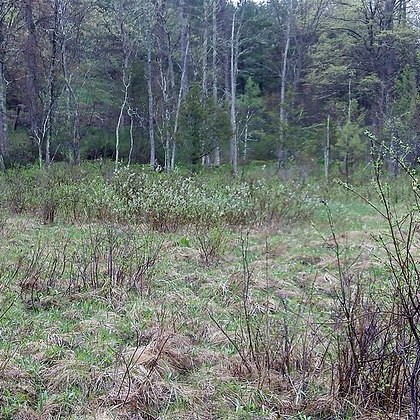
Open woodland and woodland edge with large trees and an open understorey: aspen groves, pine-oak woods, ponderosa pine forest, pinyon-juniper, and above all cottonwood-willow woodland along streams and rivers in the dry west. It avoids closed canopy and hunts from open branches at middle height. It also breeds in gardens, parks and along urban creeks, as long as there are tall trees with open space beneath. In winter it uses forest edges and second growth in northwestern South America.
Where the bird is most often found, arranged by the USNVC — the vegetation classification of the United States and Canada — and CMECS for sea and coast.




Range and movements
Breeds from central Alaska, Yukon and British Columbia through the whole western United States to southern California, Arizona and New Mexico, east to the Dakotas and western Nebraska, and south through the Sierra Madre of Mexico. In the United States it is strictly a summer bird: arriving in late April and May, departing before mid-October. Wintering is in northwestern South America, from Colombia and Venezuela to Peru and Bolivia; Mexico and Central America are crossed on a broad front. West Texas holds small breeding populations in the Davis and Guadalupe Mountains, but most Texan birds are migrants.
- Resident
- Breeding (summer)
- Winter
- Passage
- dark = core range, pale = thinly spread
Where and when to look
In June the quickest place to find it is cottonwood woodland along a creek: stand there at first light and wait for the harsh descending brzheeer, which it keeps repeating in the dusk when most songbirds have fallen silent. On the Great Plains use sound alone to separate it from Eastern Wood-Pewee, and record the bird if in doubt. Otherwise watch the long wing projection and the absence of an eyering to rule out Empidonax.
Conservation
The species sits in the lowest category of concern on the Red List; Partners in Flight puts the breeding population at over nine million birds. North American breeding bird surveys show a steady decline since 1966, on the order of one per cent a year. The causes named are the loss of riparian cottonwood-willow woodland in the dry west to grazing, water abstraction and river regulation, and the general decline of flying insects. The wintering range in the Andes is poorly surveyed.
Scientific name
Contopus sordidulus | Sclater, 1859
Philip Lutley Sclater described the species in 1859 already within the genus Contopus, so author and year stand without parentheses. The genus had been introduced by Jean Cabanis in 1855, from Greek kontos 'short' and pous 'foot'. The species name sordidulus is a Latin diminutive of sordidus 'dirty', so 'somewhat dingy', after the greyish brown plumage. The specimen described came from Orizaba in Mexico. The name pewee, in all three languages, renders the drawn-out whistle of the genus — the very sound this species does not give.