All species › Waders, gulls and terns › Sandpipers and allies › Willet
Willet | Tringa semipalmata
Willet | Playero Aliblanco
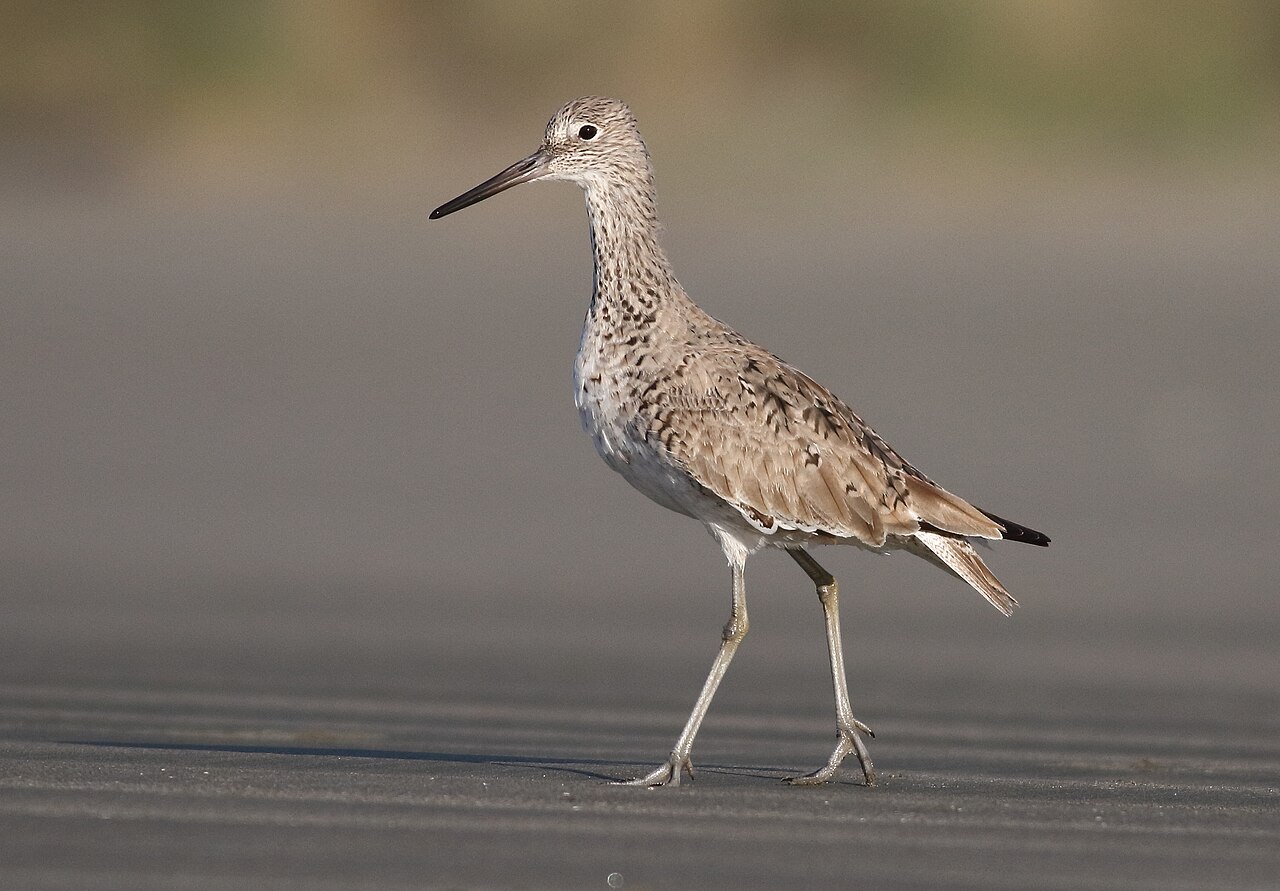
At rest the Willet is a large, plain grey shorebird, but the moment it flies a broad black-and-white band opens across the wing that no other American bird has. It comes in two strongly different forms: a smaller, darker coastal bird of the eastern salt marshes and a larger, paler bird of the western prairie sloughs. Its name is its call, which rings out over every salt marsh and prairie lake in May.
Voice
The display call is a loud, rhythmic pill-will-willet, repeated endlessly from a slow flight on stiff, quivering wingbeats over marsh or prairie. In alarm it becomes a hard, fast kip-kip-kip from a post or fence, and over an intruder a persistent kaay kaay. Birds of the eastern coastal form call higher and faster than those of the western inland form, which is useful where the two meet. Outside the breeding season the species is far quieter and mostly gives a single sharp note on take-off. The display call starts in the east in late April and runs to early July.
Recording: Ed Pandolfino — CC BY-NC-SA 4.0 · Sierrra Valley, Plumas County, California, United States · xeno-canto
Identification
A large, heavily built wader with a thick, dead-straight dark bill clearly longer than the head, and grey-blue legs — an unusual colour in this family. In winter plumage it is almost uniformly grey above and white below, without pattern; in breeding plumage the upperparts are brown-grey with dark spots and the neck, breast and flanks are barred crosswise. Male and female look alike; juveniles resemble winter birds but have neat pale feather fringes. The decisive character comes only in flight: a broad white band crosses the black wing, visible from above and below, with a white rump and a grey tail behind it. The wing is broad and fairly round, the tail short and square-ended.
Confusion species
At rest Marbled Godwit is the first confusion species, but it is warm cinnamon-brown, has a long slightly upturned bill with a pink base, and shows a cinnamon underwing in flight with no white band. Greater Yellowlegs is slimmer, with bright yellow legs and a thinner bill, and shows only a white rump patch in flight. The two forms of the species itself also need attention: the eastern coastal form (subsp. semipalmata) is smaller and more compact, warmer brown, and in breeding plumage coarsely and densely barred, with a shorter, thicker bill; the western inland form (subsp. inornata) is larger and longer-legged, paler and greyer, with a longer and finer bill and much lighter barring. Outside the breeding season that plumage difference is all but gone and only build and bill remain.
Compare sandpipers, snipes and allies: bill, legs, wing bar and rump
Habitat
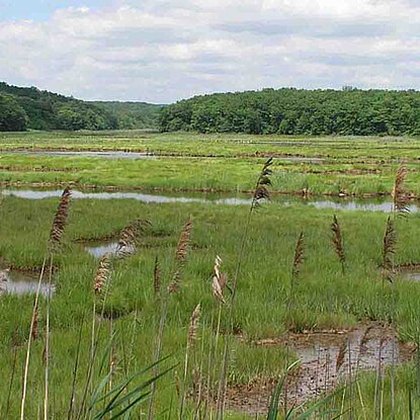
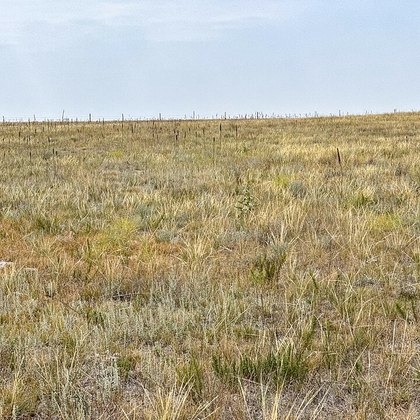
Eastern birds breed in salt marsh and on the vegetated parts of barrier islands and sandy beaches, always within reach of the tide. Western birds breed in short, dry grassland and on alkali flats around shallow prairie ponds and salt lakes, sometimes hundreds of metres from water. Outside the breeding season both stand on tidal flats, along the edges of salt marsh, on sandy beaches and on rocky groynes and jetties. They avoid deep water and closed forest; the chicks need low vegetation to creep into and open mud to feed on.
Where the bird is most often found, arranged by the USNVC — the vegetation classification of the United States and Canada — and CMECS for sea and coast.



Range and movements
The western form breeds inland in Alberta, Saskatchewan and Manitoba south across the northern Great Plains and the Great Basin to Colorado, Nevada and north-eastern California, and winters on both coasts of the United States and Mexico. The eastern form breeds in the salt marshes of the Atlantic coast from Nova Scotia to Florida, along the Gulf to Texas, and in the Bahamas and the Greater Antilles; it largely leaves North America and winters mainly on the north coast of South America, beyond the guide area. As a result the birds standing in the southern states in summer are not the ones there in winter, even though the map looks filled all year. In the nineteenth century the eastern form was shot and egged out of much of the north-east; after the hunting ban of 1918 it returned as far as Nova Scotia and southern Maine.
- Resident
- Breeding (summer)
- Winter
- Passage
- dark = core range, pale = thinly spread
Where and when to look
Go to a salt marsh or a prairie slough at sunrise in May and wait for the display flight: a calling Willet on quivering wingbeats shows the wing pattern for minutes on end and can be found from kilometres away. Outside the breeding season it pays to find a roosting flock and wait until it shifts — one flight gives the black-and-white band, and with it the species. On the south-east coast in winter, look at bill and leg: the long-billed, pale birds on the beach are then western birds, while the salt-marsh breeders are not back until April.
Conservation
The species is assessed as Least Concern (LC), with a population of a few hundred thousand birds, but numbers fell between 1966 and 2014 and it stands on the United States watch list. In the east the salt marsh is under pressure from building, dyking and rising sea level, which floods the low-lying nests more often. In the west the shallow prairie ponds are going under the plough and the water table in the Great Basin is dropping. On the Californian coast collisions with power lines and disturbance of roosts come on top of that.
Scientific name
Tringa semipalmata | (Gmelin, 1789)
Gmelin described the species in 1789 as Scolopax semipalmata, among the snipes; because it was later placed in another genus, author and year stand in parentheses. The description appeared in the second part of the thirteenth edition of the Systema Naturae, on page 659, with New York as the type locality. semipalmata is Latin for 'half-webbed', from semi- 'half' and palma 'palm', after the webs that run halfway between the front toes. The species long stood in a genus of its own, Catoptrophorus, and is now placed in Tringa together with the yellowlegs. The English name imitates the call and has been taken over in Dutch; the Spanish name refers to the white wing band.