All species › Waders, gulls and terns › Sandpipers and allies › Lesser Yellowlegs
Lesser Yellowlegs | Tringa flavipes
Kleine Geelpootruiter | Archibebe patigualdo chico
The Lesser Yellowlegs is the slim, long-legged wader that can stand at almost any shallow water on the continent in spring and autumn, from a Louisiana rice field to a settling pond behind a small town. It breeds in the openings of the northern conifer forest and travels as far as Tierra del Fuego, one of the longest journeys of any North American shank. More than half the population has gone in fifty years, and the species is now listed as Vulnerable.
Voice
The flight call is a soft, flat tew, usually single or as a couplet tew-tew, far less loud and less ringing than the three-note volley of Greater Yellowlegs. On the breeding grounds a disturbed bird calls a sharp, persistent kleep kleep kleep from a dead treetop, and keeps it up for minutes while you are near. In an undulating display flight over the bog the male delivers a rolling pill-e-wee pill-e-wee. On migration the soft single or double tew is about all you hear, and it is at once the handiest character: three or four loud notes mean you are standing beside the larger species.
Recording: Tony Rinaud — CC BY-NC-SA 4.0 · Middleton Island, Alaska, United States · xeno-canto
Identification
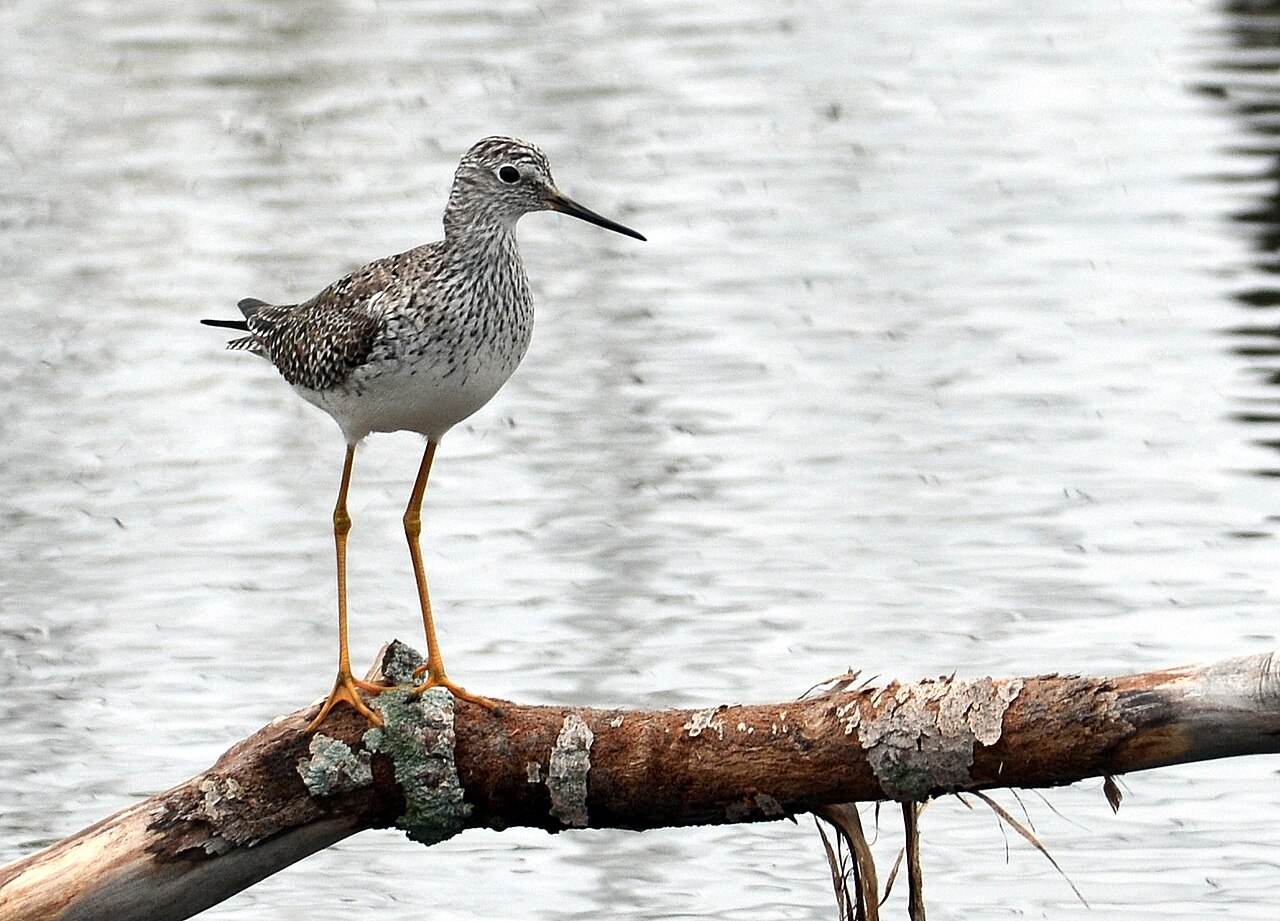
A medium-sized shank with a slight body, a long neck and long, bright yellow legs. The bill is straight, thin and dark and no longer than the head, with no paler base. In breeding plumage the upperparts are dark grey-brown with white and black flecking, and fine streaks run down neck and breast with a few dark chevrons on the flanks. In winter plumage it is much smoother and plainer grey, with a pale supercilium and a white belly. Juveniles are browner with neat pale spots along the feather edges. In flight a square white rump patch stands out against an otherwise dark, unbarred wing, and the yellow legs trail past the tail; it walks with quick steps and picks at the water surface with short, aimed jabs.
Confusion species
Greater Yellowlegs (Tringa melanoleuca) is the species it is confused with daily. Look at the bill against the head: in the Lesser it is as long as the head, thin and dead straight; in the Greater half as long again, heavier, paler at the base and slightly upturned. Voice settles it: one or two soft notes against three or four loud ones. Solitary Sandpiper is smaller and darker, with a white eye-ring, greenish legs and a dark rump. Wilson's Phalarope in winter plumage is also long-legged but has a needle-fine bill, and spins as it swims instead of wading.
Compare sandpipers, snipes and allies: bill, legs, wing bar and rump
Habitat
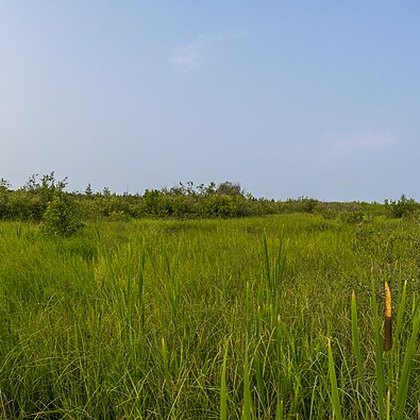
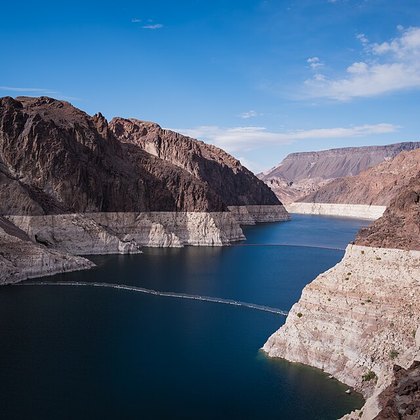
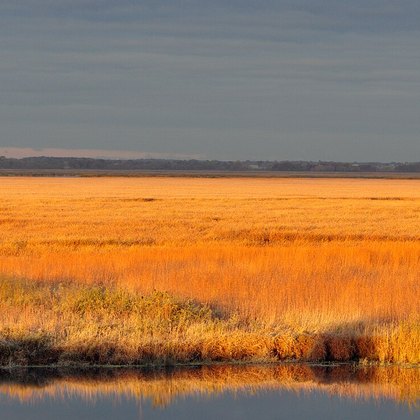
It breeds in the openings of the boreal forest: peat bogs with scattered spruce, old burns, wet sedge meadows and the margins of forest pools and ponds. On migration and in winter it seeks shallow fresh water over a soft bottom — flooded fields, rice, the drawn-down shores of reservoirs, sewage lagoons, stock ponds and the edges of salt marsh. It avoids deep water, surf and dry sand, preferring a hand's depth it can wade in up to the knee joint. In the south of the winter range it also uses coastal mud, but rarely far from fresh water.
Where the bird is most often found, arranged by the USNVC — the vegetation classification of the United States and Canada — and CMECS for sea and coast.


Range and movements
The breeding range runs from Alaska east through Yukon, the Northwest Territories, northern British Columbia and the prairie provinces to James Bay and central Quebec. From mid-July the females leave first, followed by the males and much later by the young birds; autumn passage is broad across the whole continent, with a stronger eastern stream and crossings of the Atlantic to the Caribbean. It winters along the coasts of the southern United States, throughout Mexico, Central America and the Caribbean, and on to Tierra del Fuego, beyond the guide area. In spring the movement is more concentrated inland, with the Great Plains and the Mississippi valley as the main route. The range itself has barely shifted in the past century; what has changed is the number of birds moving through it.
- Resident
- Breeding (summer)
- Winter
- Passage
- dark = core range, pale = thinly spread
Where and when to look
Look for it from April to May and from July to October at any shallow muddy edge: a flooded corner of a field, a drawn-down reservoir or a settling pond often produces more than the coast. In a party of yellowlegs, hold the bill against the head: equal length means the Lesser, half as long again the Greater — and that works at range and on a photograph. Then wait for the call, because one or two soft notes clinch the record. In autumn the juveniles stay longest and are the least wary.
Conservation
The species is listed as Vulnerable (VU). The breeding population is put at about 660,000 birds, and more than half the stock has gone in fifty years, with a steep fall in the past decade. Loss of shallow wetland in the winter range is the main cause; on top of that the species is still hunted in parts of the Caribbean and northern South America, and it is precisely the birds from the east of the breeding range that pass through those areas. Because it lives on small, shallow waters it can be helped locally: a settling pond drawn down late, or a wet corner of a field in August, provides resting places at once.
Scientific name
Tringa flavipes | (Gmelin, 1789)
Gmelin described the species in 1789 as Scolopax flavipes, among the snipes; because it was later placed in another genus, author and year stand in parentheses. The description appeared in the second part of the thirteenth edition of the Systema Naturae, on page 659, with New York as the type locality. flavipes is Latin for 'yellow-footed', from flavus 'yellow' and pes 'foot'. The genus Tringa goes back to Linnaeus and is the Latin form of a Greek word for a thrush-sized waterside bird. The Dutch, English and Spanish names all name the yellow legs and the difference in size from the larger species.