All species › Waders, gulls and terns › Sandpipers and allies › Wood Sandpiper
Wood Sandpiper | Tringa glareola
Bosruiter | Andarríos bastardo
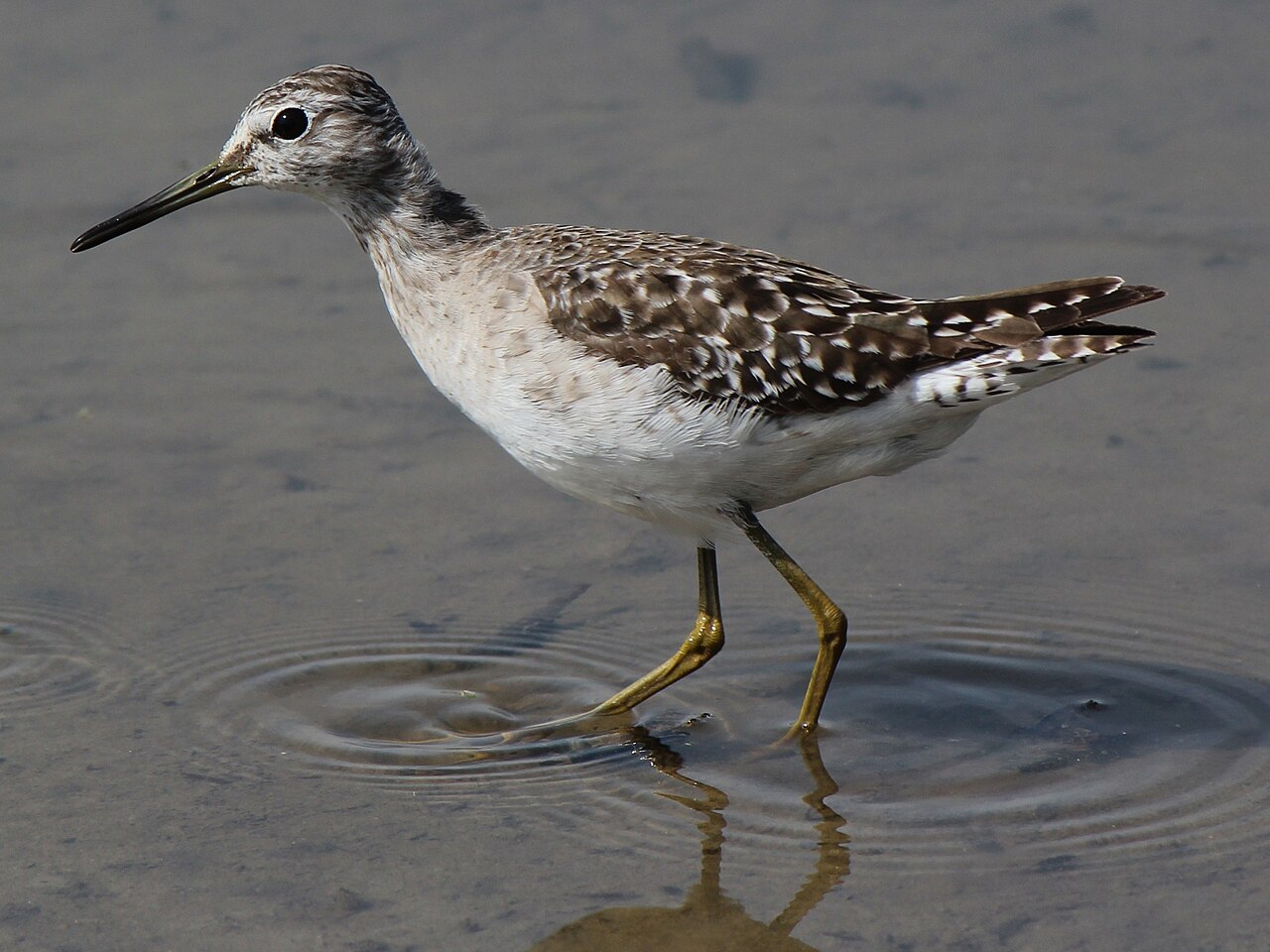
The Wood Sandpiper is a Eurasian wader that touches North America only along its western edge: it is an annual visitor in small numbers to the outer Aleutians and the Bering Sea islands, and has exceptionally nested there. It is a slim, dark shank with a back densely speckled in white, a long pale supercilium and olive-yellow legs. Flushed, it towers away steeply with a sharp three-syllable call.
Voice
The flight call is a high, sharp chiff-iff-iff of usually three quick notes, repeated as the bird climbs steeply until it is out of sight. In alarm near the nest there is a persistent, hard chip-chip-chip, given from a treetop or a post. The song is a yodelling tlee-a tlee-a tlee-a delivered by the male in an undulating flight over the marsh, wings raised and then held stiffly out. That sound is heard in North America at most on an Aleutian island in June. Usually it is the flight call that gives the bird away, since in low vegetation it is invisible until it rises.
Recording: Stanislas Wroza — CC BY-NC-SA 4.0 · Soppavann, Finland · xeno-canto
Identification
A medium-sized, slim shank with a straight, thin dark bill about the length of the head and medium-long legs of a greenish to olive yellow. The upperparts are dark grey-brown and sown all over back and wing with small cream-white spots, so that at close range the bird looks speckled. Head and neck are finely streaked and the lightly spotted breast ends sharply against a white belly; a long white supercilium runs well behind the eye. In flight a square white rump patch shows, with a finely barred tail, a plain dark upperwing without a bar and a pale, grey-white underwing; the toes project past the tail. Male and female look alike; juveniles are warmer brown with buff instead of white spotting. It walks deliberately through shallow water, bobbing lightly with head and rear body.
Confusion species
Solitary Sandpiper (Tringa solitaria) is this continent's counterpart and looks much the same, but has a dark underwing, a dark rump with white, black-barred outer tail feathers, a bold white eyering and a short supercilium that stops in front of the eye. In T. glareola both rump patch and underwing are pale and the supercilium runs far behind the eye. Lesser Yellowlegs is larger and longer-legged, with brighter yellow legs, a longer bill and much smoother, greyer upperparts without dense spotting. A juvenile Common Sandpiper is shorter-legged, holds its body low and horizontal, and shows a white wingbar in flight. The call helps: three quick sharp notes point to Wood Sandpiper, a single high note to Solitary Sandpiper.
Habitat
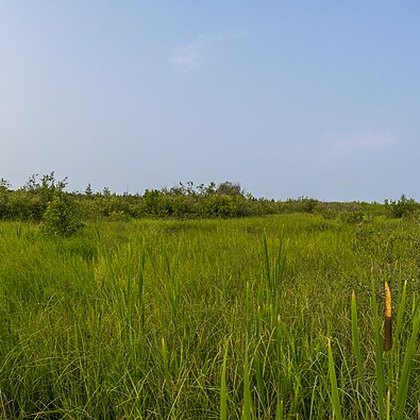
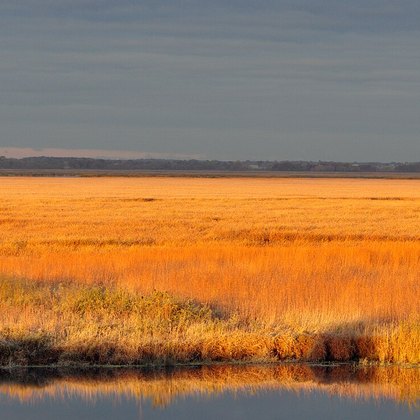
On the breeding grounds it is a bird of open wet ground within conifer forest: sphagnum bog, sedge fen, wet clearings and the boggy margins of forest pools. On passage and in winter it takes any shallow fresh water over a soft bottom: rice fields, cattle ponds, ditches, settling lagoons and the muddy edge of a pool. It keeps away from bare sandy beach, wide open tidal flats and deep water; it likes cover close at hand and slips into grass or behind a bank when disturbed. Birds found in Alaska are usually at a small island pool or in a wet peaty hollow.
Where the bird is most often found, arranged by the USNVC — the vegetation classification of the United States and Canada — and CMECS for sea and coast.



Range and movements
The breeding range runs from Scotland and Scandinavia east through inland northern Russia to eastern Siberia and north-eastern China, and south to northern Mongolia and the Commander Islands. It winters in Africa and from southern Asia to southern Japan and Australia; North America lies off that route. Even so the species reaches the continent every year in small numbers on the Asian side: in the outer Aleutians, on St. Lawrence Island and on the Pribilofs, sometimes in small parties, peaking in the last week of May and the first half of June. Nesting has occurred, exceptionally, in the Aleutians. Further east it is a true vagrant, with scattered records as far as New York State.
Where and when to look
Look for it in the last week of May in the outer Aleutians or at Gambell, at the edge of an island pool or in a wet peaty hollow rather than on the beach. Work the ground slowly: the bird sits tight and only goes up when you are close, towering away on three sharp notes — that is the moment the identification is made. Then watch for the square white rump and the pale underwing, the two characters that separate it from Solitary Sandpiper. Anyone reporting one away from Alaska is well advised to have both of those on a photograph.
Conservation
The world population runs to several million birds and the species is assessed as Least Concern (LC); numbers in the west of the range have fallen with the draining of peatland, while further east the picture is stable. There is no management task of its own in North America, since breeding has been no more than occasional and passage amounts to a few tens of birds a year. The species is, however, a good measure of how many Asian waders cross the Bering Sea each year. The small pools and peaty patches it uses on the Bering Sea islands are limited in area and quickly disturbed.
Scientific name
Tringa glareola | Linnaeus, 1758
Linnaeus described the species in 1758 in the tenth edition of the Systema Naturae, on page 149, and gave it there the name Tringa glareola; because the genus has not changed since, author and year stand without parentheses. The type locality was Europe, later restricted to Sweden. glareola is a diminutive of Latin glarea, 'gravel', after the gravelly shores where the bird was seen. The name Tringa is the Latin form of a Greek word for a thrush-sized waterside bird. The Dutch name of the bird points to its breeding ground in the forest, which is unusual in this family.