All species › Passerines › Crows, jays and magpies › Woodhouse's Scrub-Jay
Woodhouse's Scrub-Jay | Aphelocoma woodhouseii
Woodhouse' struikgaai | Chara de Woodhouse
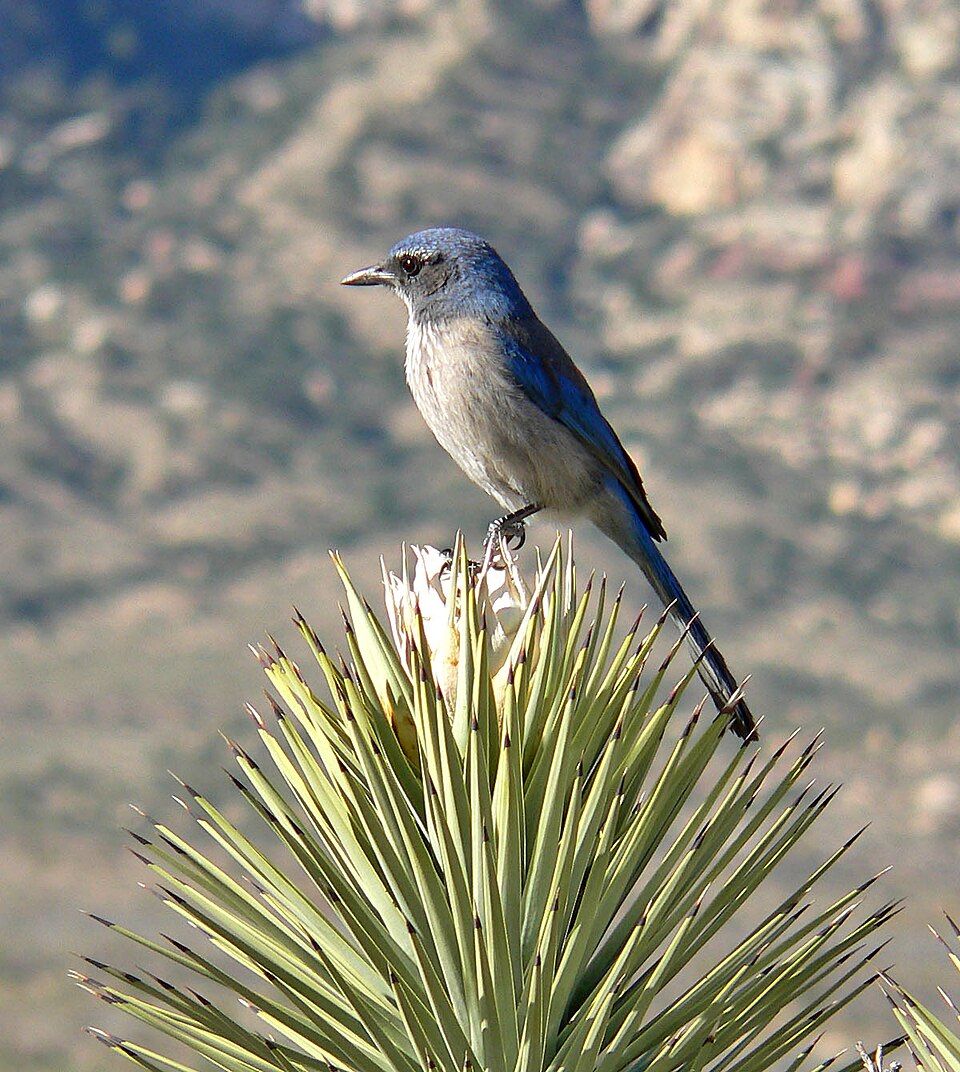
Woodhouse's Scrub-Jay is the scrub-jay of the interior: the Great Basin, the southern Rocky Mountains, the Chihuahuan Desert and the Mexican plateau. It is duller blue than its western counterpart and has a more pointed bill, suited to pinyon nuts rather than acorns.
Voice
The call is a harsh, scratchy shreep, higher in pitch than in the California Scrub-Jay and usually in series of three to six. There is also an upslurred weep and a dry rattle. It has no song in the ordinary sense; within the territory pairs use soft, muttered sequences. Birds of the southern Mexican group, sometimes held separate as Sumichrast's Scrub-Jay, have different calls.
Recording: Manuel Grosselet — CC BY-NC-SA 4.0 · Capulalpam de Méndez, Capulalpam de Méndez, Oaxaca, Mexico · xeno-canto
Identification
A crestless jay with blue head, wings and tail, a grey-brown back patch and grey underparts. The throat is dingy white and passes into the breast without a sharp edge: the blue necklace is faint or absent. The eyebrow is narrower and less white than in the California Scrub-Jay. The bill is straight and pointed, without an obvious hook. The whole bird looks paler, greyer and less contrasting; in strong light the missing breast band is what stands out.
Confusion species
This species, the California Scrub-Jay and the Island Scrub-Jay were treated as one species until 2016, the Western Scrub-Jay. The California Scrub-Jay is deeper blue, has clean white underparts, a clear continuous blue breast band and a thick, hook-tipped bill, and lives west of the Sierra Nevada; only in western Nevada do the ranges touch. The Island Scrub-Jay is larger and deeper blue and stays on Santa Cruz Island. Mexican Jay is the closest match at short range: it is larger, has a plain grey throat and breast with no white throat patch and no necklace, and lives in flocks of five to twenty birds, while Woodhouse's stays in pairs. Pinyon Jay is uniformly grey-blue and short-tailed.
Habitat
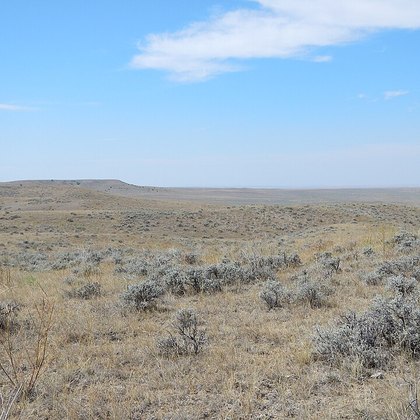
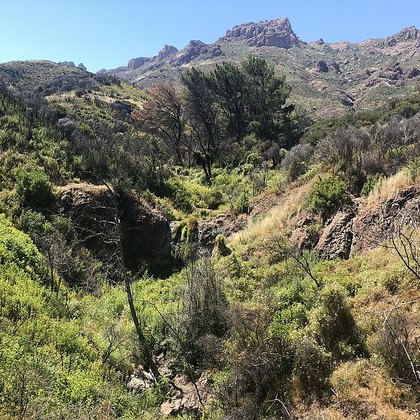
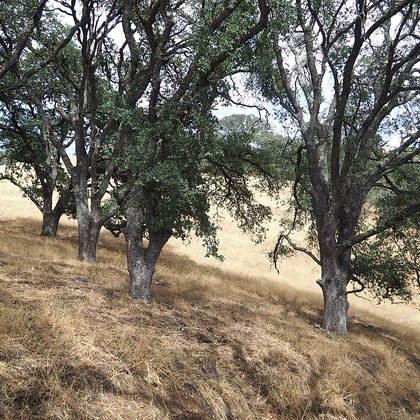
Pinyon (a low-growing pine of the dry southwestern foothills)-juniper woodland is the core, and beyond that dry scrub, oak scrub, sagebrush (grey-green wormwood scrub of the dry western interior) with taller shrubs, mesquite (a thorny pod-bearing shrub of the Southwest that forms dense thickets) stands along dry washes and, at the southern end of the range, mid-elevation pine-oak woodland. Also in towns, roadsides and gardens within that area. It occurs lower than Pinyon Jay and Mexican Jay where the three occur together.
Where the bird is most often found, arranged by the USNVC — the vegetation classification of the United States and Canada — and CMECS for sea and coast.




Range and movements
Resident from southeastern Oregon and southern Idaho through Nevada, Utah, western Colorado, southwestern Wyoming, Arizona and New Mexico to western Texas, and south across the Mexican plateau to Puebla, Veracruz, Oaxaca and Guerrero. It does not migrate, but in years when the pinyon crop fails flocks wander outside the normal range, sometimes for hundreds of kilometres. The southern Mexican part of the range is separated from the rest.
- Resident
- Breeding (summer)
- Winter
- Passage
- dark = core range, pale = thinly spread
Where and when to look
Look for it in pinyon-juniper woodland in Utah, Nevada or New Mexico; it often perches on the top of a juniper or crosses a road low down. Where the ranges meet in western Nevada, the breast band is the quickest character: continuous and blue in California Scrub-Jay, absent or at most a faint smudge in this species.
Conservation
The species is listed as Least Concern (LC) and numbers are stable. The pressure is the removal of pinyon-juniper woodland: since the twentieth century it has been cut, chained and burned on a large scale to convert it to rangeland or sagebrush. West Nile virus also affects corvids in this area. In warmer and drier years pinyon pines die off in large numbers, lowering the food supply across part of the range.
Scientific name
Aphelocoma woodhouseii | (Baird, 1858)
Spencer Fullerton Baird described the species in 1858 as Cyanocitta woodhouseii, from material taken at Fort Thorn in New Mexico; because it was later moved to another genus, author and year stand in parentheses. The species name honours Samuel Washington Woodhouse, physician and naturalist on the United States survey expeditions in the Southwest. Aphelocoma comes from Greek apheles 'simple, smooth' and komē 'head of hair', after the plain plumage. The English name Woodhouse's Scrub-Jay has been in use since the 2016 split.