All species › Passerines › Tanagers and allies › Yellow-billed Cardinal
Yellow-billed Cardinal | Paroaria capitata
Geelsnavelkardinaal | Cardenilla piquigualda
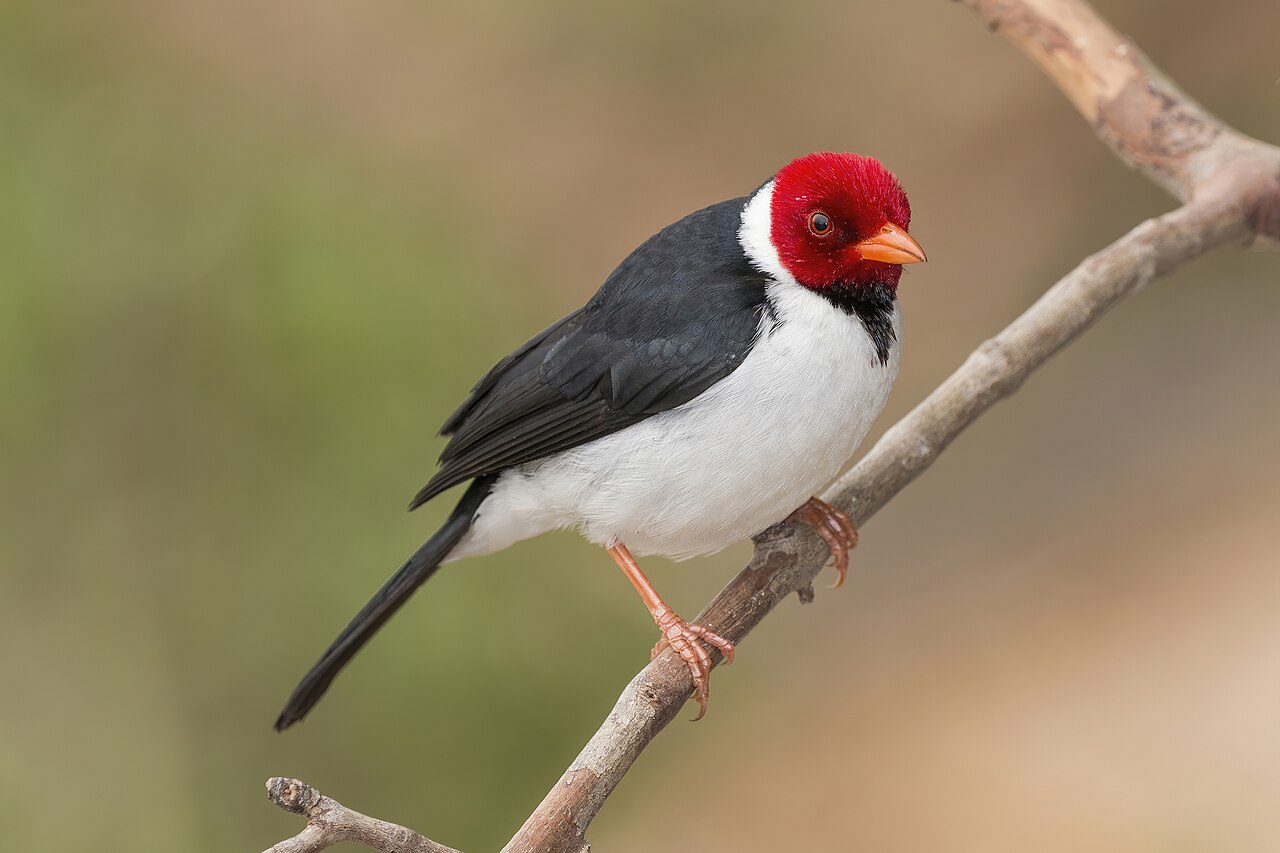
The Yellow-billed Cardinal is a South American seedeater with a red head, a black throat patch, white underparts and an orange-yellow bill. It belongs by origin to the marsh edges of the Pantanal and the Paraná basin; within this guide's window it occurs only as an introduced bird in Hawaii, chiefly along the coast of the island of Hawaii.
Voice
The voice is simple: a hard, short chik or chep, often in series and passed back and forth between members of a party, and a whistled song of two or three clear notes repeated at short intervals. Pairs call to each other from lawn and shrub. The voice is less loud and less varied than that of the Red-crested Cardinal, with which it often shares a park in Hawaii.
Recording: Luciano Buck — CC BY-NC-SA 4.0 · Colonia Carlos Pellegrini, San Martín Department, Corrientes Province, Argentina · xeno-canto
Identification
A stocky bird of about sixteen centimetres, without a crest. The head is red, the chin and throat black, and below these a white collar runs into white underparts; back, wings and tail are medium grey. Bill and legs are orange-yellow, and it is that bill colour which stands out at a distance. Male and female are alike. The juvenile has a brownish-orange head and browner upperparts, and gains the red only through its first year.
Confusion species
The Red-crested Cardinal, also introduced in Hawaii, has a pointed red crest, a pale horn-coloured bill and a red point running down onto the breast, and lacks the black throat patch. The Northern Cardinal, likewise introduced on the islands, is all red with a crest and a heavy red bill. A young Yellow-billed with its brown head resembles other species most; the orange-yellow bill and the grey and white body then identify it.
Habitat
In its original range, marsh edge, river bank and damp scrub. In Hawaii it occupies low-lying scrub, forest edges, hotel and resort lawns, fishponds and villages and harbours, nearly always close to water. It forages on the ground, usually in pairs or small parties, taking seed, small fruit and insects; spilt feed and crumbs are picked up. It is tied to the coastal lowland and does not penetrate the montane forest.
Where the bird is most often found, arranged by the USNVC — the vegetation classification of the United States and Canada — and CMECS for sea and coast.





Range and movements
The natural range lies outside this window: central and eastern Bolivia and southwestern Brazil to northeastern Argentina, Paraguay and northwestern Uruguay. Within this window it is solely a matter of the introduced Hawaiian population. That population is established on the island of Hawaii, centred on the Kona coast and also around Hilo, and has spread locally from there; it is resident, with no movement at all. On the other islands of the archipelago there are scattered records and small groups not yet firmly established.
- Resident
Where and when to look
The best chance is a car park, lawn or picnic area along the Kona coast early in the day: the birds walk about in the open on short grass. Check the bill colour first and the absence of a crest; those two features separate it at once from the Red-crested Cardinal often walking the same ground.
Conservation
The species is listed worldwide as Least Concern (LC), with a large South American range and stable numbers. In Hawaii it is an introduced population that has grown in numbers and spread since it established; it falls outside the conservation work aimed at the native Hawaiian birds. The species stays in the low-lying, heavily altered coastal zone and not in the montane forest where the native species are.
Scientific name
Paroaria capitata | (d'Orbigny; de Lafresnaye, 1837)
D'Orbigny and de Lafresnaye described the species in 1837 as Tachyphonus capitatus, from a specimen from Corrientes in Argentina; because it was later moved to another genus, authors and year stand in parentheses. The genus Paroaria was introduced in 1832 by Charles Lucien Bonaparte and goes back to tiéguacú paroára, a name in the extinct Tupi language for a small yellow, red and grey bird. The species name capitata comes from Latin caput 'head' and refers to the red head.