All species › Pigeons and doves › Pigeons and doves › Common Wood Pigeon
Common Wood Pigeon | Columba palumbus
Houtduif | Paloma torcaz | Ringeltaube | יונת ענק | Pigeon ramier
The Wood Pigeon is Europe's largest dove; in parks it is heard in its clattering take-off and drowsy cooing.
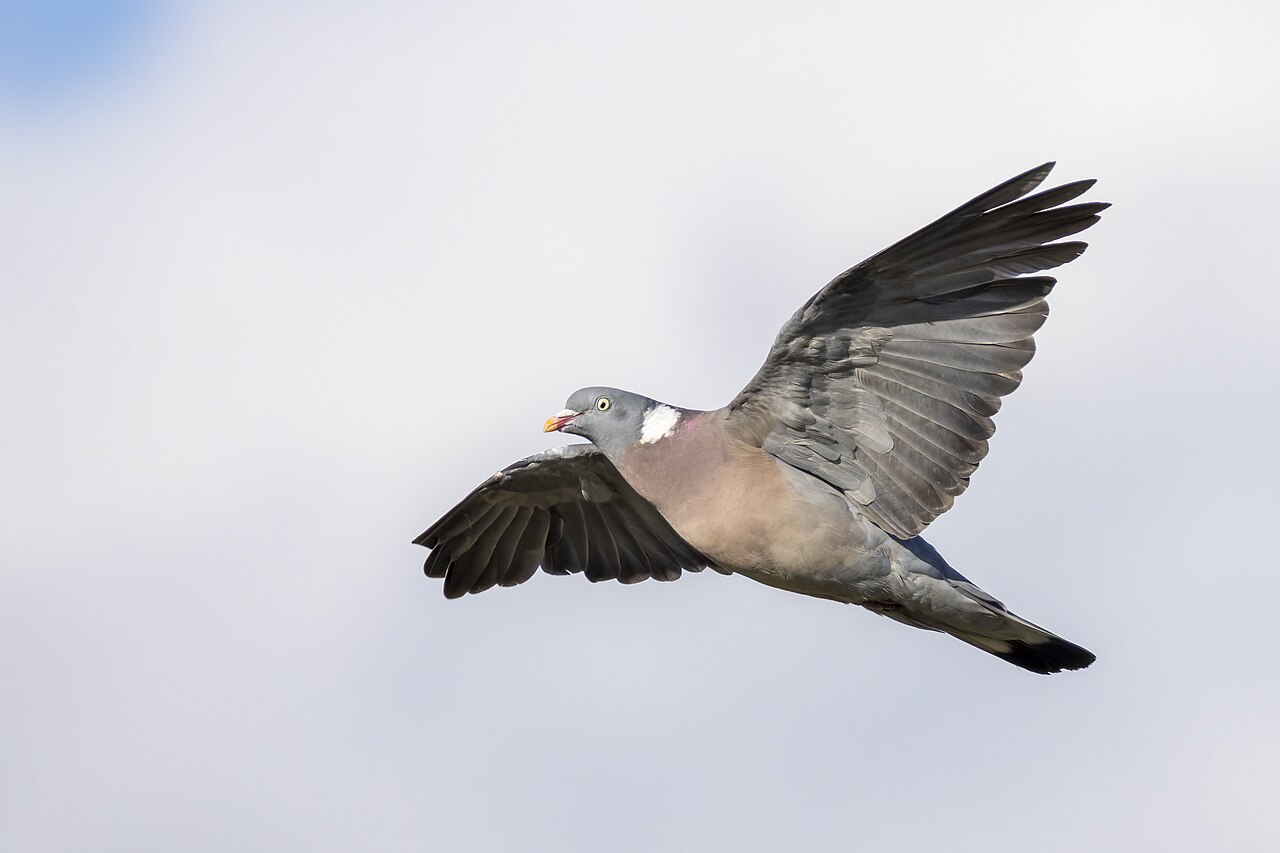
Click a thumbnail to switch the photo above.
Voice
Five syllables with the stress on the second: coo-cooo-coo, coo-coo, repeated and then cut off with a short extra note. Soporific and endlessly repeated. Heard from February into September. On flushing it claps its wings loudly, which serves as an alarm for other birds.
Recording: Benoît Van Hecke — CC BY-SA 4.0 · Wikimedia Commons
Identification
Bulky, with a small head on a heavy body. Adults show a white neck patch beside a glossy green-purple side-neck, a pink breast, a pale eye and a yellow-and-pink bill with a white cere. In flight a broad white band crosses each wing. Juveniles lack the white neck patch and have dull dark eyes.
Confusion species
Stock Dove is smaller and greyer, with no white on neck or wing, dark eyes and short black wing-bars. Feral Pigeons vary endlessly but always show a white rump and two black wing-bars. Collared Dove is paler and longer-tailed, with a black neck collar rather than a white patch.
Habitat
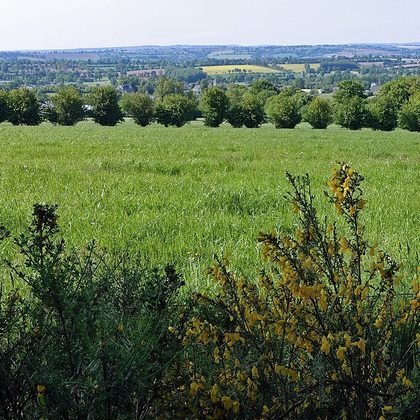
Woods, hedgerow trees, parks, avenues, gardens and leafy villages; feeds mostly in the open on arable land, grassland and brassica fields. Roosts and nests in trees, including dense ivy and conifers in the middle of cities, where it now breeds at very high density.
Where the bird is most at home, classified with EUNIS — the European standard for habitats.


Range and movements
All of Europe east to western Siberia, and in north-west Africa. Birds in north-west Europe are largely resident, but in October and November large numbers of northern birds stream along the coast and over the Pyrenees, mainly through Navarre. In Iberia it is abundant in oak woods and dehesas, wintering on acorns.
- Resident
- Breeding (summer)
- Winter
- Passage
- dark = core range, pale = thinly spread
How and when to look
For migration, watch the first two hours after sunrise in late October and early November from a coastal watchpoint or the passes of the western Pyrenees, where tens of thousands can cross in a single day. For display, March and April: males climb steeply, clap the wings at the top and glide down on stiff wings in a long shallow arc.
Conservation status
Not globally threatened (IUCN: Least Concern). Numerous and increasing, above all in towns and villages where winter survival is better than in the countryside. Farmers treat it as a pest on brassicas and young cereals. Disease such as trichomoniasis can kill many birds locally, but the overall population picture stays favourable.
Scientific name
Columba palumbus | Linnaeus, 1758
Linnaeus described the species in 1758 and placed it straight away in the genus where it still stands. He introduced the genus Columba in that same work. Columba is Latin for 'dove' and goes back to Greek kolumbos 'diver', from kolumbaō 'to dive, to swim'; classical writers used it of the rock dove for the swimming stroke of its wings in flight. palumbus is an alternative form of Latin palumbes, the word for the wood pigeon. The specimen the first description was based on came from Sweden.