All species › Pigeons and doves › Pigeons and doves › Eurasian collared-dove
Eurasian collared-dove | Streptopelia decaocto
Turkse tortel | Tórtola turca
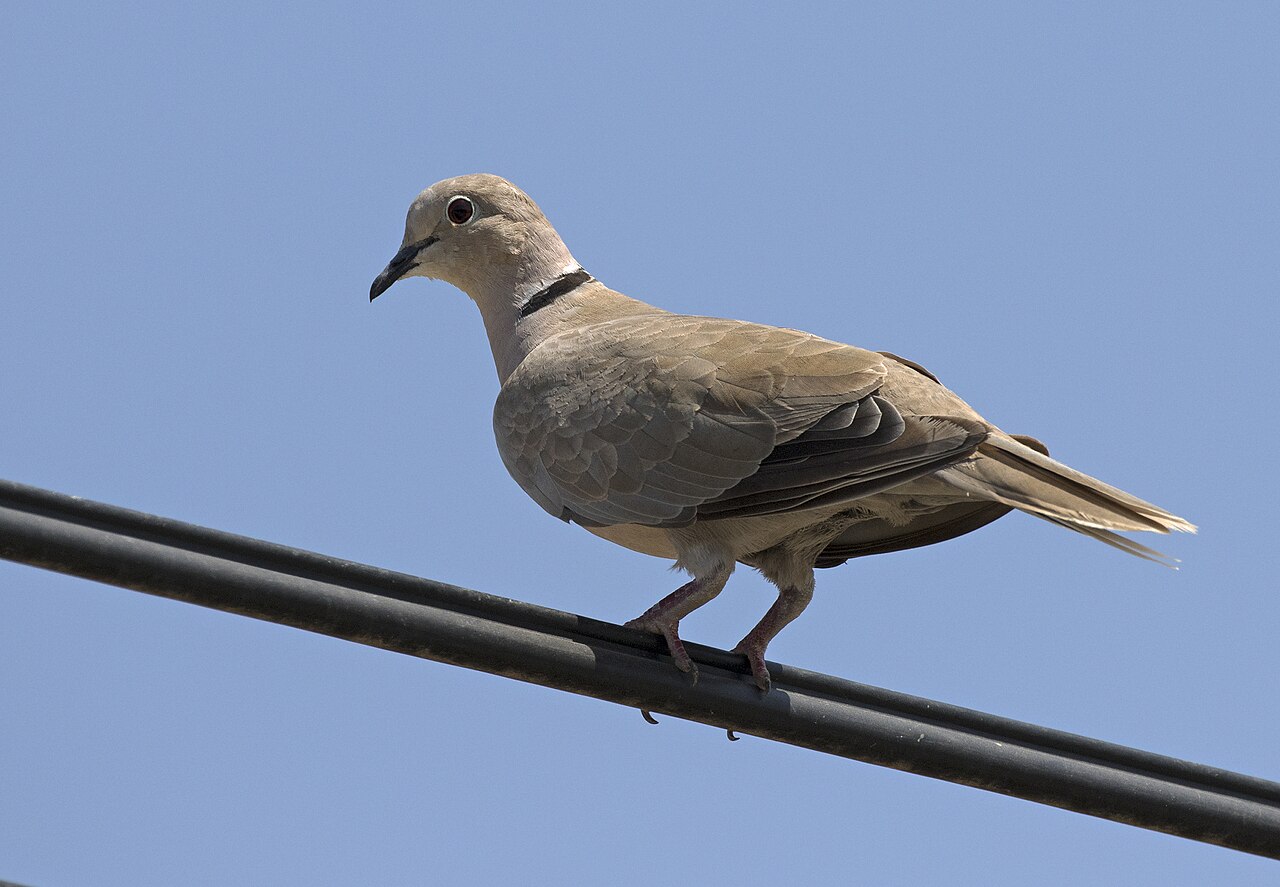
Less than a century ago a Balkan rarity, now a fixture of every village. The Collared Dove perches high and openly on aerials and wires, and gives itself away above all by its monotonous three-note call.
Voice
A monotonous three-part coo-COOO-cuk, stress on the drawn-out middle syllable, repeated five to ten times from a roof, aerial or bare branch. Heard mainly from February to September and chiefly by day, though town birds under street lighting sometimes call well into the night. On landing it gives a nasal, hoarse hraaih.
Recording: Jonathon Jongsma — CC BY-SA 3.0 · Wikimedia Commons
Identification
Pale sandy grey-brown, with a narrow white-edged black half-collar on the side of the neck in adults. The tail is long and sharply patterned below: black base, broad white tip. In flight the dark primaries and white tail corners show well; the eye is red-brown, the legs pink. Juveniles lack the collar.
Confusion species
Turtle Dove is the real pitfall: it has rufous scaled upperparts, a black-and-white striped neck patch and a much darker, smaller outline. The tail from below settles it. Collared Dove shows black with a broad white terminal band across the whole width, Turtle Dove a narrow white rim around a dark tail.
Habitat
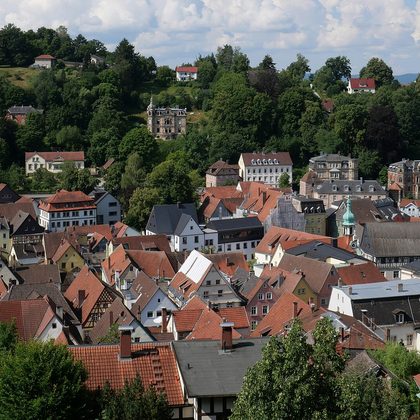
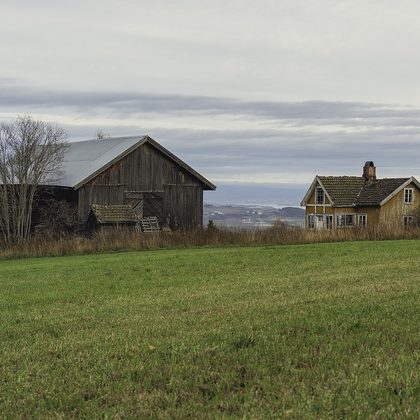
Tied closely to people: village centres, suburbs with conifers, farmyards, petting zoos, grain silos and harbours. Nests on a flimsy twig platform in a conifer, in ivy or under an eave, usually close to a reliable food source. Outside the breeding season small parties gather at spilt grain around stables and poultry units.
Where the bird is most at home, classified with EUNIS — the European standard for habitats.


Range and movements
From the Balkans the species expanded explosively during the twentieth century; the Netherlands were reached in 1947 and occupied within twenty years. It now breeds north to Scandinavia and Iceland. In Spain colonisation came later, from the 1980s, and it now nests in virtually every town and village on the peninsula.
- Resident
- Breeding (summer)
- Winter
- Passage
- dark = core range, pale = thinly spread
How and when to look
Any month will do, but March and April bring the most calling; work a village edge or a cemetery with conifers early in the morning. Watch for the display flight: a steep clattering climb followed by a glide down in an arc on a spread tail. Winter flocks gather around grain stores.
Conservation status
After the rapid advance, numbers in north-west Europe have levelled off and in the Netherlands have slowly declined over recent decades. Tidier farmyards, less spilt grain, the loss of small-scale poultry keeping and predation by Goshawk and cats all play a part. Globally the species is abundant and still spreading.
Scientific name
Streptopelia decaocto | (Frivaldszky, 1838)
Frivaldszky described the species in 1838 as Columba decaocto; because it was later moved to another genus, the author and year stand in brackets. The genus Streptopelia was introduced in 1855 by Bonaparte. Streptopelia is Greek, from streptos 'collar, twisted chain' and peleia 'dove', after the dark neck collar of these doves. decaocto is Greek for 'eighteen', from deka 'ten' and oktō 'eight', a traditional rendering of the call; in a Greek tale a maid who earned only eighteen coins a year was turned into this dove. The specimen the first description was based on came from Turkey.