All species › Passerines › Finches › European goldfinch
European goldfinch | Carduelis carduelis
Putter | Jilguero europeo
The Goldfinch is Europe's most brightly patterned finch, with a red face mask and a broad golden wingbar. Its long, pointed bill is built to extract seeds from teasels and thistles that other finches cannot reach.

Voice
The song is a fast, liquid, tinkling babble of clear notes, punctuated by a wheezy tzee-eh; heard from March into August, often from a treetop or during a fluttering song flight. The contact call, given all year and the best way to pick up flyover parties, is a light dancing tickelit.
Recording: Marie-Lan Taÿ Pamart — CC BY-SA 4.0 · Wikimedia Commons
Identification
Red face mask framed by black and white head bands, sandy brown body, black wings with a broad gold bar and white spots on the primary tips. Males show slightly more red behind the eye and blackish lesser coverts. Juveniles lack all red and are dull grey-brown with fine streaking, but already carry the full golden wingbar, which is the clincher.
Confusion species
Adults are unmistakable. Juveniles get confused with young Linnets and with Siskins, but neither has the broad unbroken yellow wingbar and white tail spots. Siskin is greenish and streaked with a fine bill; Linnet shows white wing flashes and white tail edges, but never gold.
Habitat
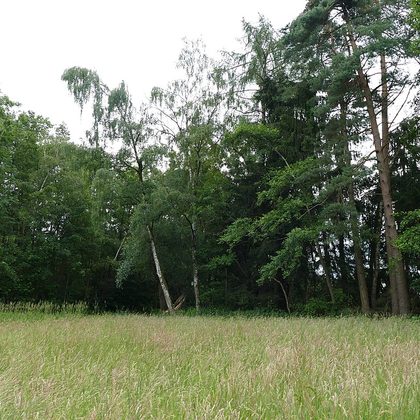
Semi-open farmland with rough ground: fallow field margins, thistle patches, verges, embankments, orchards, allotments, village edges and cemeteries. It nests high and far out on a limb, often in an orchard or avenue tree, and feeds in loose parties on seeding herbs.
Where the bird is most at home, classified with EUNIS — the European standard for habitats.



Range and movements
All of Europe except the far north. Northern breeders leave in October for France and Iberia, and small parties then pass along the Dutch coast and sea walls. In Spain the Goldfinch is common and widespread, from olive groves and huertas to city parks, reinforced in winter by birds from the north.
- Resident
- Breeding (summer)
- Winter
- Passage
- dark = core range, pale = thinly spread
How and when to look
The best months are August and September, when family parties work over dead thistles and teasels; find a rough patch along a dyke or railway and wait for the tinkling tickelit. Early morning they hang most calmly on the seedheads and allow a close approach.
Conservation status
Not globally threatened (IUCN: Least Concern). Numbers in the Netherlands have increased, helped by rough verges, set-aside and garden feeding on nyjer seed. In southern Europe illegal trapping for the cagebird trade still exerts real pressure, particularly around urban areas.
Scientific name
Carduelis carduelis | (Linnaeus, 1758)
Linnaeus described the species in 1758 as Fringilla carduelis; because it was later moved to another genus, the author and year stand in brackets. The genus Carduelis was introduced in 1760 by Brisson. Carduelis is the Latin word for the goldfinch, derived from carduus 'thistle', whose seeds the bird eats. The specific name repeats the genus name. The specimen the first description was based on came from Sweden.