All species › Gannets and cormorants › Cormorants › Great cormorant
Great cormorant | Phalacrocorax carbo
Aalscholver | Cormorán grande
The Cormorant is the black fisherman that stands with wings spread to dry after every bout of diving, a posture no other European waterbird adopts. Since the poisoned decades of the twentieth century the species has increased strongly; that increase brings it into conflict with fisheries.

Voice
Essentially mute away from the colony. At the nest, from February to June, it gives deep guttural notes and pig-like grunting, a rolling kroa-kroa-kroa amplified by dozens of neighbours. A colony is heard, and smelled, before it is seen.
Recording: Sonothèque ADVL — CC0 · Wikimedia Commons
Identification
Large and black with a bronze-green gloss, a white chin patch and bare yellow skin around the bill base. Breeding birds add a white thigh patch, and the inland form shows extensive white on head and neck. Juveniles are brown with variably white underparts. It swims low, leaps clear when diving, and flies goose-like with a kinked neck, often in lines.
Confusion species
Shag is smaller and slimmer, with a steep forehead, thin bill, bottle-green gloss and no white on the face; in spring it carries a curled crest and it sticks to rocky coasts and open sea. Juvenile Shag is brown with a dark belly. Pygmy cormorant of south-east Europe is small and long-tailed.
Habitat
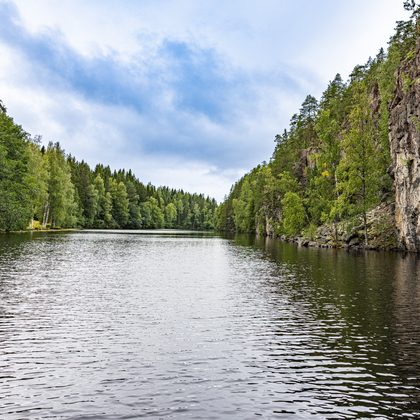
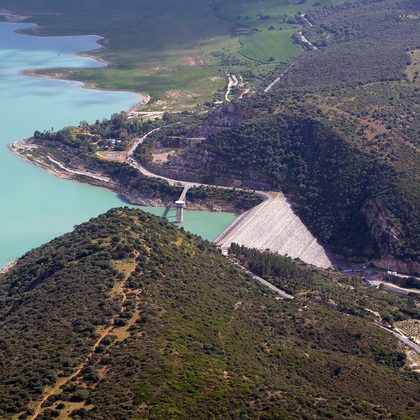
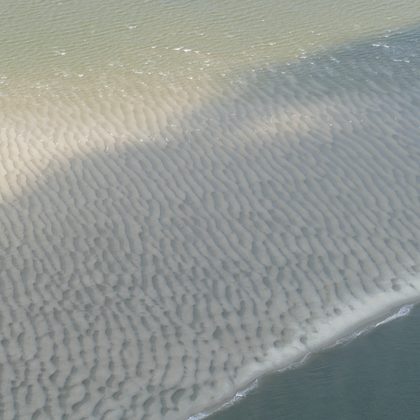
Any fish-rich water: large lakes, rivers, harbours, canals and shallow seas. Loafs on groynes, buoys, posts and dead trees, and breeds colonially in trees that die off under years of guano, or on the ground on islands.
Where the bird is most at home, classified with EUNIS — the European standard for habitats.


Range and movements
All of Europe and around the Mediterranean into North Africa and the Levant. In north-west and central Europe numerous year-round, with large colonies in the Low Countries (form sinensis). In the Mediterranean region mainly an abundant winter visitor on reservoirs, rivers and rice fields, with growing breeding numbers along the coast and in the Ebro delta.
- Resident
- Breeding (summer)
- Winter
- Passage
- dark = core range, pale = thinly spread
How and when to look
Early morning at a roost, as birds stream out in lines towards the fishing grounds. In winter scan large reservoirs and lakes for cooperative flocks driving fish like a net.
Conservation status
Strongly recovered after toxic pesticides were banned and legal protection came in. That success brings conflict with commercial fisheries and fish farms, and with it disturbance and licensed shooting. Locally, water quality and fish stocks decide how colonies fare.
Scientific name
Phalacrocorax carbo | (Linnaeus, 1758)
Linnaeus described the species in 1758 as Pelecanus carbo; because it was later moved to another genus, the author and year stand in brackets. The genus Phalacrocorax was introduced in 1760 by Brisson. Phalacrocorax is the Latinised form of Greek phalakrokorax, from phalakros 'bald' and korax 'raven'. carbo is Latin for 'charcoal', after the black plumage. The specimen the first description was based on came from the North Atlantic.