All species › Passerines › Reed warblers › Great reed warbler
Great reed warbler | Acrocephalus arundinaceus
Grote karekiet | Carricero tordal
Europe's largest reed warbler is also by far its noisiest: the grinding song carries hundreds of metres across open water. In the Netherlands it has fallen from a common marsh bird to a scarcity of old standing reed.

Voice
The song is a loud, slow, grating stutter mixing deep croaks and shrill squeaks, classically rendered karra-karra-kreet-kreet-kreet, with frog-like notes between; heard from late April to mid-July, through the middle of the day and sometimes at night. Alarm is a deep churring tcharr.
Recording: Jan Cibulka — CC BY-SA 4.0 · Wikimedia Commons
Identification
Bulky, almost thrush-sized for a reed warbler, with a heavy long bill, a flat crown often raised into a peak, and a short pale supercilium that stops at the eye. Warm brown above, creamy on the throat with dull buff flanks, and strikingly large, powerful legs and feet. Sexes alike; juveniles are warmer rufous.
Confusion species
Reed Warbler is the standard confusion, but it is much smaller, finer-billed and sings in an even, chuntering rhythm, where great reed warbler is slower, deeper and far louder. Savi's warbler gives a level reeling trill, and sedge warbler shows a bold supercilium and streaked crown. Size alone deceives: use bill, voice and the heavy legs.
Habitat
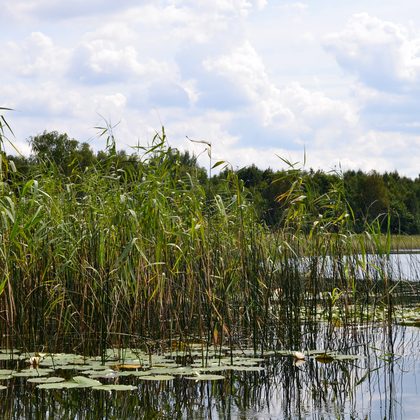
Old, stout standing reed with its feet in water, in broad fringes along lakes, oxbows, clay pits and fish ponds. It avoids narrow, dried-out or annually cut reed; nests are slung low between thick, second-year stems over open water.
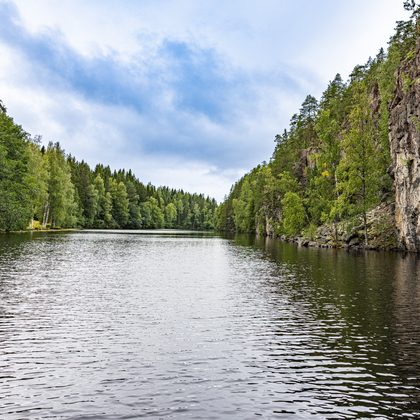
Where the bird is most at home, classified with EUNIS — the European standard for habitats.

Range and movements
From Iberia and North Africa to central Asia, across almost all of Europe apart from the British Isles and the far north. In the Mediterranean region a widespread summer visitor to reed fringes along rivers, rice fields and lagoons, with strongholds in the Ebro delta, l'Albufera, Doñana and the lagoons of La Mancha; in north-west Europe much reduced and confined to a few large marshes. All birds winter in sub-Saharan Africa.
- Breeding (summer)
- Passage
- dark = core range, pale = thinly spread
How and when to look
May and early June, at any hour of daylight: take a dyke or boardwalk beside broad standing reed and scan the plumes, because singing males often climb into full view at the top. In the Mediterranean region one morning at a lagoon or rice field is usually enough; in north-west Europe this takes searching.
Conservation status
Not globally threatened, but sharply declined in north-west Europe with the loss of broad, multi-year standing reed. Rigid water levels without natural fluctuation, grazing by geese and muskrat, annual reed harvest and boat wash are the main causes; in the Netherlands it is Red-Listed.
Scientific name
Acrocephalus arundinaceus | (Linnaeus, 1758)
Linnaeus described the species in 1758 as Turdus arundinaceus; because it was later moved to another genus, the author and year stand in brackets. The genus Acrocephalus was introduced in 1811 by Naumann & Naumann. Acrocephalus is Greek, from akros 'topmost, pointed' and kephalē 'head'; the Naumanns, who introduced the genus, called these birds Spitzkopf 'pointed head', so they read akros as 'pointed'. arundinaceus is Latin for 'like a reed', from arundo, genitive arundinis, 'reed'. The specimen the first description was based on came from northern Europe.