All species › Passerines › Sylvia warblers › Greater whitethroat
Greater whitethroat | Curruca communis
Grasmus | Curruca zarcera
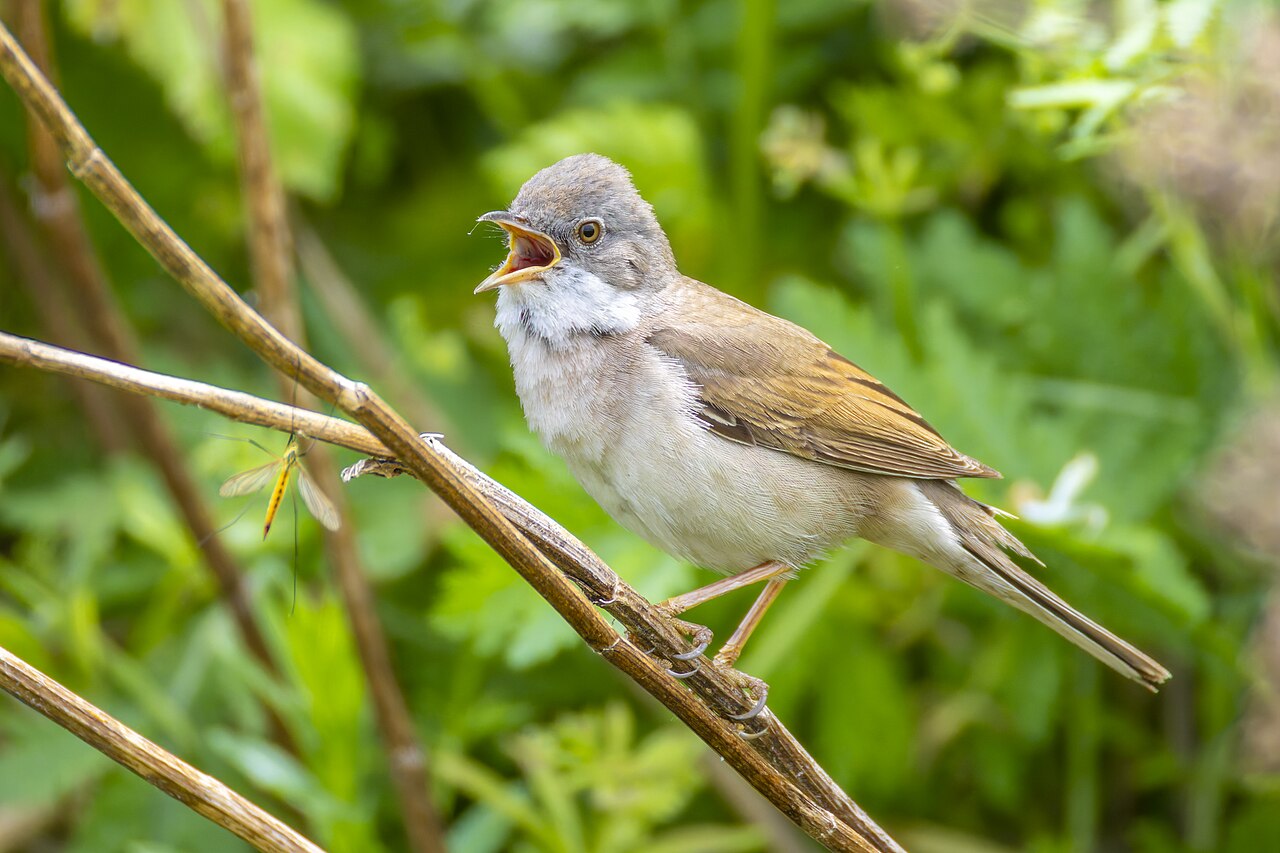
The Whitethroat is a slim, long-tailed warbler of the bramble patch that throws its quick, scratchy phrase out from a projecting twig and sometimes leaps after it in a short song flight. By mid-May every dyke and rough field edge is full of them.
Click a thumbnail to switch the photo above.
Voice
A short, hurried, scratchy chatter of two to three seconds, as if someone hoarse were rattling something off at speed: cher-cher-witcher-witcher-cher-chewee, rough in tone, with no clear whistles and a small cheerful flourish at the end. It is delivered from a projecting twig on top of a bramble or from a barbed-wire fence, and very often in a song flight: the bird springs up at an angle, hangs a moment on fluttering wings and drops back onto the bush still singing. The call is a hard, short check, and an agitated bird gives a drawn-out, rasping chairrr, like a comb drawn across a fingernail. Song runs from the last days of April into July, is fiercest in the first half of May and loudest in the first hour after sunrise, but continues through the middle of the day and, in warm weather, into the evening.
Recording: Sander Pieterse — CC BY-SA 4.0 · Wikimedia Commons
Identification
Slim and long-tailed, with a striking rusty wing panel: the secondaries and tertials are broadly fringed rufous, and at any distance that warm panel is the first thing you see. The legs are pale — straw, buff or flesh-coloured. The throat is clean white and stands out sharply. The male has an ash-grey head with a narrow white eye-ring and a pink flush on the breast; the female is browner-headed and duller below. The long tail has white outer feathers, easily seen as the bird dives for cover. The crown feathers are often raised, giving a shaggy, angular head.
Confusion species
Lesser whitethroat is the main confusion species and three features settle it: leg colour (pale straw in Whitethroat, lead-grey to almost black in Lesser), wing (a broad rusty panel in Whitethroat, plain grey-brown with no warm tones in Lesser) and face (Lesser shows a dark ear-covert mask contrasting with a grey crown, Whitethroat does not). The songs separate them instantly too: a scratchy, hurried chatter in Whitethroat, a dry rattle on one pitch in Lesser. Barred warbler is much bulkier and heavier, with a yellow iris and two white wing bars. In the Mediterranean, Subalpine Warbler recalls a small Whitethroat, but has an orange throat and breast and a red eye-ring.
Habitat
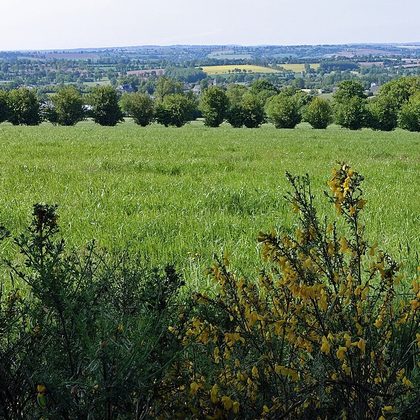
Open, rank, thorny country with no tall trees: bramble banks, hawthorn hedges, nettle beds, dykes and verges, young plantations and clear-fells, rank field margins, dune scrub and neglected corners. The nest is placed low in nettles, bramble or a thorn bush. On migration it uses almost any scrub, including dry ramblas and Mediterranean maquis.
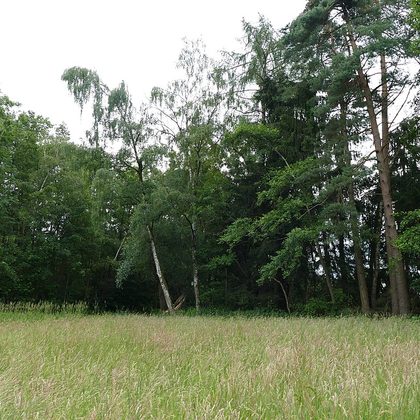
Where the bird is most at home, classified with EUNIS — the European standard for habitats.


Range and movements
Breeds across the whole of Europe and into Siberia, and also in Turkey, the Levant and north-west Africa; winters in the Sahel, just south of the Sahara. In north-western Europe a common breeder of dykes, rough margins and dune scrub; in the Low Countries it crashed by three-quarters in a single year after the great Sahel drought of 1968 and 1969, only recovered in the 1990s and is now increasing slightly again. In the Mediterranean it is more scattered: in Iberia it breeds in the north and centre, in hedgerow country and montane scrub. In August and September large numbers pass through Iberia and over North Africa and the Levant.
- Breeding (summer)
- Passage
- dark = core range, pale = thinly spread
How and when to look
Mid-May, in the first two hours after sunrise, along a dyke or a bramble-rich field edge. Do not look inside the bush but at the topmost twigs: the Whitethroat sings deliberately in the open. Check the legs on every singing bird, because next to a Lesser whitethroat the difference clicks in one go. The song flight — up at an angle, a moment of quivering, then down again still singing — betrays birds you would otherwise miss.
Conservation status
Not threatened and with a very large European population, largely recovered from the crash of the late 1960s. Numbers still swing from year to year with rainfall in the Sahel. Over the longer term the clearance of rank vegetation, the flailing of verges and ditch banks during the breeding season, and the loss of hedges and odd corners in farmland are the biggest pressures.
Scientific name
Curruca communis | (Latham, 1787) (GBIF: Sylvia communis)
Latham described the species in 1787 as Sylvia communis; because it was later moved to another genus, the author and year stand in brackets. The genus Curruca was introduced in 1802 by Bechstein. Curruca is Latin, the name of an unidentified small bird mentioned by the Roman poet Juvenal. communis is Latin for 'common'. The specimen the first description was based on came from Kent, England.