All species › Passerines › Reed warblers › Icterine warbler
Icterine warbler | Hippolais icterina
Spotvogel | Zarcero icterino
One of the last summer visitors to arrive in central Europe, and at once one of the most conspicuous singers: a yellow-bellied, long-winged warbler that pours an endless hurried jumble from a bare twig. Learn the voice once and you will find the bird on the same hedgerow every year. In Spain it is mainly a passage migrant, found along the coast.

Voice
The song is a long, hurried medley with no clear beginning or end, running four to eight seconds at a stretch, in which grating, nasal and clear notes tumble over one another and imitations of swallow, sparrow and swift surface. The hallmark is the fixed phrase that keeps breaking through: a nasal, three-part de-de-roid, falling and then lifting again, standing like a signature in the tangle. The call is a hard teck or a rattled tettettet. Song from mid-May to early July, fiercest at first light, usually from an open twig high in a tree.
Recording: Olivier Grimm — CC BY-SA 4.0 · Wikimedia Commons
Identification
Grey-green above, sulphur-yellow on throat, breast and belly, with a long broad-based bill showing an orange lower mandible and a flat, sloping forehead that gives the head an angular, pointed look. The primary projection is long, about equal to the exposed tertials, and the secondaries carry a pale wing panel that shows up at range on fresh birds. The legs are blue-grey and the tail is square-ended. Sexes alike.
Confusion species
Melodious warbler is the real puzzle: rounder-headed, shorter-winged — its primary projection is at most half the tertial length — usually showing no pale wing panel, and with brown-grey rather than blue-grey legs. Marsh warbler is warmer brown, has a rounded tail and lacks the yellow. Willow warbler is smaller, finer-billed and shows a clear supercilium instead of the Icterine's open, pale face.
Habitat
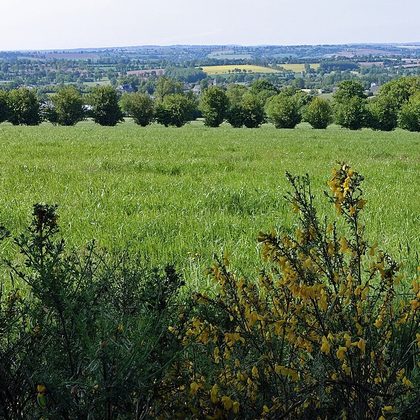
Open broadleaved woodland, woodland edges, hedgerows, willows along ditches, orchards, parks and overgrown gardens: anywhere with tall loose bushes and a bare song post above them. It avoids closed forest and seeks the untidy transition between scrub and tree.
Where the bird is most at home, classified with EUNIS — the European standard for habitats.




Range and movements
Breeds across northern and central Europe, from north-east France and the Netherlands east to Siberia and north into Scandinavia. In the Netherlands still numerous in the east and north but much thinned out in the west. The narrow contact zone with melodious warbler runs precisely through France and Belgium, where the two overlap and occasionally hybridise. In Spain only a scarce coastal migrant. Winters in southern Africa.
- Breeding (summer)
- Passage
- dark = core range, pale = thinly spread
How and when to look
The second half of May, the first hour after sunrise, along a hedgerow or a line of willows beside a ditch, is the best time to find the singing bird. Late-summer migrants sit low in elder and stay completely silent; in Spain, August and September is the time to check coastal copses and gardens for the long primary projection and pale wing panel, since passage birds there are silent throughout.
Conservation status
Not globally threatened and still numerous in eastern Europe, but declining for decades in north-west Europe. The loss of untidy hedgerows, rank ditch banks and old orchards removes nesting cover, while drought in the Sahel and along the flyway depresses survival. Where scrub is allowed to run wild it returns quickly.
Scientific name
Hippolais icterina | (Vieillot, 1817)
Vieillot described the species in 1817 as Sylvia icterina; because it was later moved to another genus, the author and year stand in brackets. The genus Hippolais was introduced in 1827 by Conrad von Baldenstein. Hippolais goes back to Greek hupolais, a small bird mentioned by Aristotle, misspelt by Linnaeus; the word may be onomatopoeic or formed from hupo 'under' and laas 'stone'. icterina is Greek for 'jaundice-yellow', from ikteros, which denoted both jaundice and yellow-green birds, after the yellow underparts. The specimen the first description was based on came from France.