All species › Cranes, rails and allies › Rails and crakes › Little crake
Little crake | Zapornia parva
Klein waterhoen | Polluela bastarda
A little crake of deep, old reed and floating vegetation, which in the Netherlands turns up mainly as a spring overshoot. Usually it is one singing male in a marsh, gone again after a few nights.
Voice
The male sings a series of nasal barking notes, kwek kwek kwek, starting slowly, gradually accelerating and falling in pitch, and ending in a fast rattling run like a ping-pong ball settling. The female also accelerates but stays higher. Heard mainly from late April to mid-June, at dusk and in the first half of the night; Baillon's, by contrast, rattles evenly and dryly with no acceleration.
No freely licensed recording is available for this species yet.
Identification
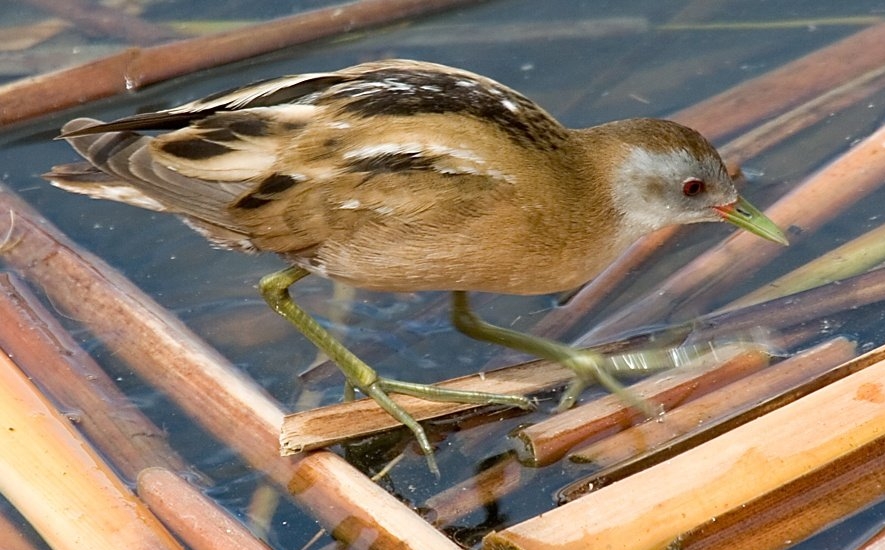
About Starling-sized, with a long tail and long green legs showing no red on the tibia. The male is slate-blue on face and underparts with an olive-brown, black-streaked back; the female has buff underparts and a white throat. Both have a short green bill with a red spot at the base. It climbs nimbly among reed stems.
Confusion species
Baillon's crake is the real problem: it has flesh-toned legs, extensive white streaking on the mantle, bold black-and-white barring reaching well onto the belly, and no red at the bill base. On little crake only the rear flanks are faintly barred, and the wing tip projects further beyond the tail. Spotted crake is larger and white-spotted.
Habitat
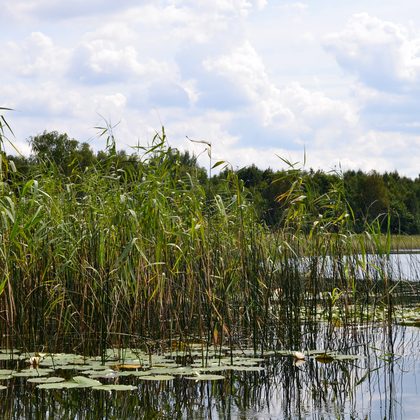
Deep, permanently flooded old reed and reedmace with open water between the stems and abundant floating plant mats. It needs more water than spotted crake and climbs in the vegetation more than it walks on mud. Breeds in the fringing zones of lakes, deltas and old fishpond complexes.
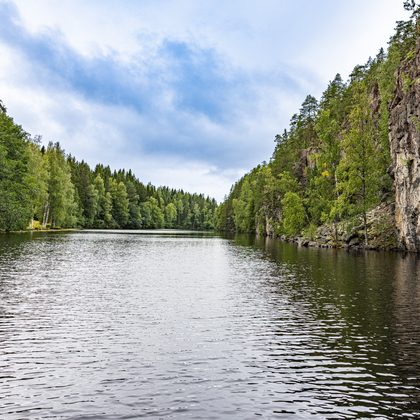
Where the bird is most at home, classified with EUNIS — the European standard for habitats.

Range and movements
A breeder of eastern Europe from Hungary and Poland to the Volga, with strongholds in the Danube delta and around the Neusiedler See; sporadic breeding in eastern and southern Iberia. It winters in Africa and the Mediterranean, passing through from Malta to Cyprus and the Levant. In north-west Europe a rare visitor, March to May, annual in small numbers.
- Breeding (summer)
- Winter
- Passage
- dark = core range, pale = thinly spread
How and when to look
Away from the breeding range, mid-April to mid-May offers the best chance; with a spell of easterly winds visit a large wet reed marsh and listen from sunset until a couple of hours after. Singing birds sometimes show at first light on a reed fringe above open water. Be patient and leave the playback at home.
Conservation status
Not threatened globally, but the western edge of the range is erratic and the species disappears where reed marshes are drained or levels held artificially low. In eastern Europe large reedbeds are lost to drainage and reed burning. Dutch records are slowly increasing, probably as much through better night survey work as through real change.
Scientific name
Zapornia parva | (Scopoli, 1769) (GBIF: Porzana parva)
Scopoli described the species in 1769 as Rallus parvus; because it was later moved to another genus, the author and year stand in brackets. The genus Zapornia was introduced in 1816 by Leach. Zapornia is a near-anagram of Porzana, the genus of the French ornithologist Louis-Pierre Vieillot. parva is Latin for 'small', after the modest size of this little crake. The specimen the first description was based on came from Carniola, Slovenia.