All species › Passerines › Tyrant flycatchers and allies › Acre Tody-Tyrant
Acre Tody-Tyrant | Hemitriccus cohnhafti
Acretodietiran | Titirijí de Acre | Maria-sebinha-do-acre
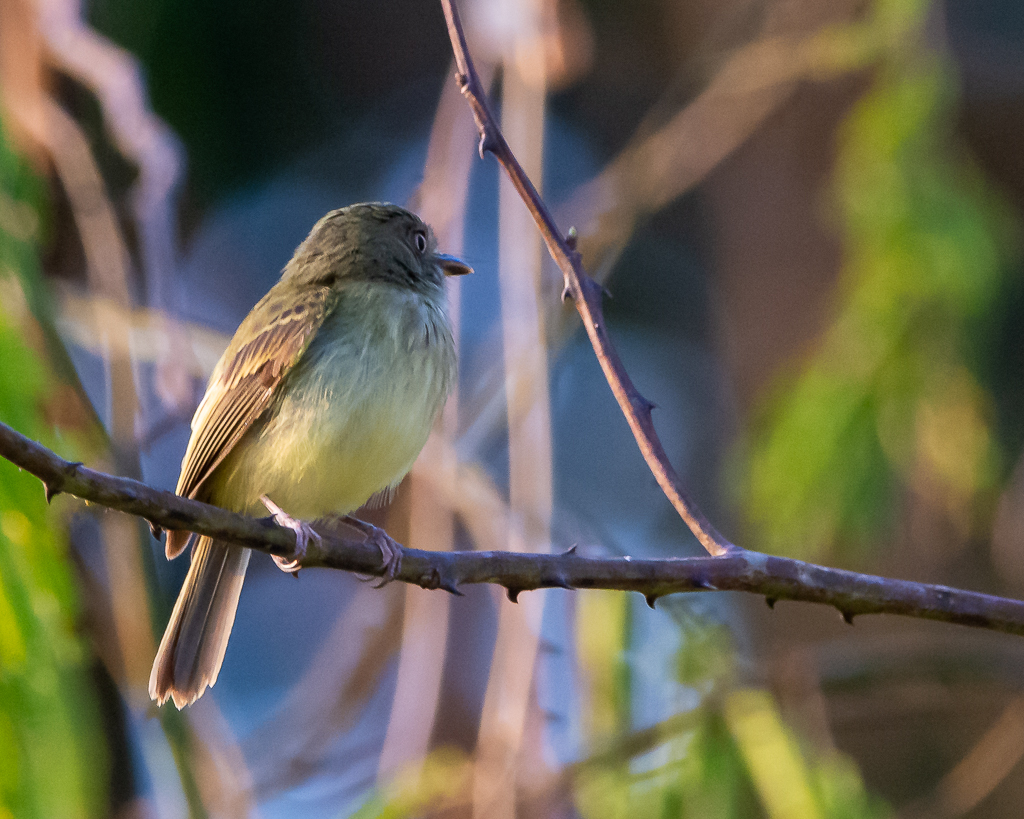
The Acre Tody-Tyrant is a drab olive tody-tyrant that was described as a species only in 2013, from Acre and adjacent south-eastern Peru. It lives in low secondary forest with dead bamboo on dry, nutrient-poor soil. Its closest relatives are Snethlage's Tody-Tyrant and Yungas Tody-Tyrant of the Andes, outside this area.
Voice
A trill, usually at long intervals, sometimes repeated quickly. Calls are single skep or keek notes and lower kup notes.
Recording: Jacob Wijpkema — CC BY-NC-SA 4.0 · converted to mono · xeno-canto
Identification
10.5 cm, with a flat bill. The upperparts are mostly olive-green, the crown the same colour as the back. The lores and the area above them are buff. The wings have two narrow, bronzy wing bars. Throat and breast are pale olive with creamy yellow streaks, the belly paler. The sexes are alike.
Confusion species
Snethlage's Tody-Tyrant Hemitriccus minor lacks buff lores and has fainter wing bars; in Acre it lives mainly in other forest. Flammulated Bamboo Tyrant Hemitriccus flammulatus also lives in bamboo, but is larger and browner, with a whitish, grey-streaked breast. The song is the best feature.
Habitat
Secondary forest on well-drained, nutrient-poor soils, often with much dead or collapsed Guadua bamboo, with a canopy usually no higher than 12 m, in the lowlands below about 300 m. It appears to avoid seasonally flooded forest and tall terra firme forest. It forages for insects in dense growth; little is known about the nest.
Where the bird is most at home, classified by the vegetation units of Amazonia and the Guianas.


Range and movements
Brazil: only in Acre, mainly in the east of the state. Absent from Venezuela and the Guianas. Outside the guide area in south-eastern Peru (Madre de Dios) and probably in adjacent north-western Bolivia (Pando).
- Resident
- dark = core range, pale = thinly spread
How and when to look
Search in Acre, for example around Rio Branco, in low secondary forest with dead bamboo; listen for the trill at long intervals and the single keek calls.
Conservation status
Near Threatened. The range is small, about 15,000 km², and lies in the arc of deforestation; the habitat is being lost and fragmented by the clearing of pasture for cattle. The species may be more widespread than currently known.
Scientific name
Hemitriccus cohnhafti | Zimmer, Whittaker, Sardelli, Guilherme & Aleixo, 2013
Zimmer, Whittaker, Sardelli, Guilherme & Aleixo described the species in 2013 and placed it straight away in the genus where it still stands. The genus Hemitriccus was introduced in 1860 by Cabanis & Heine. Hemitriccus is Greek, from hēmi- 'half, small' and trikkos, an unidentified small bird; in ornithology triccus denotes a tyrant flycatcher: 'small tyrant'. cohnhafti honours the American ornithologist and biogeographer Mario Cohn-Haft, who lives and works in Brazil. The specimen the first description was based on came from near Assis Brasil, Acre, Brazil.