All species › Passerines › Tyrant flycatchers and allies › Snethlage's Tody-Tyrant
Snethlage's Tody-Tyrant | Hemitriccus minor
Snethlages todietiran | Titirijí de Snethlage | Maria-sebinha
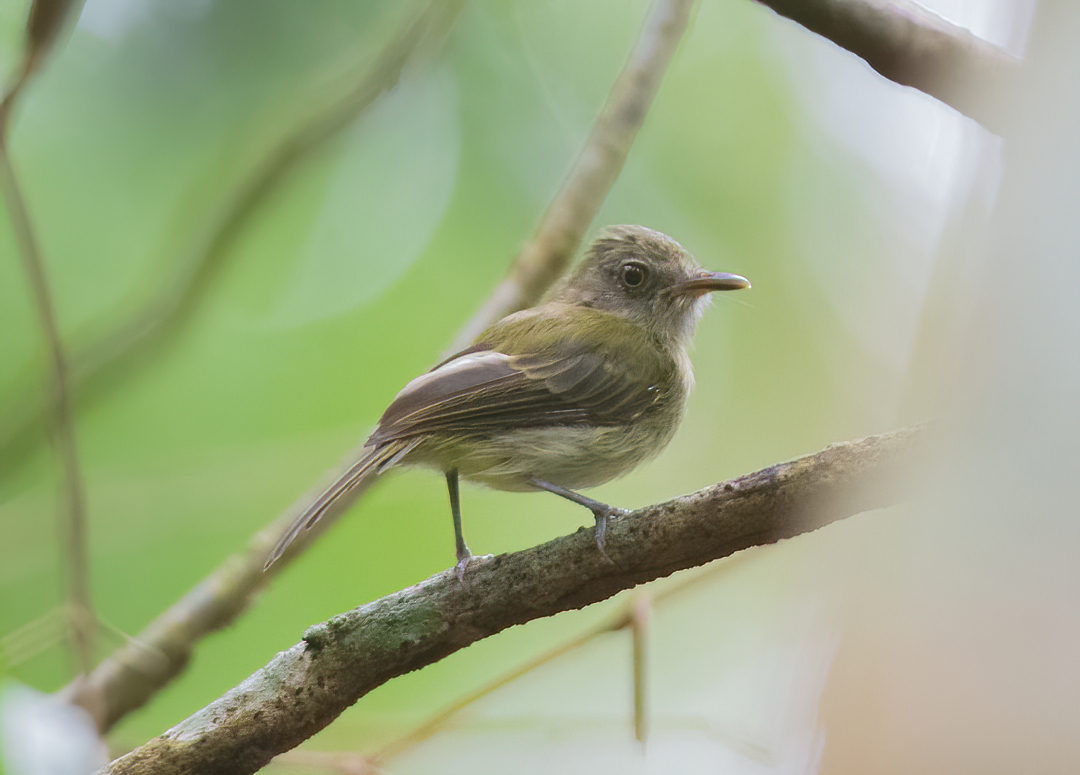
Snethlage's Tody-Tyrant is a small, olive-green tody-tyrant of central and southern Brazilian Amazonia. It lives in vine tangles and dense growth at forest edges and in gaps within the forest. The species is named after the German ornithologist emilie snethlage, who worked in Belém.
Voice
A short, gravelly, downslurred trill drrru; pitch, pace and length differ between forms.
Recording: JAYRSON ARAUJO DE OLIVEIRA — CC BY-NC-SA 4.0 · xeno-canto
Identification
10 cm, with a fairly broad, flat bill and a short, somewhat bushy crest. Crown, face, back and rump are olive-green, the wings and tail olive with greenish-yellow edges and two faint wing bars. The underparts are pale yellow with faint greyish-olive streaks on throat and breast, the centre of the belly unstreaked; some birds are largely white below. The eye is white to pale yellow. Forms west of the Rio Madeira are paler below with more distinct wing bars. The sexes are similar; the female is slightly yellower below.
Confusion species
Acre Tody-Tyrant Hemitriccus cohnhafti in Acre has buff lores and more distinct wing bars. White-eyed Tody-Tyrant Hemitriccus zosterops has a white eye-ring, distinct yellow wing bars and a greyer breast. Zimmer's Tody-Tyrant Hemitriccus minimus is smaller, with a dark eye and a white throat. The pale eye, faint streaks and plain wing together point to this species.
Habitat
Vine tangles, dense growth at forest edges and in treefall gaps in terra firme forest and mature secondary forest; the form west of the Rio Madeira mainly in igapó. In the lowlands. It usually forages 3 to 8 m above the ground for insects, which it picks from leaves in short sallies.
Where the bird is most at home, classified by the vegetation units of Amazonia and the Guianas.



Range and movements
Brazil: in central and southern Amazonia, south of the Amazon from the Rio Madeira east via the Tapajós and Xingu to the Tocantins in Pará, south into northern Rondônia and Mato Grosso; west of the Madeira on both sides of the Amazon west into western Amazonas. Venezuela: reported, but poorly documented. A few unconfirmed records are known from French Guiana. Outside the guide area in north-eastern Bolivia.
- Resident
- dark = core range, pale = thinly spread
How and when to look
In Pará or Mato Grosso, for example around Alta Floresta or along the Tapajós, listen in vine tangles and dense forest edges for the short gravelly trill and then search at 3 to 8 m.
Conservation status
Least Concern. The species has a large range, but much of it lies in the arc of deforestation in southern Amazonia, where the habitat is disappearing rapidly.
Scientific name
Hemitriccus minor | (Snethlage, HMMEE, 1907)
Snethlage, HMMEE described the species in 1907 as Euscarthmus zosterops minor; because it was later moved to another genus, the author and year stand in brackets. The genus Hemitriccus was introduced in 1860 by Cabanis & Heine. Hemitriccus is Greek, from hēmi- 'half, small' and trikkos, an unidentified small bird; in ornithology triccus denotes a tyrant flycatcher: 'small tyrant'. minor is Latin for 'smaller'. The specimen the first description was based on came from Arumateua, lower Rio Tocantins, Pará, Brazil.