All species › Passerines › Tanagers and allies › Bay-chested Warbling Finch
Bay-chested Warbling Finch | Castanozoster thoracicus
Roestborstboomgors | Monterita pectoral | Peito-pinhão
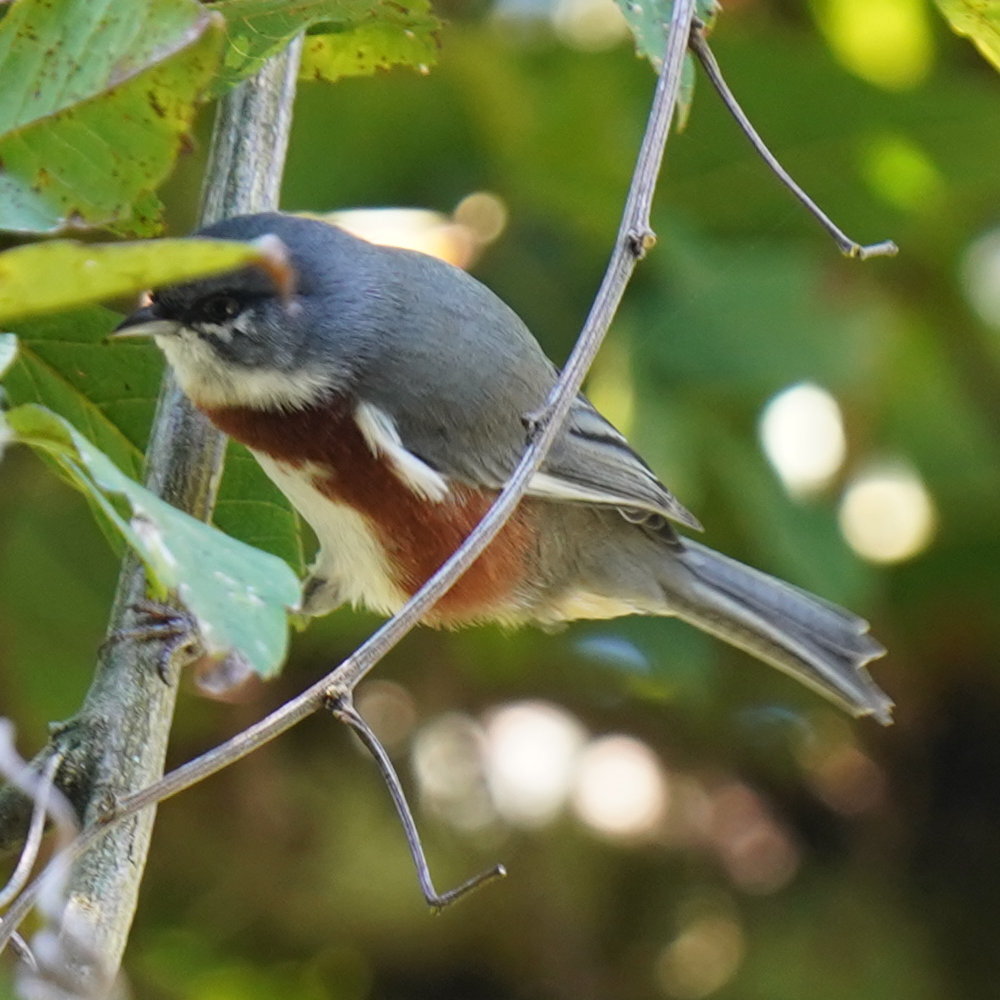
Bay-chested Warbling Finch is a small grey warbling finch of the montane Atlantic Forest of southern and southeastern Brazil. A broad chestnut breast band on white underparts and a white patch below the eye mark it. It is attracted to seeding bamboo and is then sometimes present in larger numbers.
Voice
The song is a high, thin, fast series of notes, often from the treetop. The call is a high tsee.
Recording: JAYRSON ARAUJO DE OLIVEIRA — CC BY-NC-SA 4.0 · xeno-canto
Identification
13–14 cm, with a pointed dark bill and a fairly long tail. Head and upperparts are grey, with a white patch below the eye. The throat is white; across the breast runs a broad chestnut band that continues onto the flanks. The belly is white, the long tail grey. The sexes are alike.
Confusion species
Black-and-rufous Warbling Finch Poospiza nigrorufa is larger and darker, with a long white supercilium and rufous throat and breast; it lives in shrubbery along rivers and marshes. Grey-throated Warbling Finch Microspingus cabanisi and Buff-throated Warbling Finch Microspingus lateralis have a white supercilium, a browner back and rufous flanks, but no chestnut breast band.
Habitat
Montane and cloud forest of the Atlantic Forest, forest edges, secondary forest and bamboo stands, also araucaria forest, mainly in the higher mountains. It searches the middle levels and canopy for insects and eats fruits of Miconia; when bamboo is seeding it feeds mainly on bamboo seed and gathers there in small groups. Little is known about the nest.
Where the bird is most at home, classified by the vegetation units of Amazonia and the Guianas.



Range and movements
Brazil: endemic to the mountains of the south and southeast, from Minas Gerais, Espírito Santo and Rio de Janeiro through São Paulo, Paraná and Santa Catarina to Rio Grande do Sul, mainly in the Serra do Mar and the Serra da Mantiqueira. Absent from Venezuela, Guyana, Suriname and French Guiana. Outside the guide area at most rare in extreme northeastern Argentina.
- Resident
- dark = core range, pale = thinly spread
How and when to look
In montane forest at, for example, Itatiaia or the Serra dos Órgãos, search mixed flocks in the treetops, and watch especially at places where bamboo is seeding; the breast band shows well when the bird hangs from a branch.
Conservation status
Least Concern (IUCN). The species depends on montane forest, which is fragmented in much of the Atlantic Forest; fairly common in protected areas in the Serra do Mar and the Serra da Mantiqueira.
Scientific name
Castanozoster thoracicus | (Nordmann, 1835)
Nordmann described the species in 1835 as Fringilla thoracica; because it was later moved to another genus, the author and year stand in brackets. The genus Castanozoster was introduced in 2016 by Burns, Unitt & Mason. Castanozoster is Greek, from kastanon 'chestnut' and zōstēr 'belt', after the chestnut breast band. thoracicus is Medieval Latin for 'of the chest', after the chestnut breast band. The specimen the first description was based on came from Brazil (not further specified).