All species › Passerines › Tanagers and allies › Grey-hooded Bush Tanager
Grey-hooded Bush Tanager | Cnemoscopus rubrirostris
Grijskoptangare | Tangara capuchigrís | Sanhaço-de-capuz-cinza
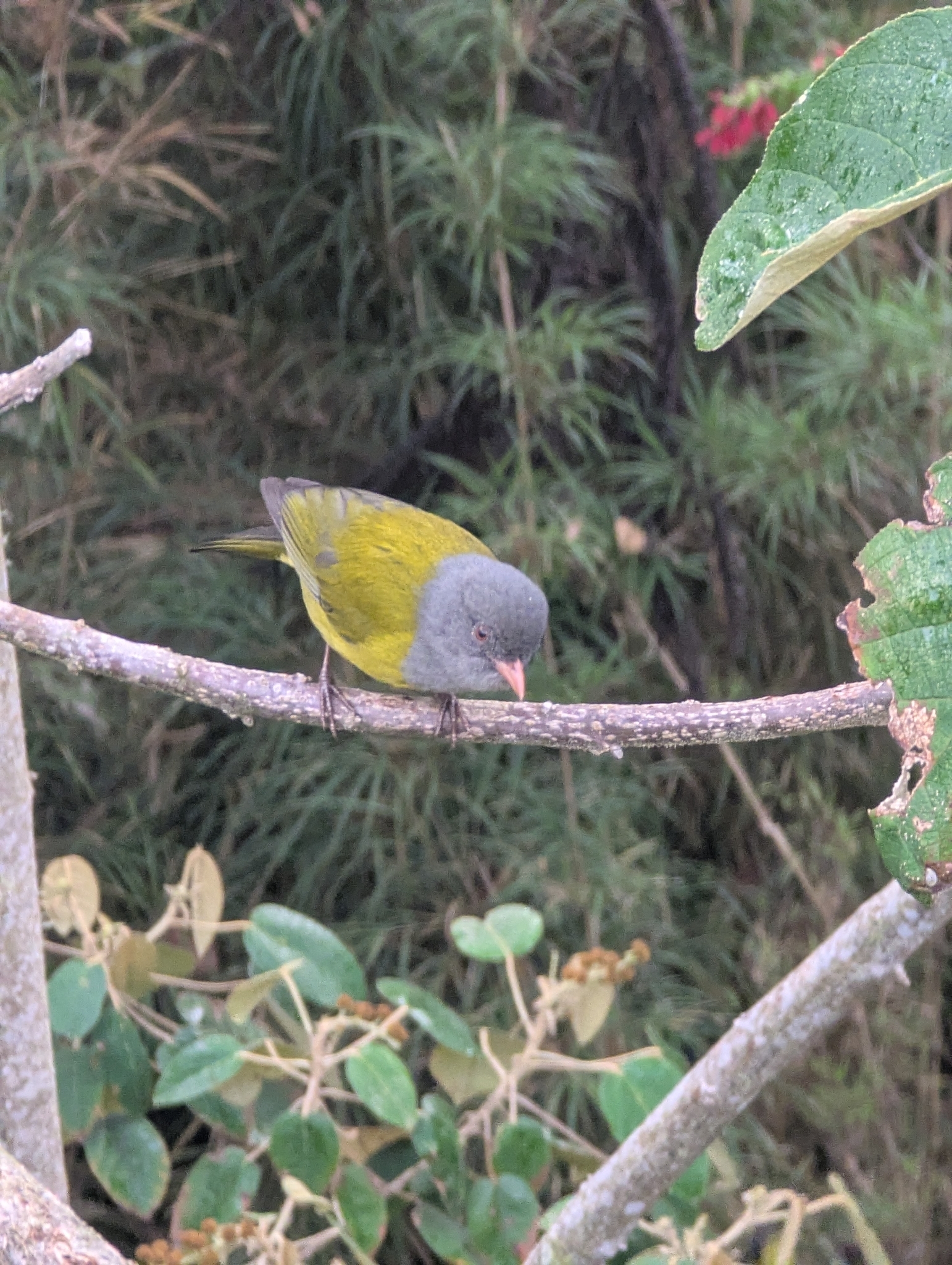
Grey-hooded Bush Tanager is a slender tanager of higher montane forest in the Andes, from Venezuela to Peru. A grey hood, yellow underparts and a pink bill mark it, as does its habit of constantly flicking its tail. In the guide area it lives only in the Venezuelan Andes.
Voice
High, thin tsit calls and a short, soft series of high notes as a song.
Recording: Carlos Delgado JUMABITA — CC BY-NC-SA 4.0 · converted to mono · xeno-canto
Identification
15 cm, slender, with a fairly long tail. Head, throat and upper breast form a grey hood; back, wings and tail are olive-green. The rest of the underparts is bright yellow. Bill and legs are pink to flesh-coloured. The sexes are alike. Young birds are duller, with an olive-grey head.
Confusion species
Oleaginous Hemispingus Sphenopsis frontalis is plain olive-green with a faint yellow supercilium and lacks the grey hood. Black-capped Hemispingus Kleinothraupis atropileus has a black head with a white supercilium. Grey-capped Hemispingus Kleinothraupis reyi has only a grey crown, a yellow throat and a dark bill. Ashy-throated Chlorospingus Chlorospingus canigularis lives lower, has only a grey throat, a whitish belly and a dark bill.
Habitat
Humid montane forest and cloud forest, mainly in the middle and upper levels and at forest edges, also in tall secondary forest, roughly between 2000 and 3300 m. It searches branches and foliage for insects, constantly flicking its tail, and travels with mixed flocks of other tanagers. The nest is an open cup in a tree.
Where the bird is most at home, classified by the vegetation units of Amazonia and the Guianas.

Range and movements
Venezuela: in the western Andes, in Táchira and Mérida, locally in continuous montane forest. Absent from Brazil, Guyana, Suriname and French Guiana. Outside the guide area in the Andes of Colombia, on both slopes in Ecuador and on the east slope in Peru south to the centre of the country.
- Resident
- dark = core range, pale = thinly spread
How and when to look
In mixed flocks in the cloud forest of Mérida and Táchira, look for a yellow bird with a grey hood that flicks its tail incessantly; the pink bill is visible at a distance.
Conservation status
Least Concern (IUCN). The species is widespread in the Andes and locally fairly common in continuous montane forest; in Venezuela its habitat is limited to the montane forests of the west, where clearing fragments the forest locally.
Scientific name
Cnemoscopus rubrirostris | (de Lafresnaye, 1840)
De Lafresnaye described the species in 1840 as Arremon rubrirostris; because it was later moved to another genus, the author and year stand in brackets. The genus Cnemoscopus was introduced in 1919 by Bangs & Penard. Cnemoscopus is Greek, from knēmos 'mountain slope' and skopos 'searcher, watcher', after the temperate Andean slopes of Colombia where the species was described. rubrirostris is Latin, from ruber 'red' and -rostris '-billed', after the pink to reddish bill. The specimen the first description was based on came from Bogotá, Colombia.