All species › Passerines › Ovenbirds and woodcreepers › Black-billed Scythebill
Black-billed Scythebill | Campylorhamphus falcularius
Zwartsnavelmuisspecht | Picoguadaña piquinegro | Arapaçu-de-bico-torto
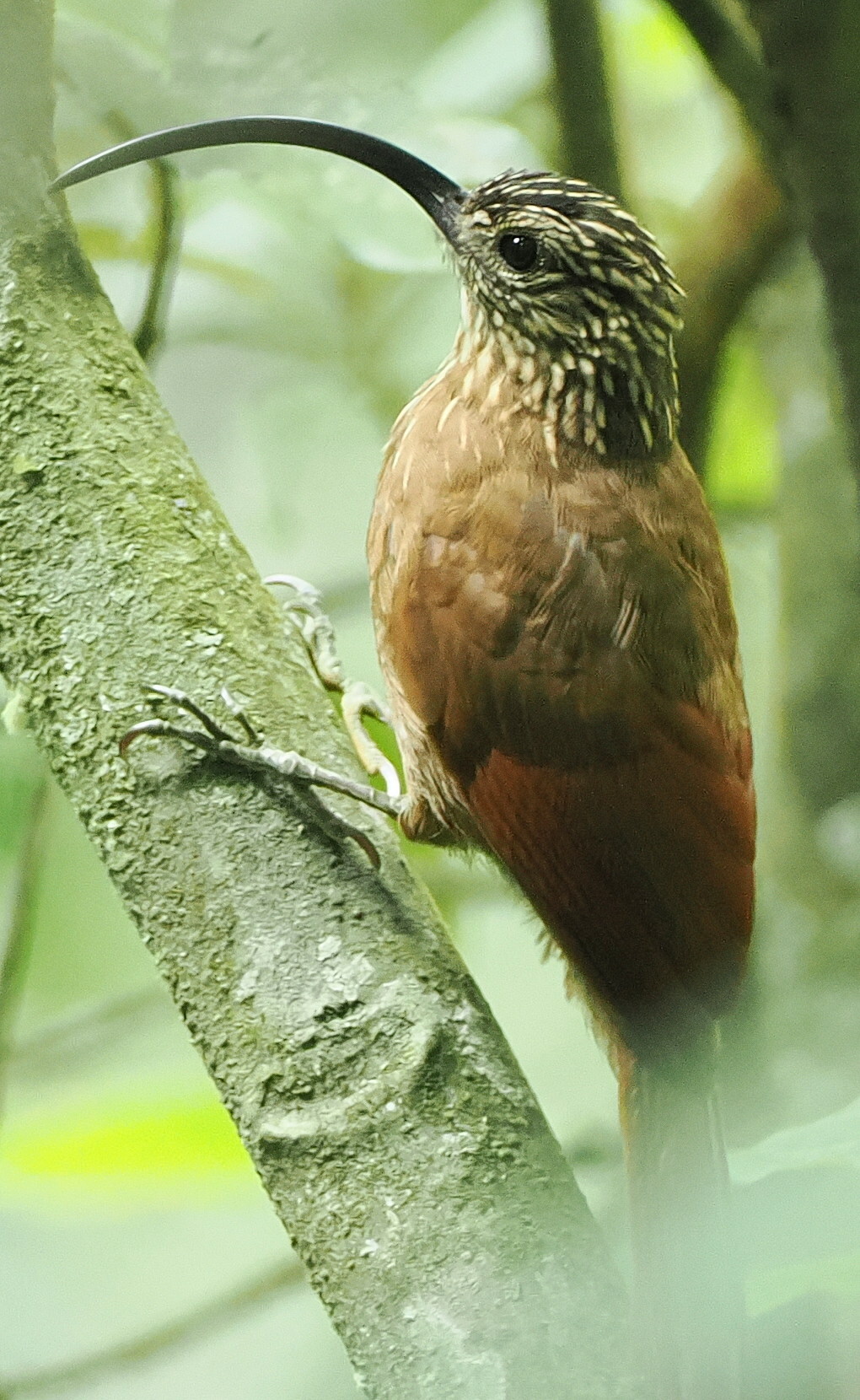
Black-billed Scythebill is the scythebill of the Atlantic Forest. With its very long, strongly curved, dark bill it probes insects from bromeliads, bamboo, epiphytes and bark crevices. It lives in south-eastern Brazil and adjacent parts of Paraguay and Argentina.
Voice
The song is a raspy, level to descending series of notes, repeated five or six times. The call is a very high, piercing note.
Recording: Aran Rodrigues Cardoso — CC BY-NC-SA 4.0 · shortened to the first 60 s, mono · xeno-canto
Identification
24–28 cm, slender, with a very long, thin, strongly decurved, blackish bill. Crown and nape are blackish with whitish to ochre streaks, face and neck streaked buff and blackish. Back and wing coverts are brown to olive-brown, wings, uppertail coverts and tail rufous. The underparts are pale brown to olive-brown with fine pale streaks on throat and breast. Brazilian birds are on average more rufescent. The sexes are alike.
Confusion species
Red-billed Scythebill Campylorhamphus trochilirostris has a reddish rather than blackish bill and lives in drier forest, caatinga and gallery forest; in the north of the range the two species occur close together. Scaled Woodcreeper Lepidocolaptes squamatus and Scalloped Woodcreeper Lepidocolaptes falcinellus have a much shorter, pale bill and clearly scaled underparts. Lesser Woodcreeper Xiphorhynchus fuscus is smaller, with a short, almost straight bill.
Habitat
Humid and semi-humid Atlantic Forest, cloud forest, older secondary forest and especially forest with much bamboo, in the north also forest remnants into the transition to Caatinga and Cerrado. In the south from sea level to at least 1600 m, in the north rarely below 600 m. It forages in the middle and lower levels along trunks, bamboo stems, bromeliads and epiphytes for arthropods, alone or with mixed flocks. The nest is in a tree cavity.
Where the bird is most at home, classified by the vegetation units of Amazonia and the Guianas.




Range and movements
Brazil: in the Atlantic Forest from the Chapada Diamantina in Bahia south through Minas Gerais, Espírito Santo, Rio de Janeiro, São Paulo, Paraná and Santa Catarina to northern Rio Grande do Sul. Absent from Venezuela, Guyana, Suriname and French Guiana. Outside the guide area in eastern Paraguay and north-eastern Argentina (Misiones and Corrientes).
- Resident
- dark = core range, pale = thinly spread
How and when to look
Search montane forest of the Serra do Mar and the Serra da Mantiqueira, especially where bamboo grows, and follow mixed flocks in the middle level. The long, dark scythe-shaped bill is often the first thing you see as the bird probes into a bromeliad or among bamboo.
Conservation status
Least Concern (IUCN). The species depends on forest and disappears where the Atlantic Forest is cleared or heavily fragmented; large populations still live in the protected mountain areas of the Serra do Mar.
Scientific name
Campylorhamphus falcularius | (Vieillot, 1822)
Vieillot described the species in 1822 as Dendrocopus Falcularius; because it was later moved to another genus, the author and year stand in brackets. The genus Campylorhamphus was introduced in 1901 by Bertoni. Campylorhamphus is Greek, from kampulos 'curved' and rhamphos 'bill', after the long, strongly decurved bill. falcularius is Latin, from falcula 'small sickle', diminutive of falx 'scythe', after the strongly curved bill. The specimen the first description was based on came from Serra dos Órgãos, Rio de Janeiro, Brazil.