All species › Passerines › Ovenbirds and woodcreepers › Curve-billed Scythebill
Curve-billed Scythebill | Campylorhamphus procurvoides
Kromsnavelmuisspecht | Picoguadaña piquicurvo | Arapaçu-de-bico-curvo
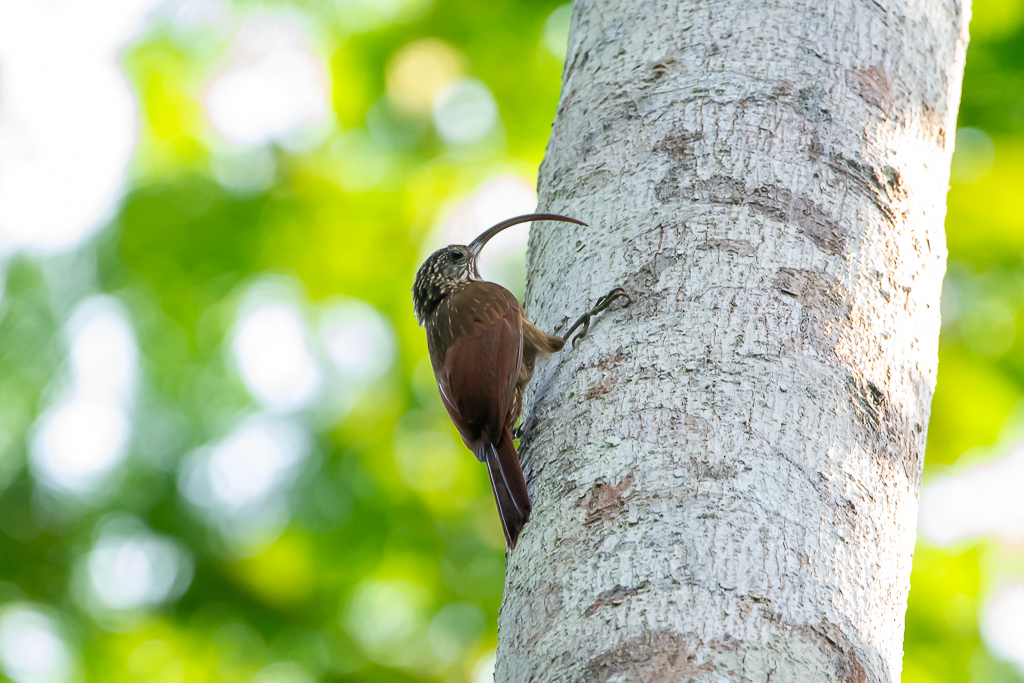
Curve-billed Scythebill is a scythebill of the interior of terra firme forest in Amazonia and the Guianas. It uses its long, strongly curved bill to extract insects from crevices, moss clumps and leaf rosettes. Tapajos Scythebill and Xingu Scythebill south of the Amazon were formerly included in this species.
Voice
Sings mainly in the early morning, in short series of whistled notes; in birds of the west and north-west the series ends in a faster, harsher rattle. The call is an explosive, rather harsh chit-di-dit.
Recording: Felipe Arantes — CC BY-NC-SA 4.0 · xeno-canto
Identification
22–25 cm, with a long, strongly decurved, dark reddish-brown bill that is shorter than that of Red-billed Scythebill. Head, mantle and underparts are brown with fine buff streaks; the throat is whitish and streaked. Wings, rump and tail are rufous. The subspecies differ in the width of the streaking. The sexes are alike.
Confusion species
Red-billed Scythebill Campylorhamphus trochilirostris has a longer, redder bill and lives mainly in riverine forest, várzea and bamboo. Tapajos Scythebill Campylorhamphus probatus and Xingu Scythebill Campylorhamphus multostriatus are almost identical and live south of the Amazon, east of the Madeira. Other woodcreepers in the guide area have a much shorter, less curved bill.
Habitat
The interior of humid terra firme forest, also forest on white sand, only occasionally in flooded forest or at the edge; mostly below 500 m, in Suriname to 700 m. It forages in the middle levels along trunks and lianas for insects and spiders, often with mixed flocks. The nest is in a tree cavity.
Where the bird is most at home, classified by the vegetation units of Amazonia and the Guianas.



Range and movements
Brazil: north of the Amazon from the Colombian border east to Amapá, and south of it only west of the Madeira. Venezuela: scarce in the south and east, in Amazonas and Bolívar. Guyana, Suriname and French Guiana: scattered in forest of the interior. Outside the guide area in south-eastern Colombia, north-eastern Ecuador and extreme north-eastern Peru.
- Resident
- dark = core range, pale = thinly spread
How and when to look
In extensive, undisturbed terra firme forest, follow mixed flocks in the middle level, for example in the interior of French Guiana or north of Manaus, and listen in the early morning for the short whistled series and the explosive chit-di-dit.
Conservation status
Least Concern (IUCN). The species lives at low density, is sensitive to fragmentation and quickly disappears from fragmented forest.
Scientific name
Campylorhamphus procurvoides | (de Lafresnaye, 1850)
De Lafresnaye described the species in 1850 as Xiphorhynchus procurvoides; because it was later moved to another genus, the author and year stand in brackets. The genus Campylorhamphus was introduced in 1901 by Bertoni. Campylorhamphus is Greek, from kampulos 'curved' and rhamphos 'bill', after the long, strongly decurved bill. procurvoides means 'resembling procurvus', as Lafresnaye found its bill and plumage colour similar to Temminck's Dendrocolaptes procurvus. The specimen the first description was based on came from Cayenne, French Guiana.