All species › Passerines › Tyrant flycatchers and allies › Black-throated Tody-Tyrant
Black-throated Tody-Tyrant | Hemitriccus granadensis
Zwartkeeltodietiran | Titirijí gorjinegro | Maria-de-garganta-preta
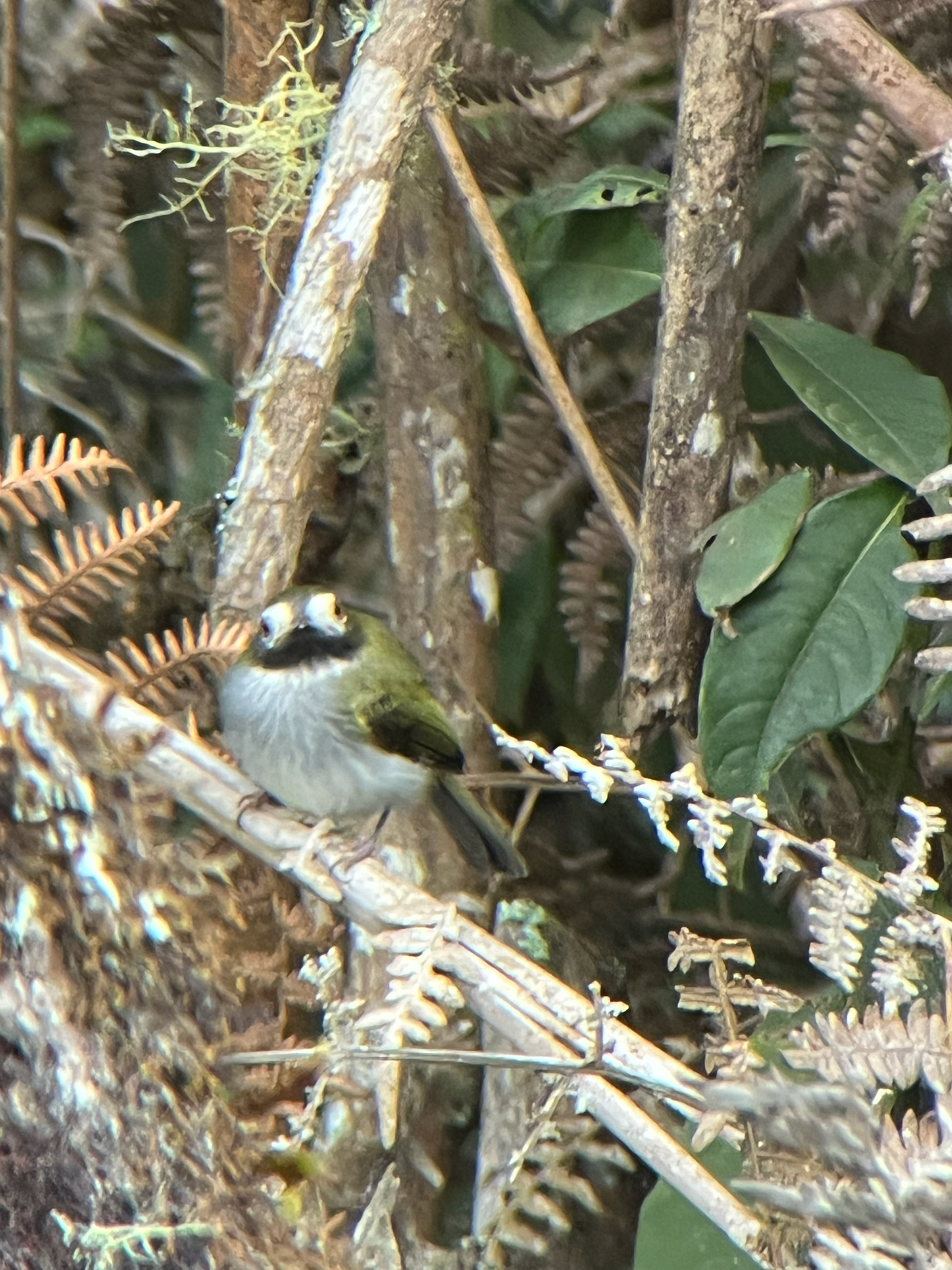
Black-throated Tody-Tyrant is a small flycatcher of cloud forest and upper montane forest in the Andes, with a black throat and pale spectacles. In the guide area it occurs only in the mountains of western and northern Venezuela, higher than most related species. It keeps to dense undergrowth and forest edges.
Voice
Sharp, separate pik and peet calls, nasal notes and a short, rattling trill.
Recording: Guilherme Melo — CC BY-NC-SA 4.0 · shortened to the first 60 s, mono · xeno-canto
Identification
10 cm, with a flat bill and a fairly short tail. Crown and back dark olive, the wings dark with olive edges and no distinct wing bars. The lores and eye-ring form white to ochre spectacles. The upper throat is sooty black, the breast grey, merging into a whitish belly with a yellow wash on the flanks. The iris varies from chestnut to pale orange. Birds in the Perijá are darker with a pure grey breast, those in the coastal range whiter on the breast. The sexes are alike.
Confusion species
Scale-crested Pygmy Tyrant Lophotriccus pileatus lives lower in montane forest and has a crest with rufous feather edges, a streaked breast and no black throat. Rufous-crowned Tody-Flycatcher Poecilotriccus ruficeps has a rufous crown, black-and-white sides to the head and a yellow belly. Other small montane flycatchers lack the combination of black throat and pale spectacles.
Habitat
Undergrowth and edges of cloud forest and upper montane forest, also scrub in clearings, treefalls and landslides; in Venezuela roughly between 1800 and 3000 m. It forages alone or in pairs low to mid-height for insects, which it picks from leaves with short sallies.
Where the bird is most at home, classified by the vegetation units of Amazonia and the Guianas.


Range and movements
Venezuela: in the Serranía de Perijá, in western Táchira (Páramo de Tamá) and very locally in the coastal range near Caracas. Absent from Brazil and the Guianas. Outside the guide area in the Andes of Colombia, Ecuador, Peru and Bolivia and in the Sierra Nevada de Santa Marta.
- Resident
- dark = core range, pale = thinly spread
How and when to look
Search forest edges and scrub in clearings in cloud forest above 1800 m, for example in El Tamá National Park. Listen for the sharp pik calls low in the vegetation.
Conservation status
Least Concern. Widespread in the Andes. In Venezuela the range is small; deforestation for farming and cattle in the Perijá and the Andes of Táchira reduces its habitat there.
Scientific name
Hemitriccus granadensis | (Hartlaub, 1843)
Hartlaub described the species in 1843 as Todirostrum granadense; because it was later moved to another genus, the author and year stand in brackets. The genus Hemitriccus was introduced in 1860 by Cabanis & Heine. Hemitriccus is Greek, from hēmi- 'half, small' and trikkos, an unidentified small bird; in ornithology triccus denotes a tyrant flycatcher: 'small tyrant'. granadensis refers to New Granada, the old Spanish colonial name for the region of present-day Colombia, where the species was collected. The specimen the first description was based on came from Santa Elena, Antioquia, Colombia.