All species › Passerines › Tyrant flycatchers and allies › Buff-breasted Tody-Tyrant
Buff-breasted Tody-Tyrant | Hemitriccus mirandae
Geelborsttodietiran | Titirijí de Miranda | Maria-do-nordeste
Buff-breasted Tody-Tyrant is a small flycatcher found only in north-eastern Brazil. It lives in the humid montane forests (brejos de altitude) on isolated ridges above the dry caatinga and the coastal plain. Its creamy face and breast distinguish it from the other tody-tyrants in that region.

Voice
A short burst of seven or eight sharp, accented notes that speed up and rise in pitch.
Recording: Guilherme Melo — CC BY-NC-SA 4.0 · converted to mono · xeno-canto
Identification
10 cm, with a flat bill and a fairly short tail. Crown, back and tail dark olive. Face, throat and breast pale creamy buff, the belly whiter, the undertail coverts pale yellow. The wings are dark with pale edges to the coverts and flight feathers. The iris is orange. The sexes are alike.
Confusion species
Pearly-vented Tody-Tyrant Hemitriccus margaritaceiventer lives lower, in caatinga and dry forest, and has a streaked throat and breast and white underparts without a buff tone. White-bellied Tody-Tyrant Hemitriccus griseipectus has a white throat, a greyish breast and a white belly. Eared Pygmy Tyrant Myiornis auricularis is smaller, with a black ear spot, a streaked throat and a yellow belly.
Habitat
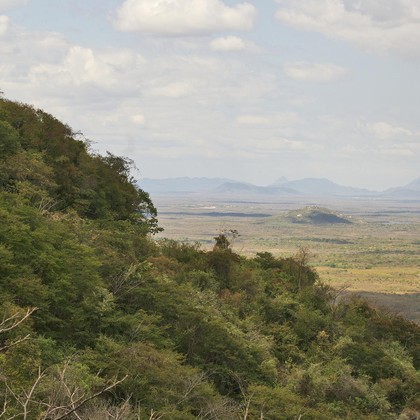
Semi-humid montane forest, both primary and secondary, on the slopes of isolated ridges between about 600 and 1000 m. It forages in the undergrowth and middle storey for insects, which it picks from leaves with short sallies.
Where the bird is most at home, classified by the vegetation units of Amazonia and the Guianas.

Range and movements
Brazil: endemic to the north-east, in separate montane forests in Ceará (including the Serra de Baturité), Paraíba, Pernambuco and Alagoas. Absent from Venezuela and the Guianas.
- Resident
- dark = core range, pale = thinly spread
How and when to look
Search the montane forests of the Serra de Baturité in Ceará or the higher forest reserves of Pernambuco and Alagoas. Listen for the short, accelerating series of sharp notes in the undergrowth.
Conservation status
Vulnerable. The range is small and severely fragmented, and the population is estimated at 1500 to 7000 mature individuals and is probably declining. Clearance of the brejos de altitude for farming is the main threat.
Scientific name
Hemitriccus mirandae | (Snethlage, HMMEE, 1925)
Snethlage, HMMEE described the species in 1925 as Todirostrum mirandae; because it was later moved to another genus, the author and year stand in brackets. The genus Hemitriccus was introduced in 1860 by Cabanis & Heine. Hemitriccus is Greek, from hēmi- 'half, small' and trikkos, an unidentified small bird; in ornithology triccus denotes a tyrant flycatcher: 'small tyrant'. mirandae honours the Brazilian zoologist Alípio de Miranda-Ribeiro (1874–1939), best known as an ichthyologist. The specimen the first description was based on came from Serra da Ibiapaba, northern Ceará, Brazil.