All species › Jacamars and puffbirds › Puffbirds › Brown-banded Puffbird
Brown-banded Puffbird | Notharchus ordii
Bruinbandbaardkoekoek | Buco pechipardo | Macuru-de-peito-marrom
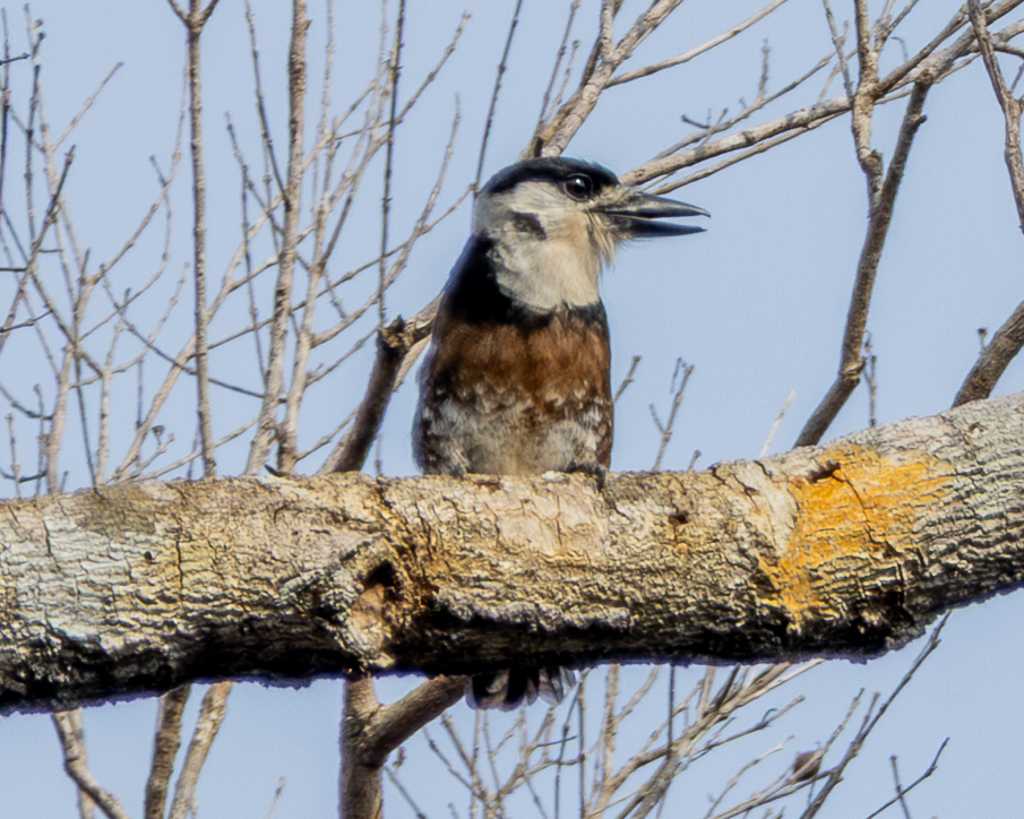
The Brown-banded Puffbird is a black-and-white puffbird of Amazonia, recognisable by the brown band below the black breast band. It is scattered and local, with a preference for forest on poor white-sand soils. Like its relatives, it sits still for long periods high in the canopy.
Voice
A series of clear whistles that first rises in pitch and then falls again, sometimes in duet; also single, plaintive whistles.
Recording: JAYRSON ARAUJO DE OLIVEIRA — CC BY-NC-SA 4.0 · xeno-canto
Identification
20–21 cm, with a large head and a heavy, hook-tipped black bill. The crown, eye area, back, wings and tail are black; the forehead is white. The throat and sides of the neck are white. A black band crosses the breast, with a broader brown band below it. The belly is white and the flanks are barred black. The sexes are alike.
Confusion species
White-necked Puffbird Notharchus hyperrhynchus and Guianan Puffbird Notharchus macrorhynchos are larger, with a broad white collar and no brown band on the breast. Pied Puffbird Notharchus tectus is smaller, with a narrow white eyebrow, a white scapular stripe and white spots in the tail.
Habitat
The canopy and edges of tall lowland forest, especially white-sand forest and its low, open forms, locally also terra firme and the edges of flooded forest along blackwater rivers, up to about 500 m. It perches high on an open branch and sallies for large insects. It probably nests, like related species, in a cavity in a termite nest.
Where the bird is most at home, classified by the vegetation units of Amazonia and the Guianas.



Range and movements
In Brazil scattered and local in Amazonia, including along the Rio Negro and the Madeira in Amazonas, in Rondônia, in Pará along the Tapajós and the Xingu and in northern Mato Grosso. In Venezuela locally in southern Amazonas, in the Río Negro drainage. Absent from Guyana, Suriname and French Guiana. Outside the guide area very locally in eastern Colombia, north-eastern Peru and northern Bolivia.
- Resident
- dark = core range, pale = thinly spread
How and when to look
Search for birds on bare branches above the canopy from clearings or a canopy tower, for example at the towers along the Rio Cristalino in northern Mato Grosso or in white-sand forest along the Rio Negro.
Conservation status
Least Concern. The species is scattered and local, but the range is large and still largely forested.
Scientific name
Notharchus ordii | (Cassin, 1851)
Cassin described the species in 1851 as Bucco Ordii; because it was later moved to another genus, the author and year stand in brackets. The genus Notharchus was introduced in 1863 by Cabanis & Heine. Notharchus is Greek, from nōthēs 'sluggish' and arkhos 'leader': 'sluggish chief', after the lethargic behaviour of puffbirds. ordii honours the American naturalist George Ord (1781–1866) of Philadelphia. The specimen the first description was based on came from Venezuela.