All species › Jacamars and puffbirds › Puffbirds › Buff-bellied Puffbird
Buff-bellied Puffbird | Notharchus swainsoni
Swainsons baardkoekoek | Buco de Swainson | Macuru-de-barriga-castanha
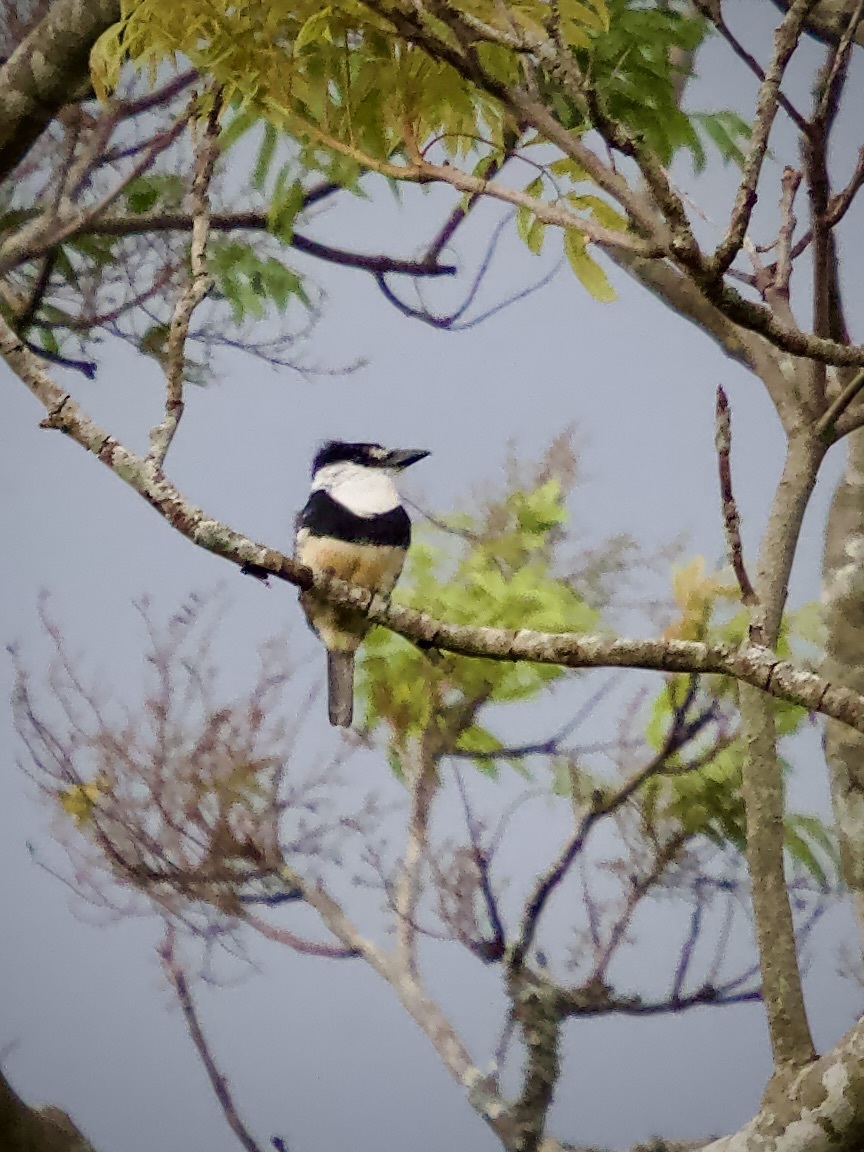
The Buff-bellied Puffbird is the large black-and-white puffbird of the Atlantic Forest, with a buff belly. It sits motionless for long periods on high, bare branches in the canopy or at the forest edge and is then recognised mainly by its silhouette. It was formerly included in White-necked Puffbird.
Voice
Rather quiet. The song is a long, high, slightly trilling series of whistles, often in duet; it also gives soft, plaintive notes.
Recording: JAYRSON ARAUJO DE OLIVEIRA — CC BY-NC-SA 4.0 · xeno-canto
Identification
23–25 cm, with a heavy, hooked black bill and a large head. Crown, upperparts, wings and tail are black; the forehead is black, without a white band. The cheek is greyish, the throat and sides of the neck white, continuing into a white collar on the nape. A broad black band crosses the breast, and the belly and flanks are pale buff to pale cinnamon. The sexes are alike.
Confusion species
Guianan Puffbird Notharchus macrorhynchos and White-necked Puffbird Notharchus hyperrhynchus of Amazonia have a white forehead and a white belly; they do not occur together with this species. Pied Puffbird Notharchus tectus of Amazonia is much smaller, with white spots on the crown and a white scapular stripe. White-eared Puffbird Nystalus chacuru is brown with a red bill and a white ear patch.
Habitat
Canopy and edges of humid lowland forest, semi-deciduous forest and lower montane forest, also forest remnants and clearings with tall dead trees and plantations with shade trees; mainly in the lowlands and on lower slopes. It sits still for long periods on a high, bare branch and sallies out for large insects and small vertebrates. It breeds in a cavity it excavates in an arboreal termite nest.
Where the bird is most at home, classified by the vegetation units of Amazonia and the Guianas.




Range and movements
In Brazil in the east and south-east, from Bahia and Minas Gerais through Espírito Santo, Rio de Janeiro and São Paulo to Paraná and Santa Catarina. Outside the guide area in eastern Paraguay and north-eastern Argentina.
- Resident
- dark = core range, pale = thinly spread
How and when to look
At forest edges and clearings in the Atlantic Forest, scan the tops of tall, bare trees; the bird often sits long on the same branch and can then be recognised by its black-and-white head and broad breast band.
Conservation status
Least Concern. The species has a fairly large range and also uses forest edges, but depends on large trees and has become scarce locally because of deforestation.
Scientific name
Notharchus swainsoni | (Gray, 1846)
Gray described the species in 1846 as Bucco swainsoni; because it was later moved to another genus, the author and year stand in brackets. The genus Notharchus was introduced in 1863 by Cabanis & Heine. Notharchus is Greek, from nōthēs 'sluggish' and arkhos 'leader': 'sluggish chief', after the lethargic behaviour of puffbirds. swainsoni honours the English naturalist and illustrator William Swainson (1789–1855), who collected in Brazil. The specimen the first description was based on came from Brazil (not specified further).