All species › Passerines › Tyrant flycatchers and allies › Chapada Flycatcher
Chapada Flycatcher | Guyramemua affine
Chapadatiran | Fiofío de la Chapada | Suiriri-da-chapada
The Chapada Flycatcher is a grey, white and yellow flycatcher of the cerrado of central Brazil. It was described as a separate species only in 2001, after long being regarded as a form of Suiriri Flycatcher; voice and display behaviour proved to be the difference. Genetic studies later showed that it is more closely related to the scrub flycatchers, and it was given its own genus, Guyramemua.
Voice
Voice is the main difference from Suiriri Flycatcher, and the two species do not respond to each other's calls. Males give a loud series of paired, twangy couplets; females a loud, bubbling rattle, often preceded by one or two whur notes, and a contact call like zhuwheep. Pairs sing in duet, each with its own song; the male flutters its wings and fans its tail while doing so.
Recording: JAYRSON ARAUJO DE OLIVEIRA — CC BY-NC-SA 4.0 · xeno-canto
Identification
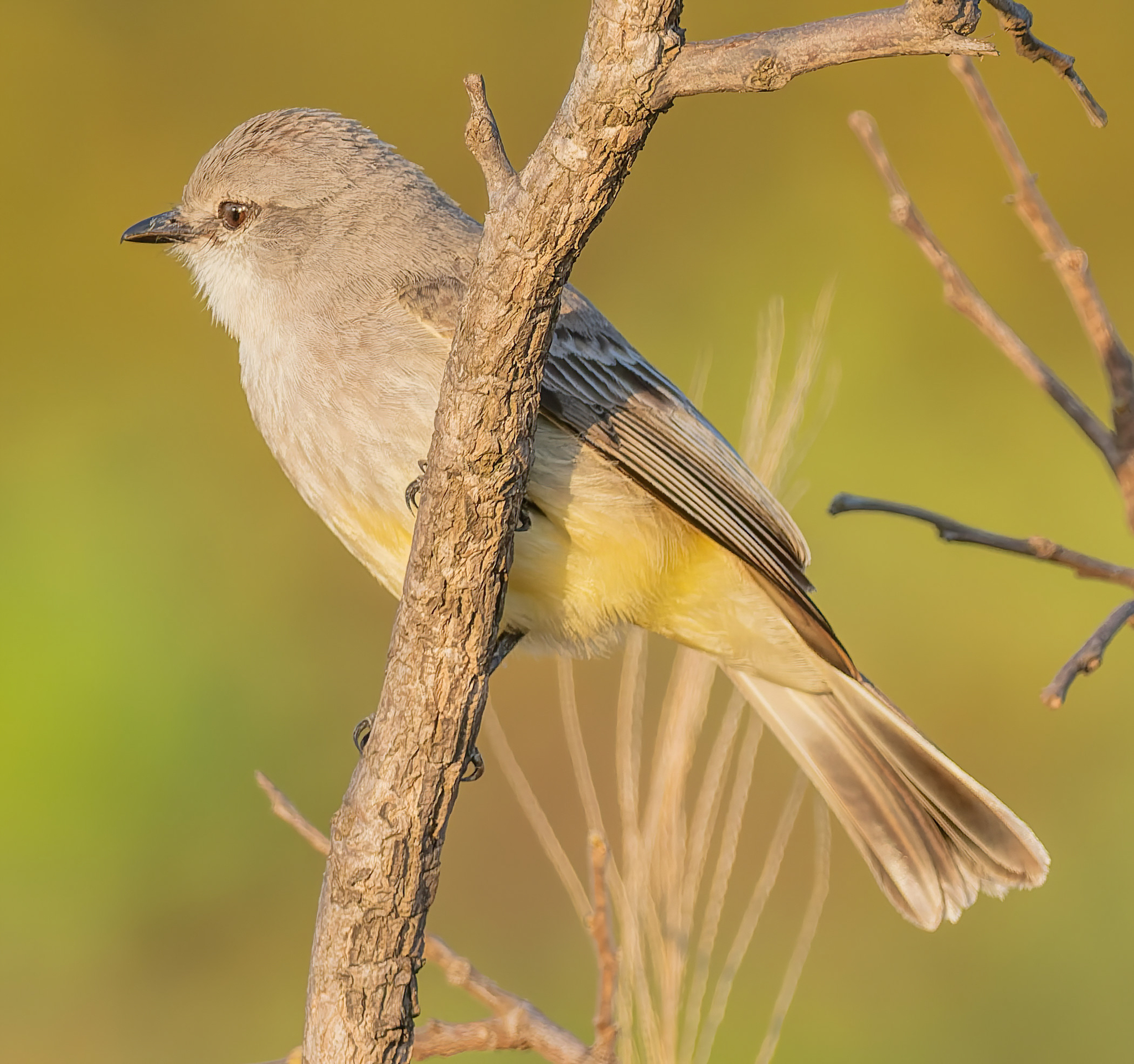
15–16 cm, with a rather short, black bill. Crown and nape are grey with an olive wash, with a white spot in front of the eye and a short white supercilium. The upperparts are grey with an olive wash, the wings darker, with greyish-white tips to the coverts that form two wing bars. The tail is dark grey, with pale outer webs and broad whitish tips. Throat and breast are whitish, the belly and undertail coverts pure yellow. The iris is brown. The sexes are alike.
Confusion species
Suiriri Flycatcher Suiriri suiriri, which lives in the same cerrado, is very similar; it has a longer bill, lacks the broad pale tail tips and pale outer webs, and does not perform a wing-fluttering display. Voice is the most reliable feature. Southern Scrub Flycatcher Sublegatus modestus is smaller, with a very short bill and a browner grey back. Lesser Elaenia Elaenia chiriquensis and other elaenias have a pale base to the lower mandible and often a white crown patch.
Habitat
Typical cerrado with scattered trees and shrubs 2 to 5 m tall, also open campo cerrado and campo sujo, mostly between 250 and 750 m, possibly up to 1200 m. It forages mainly from the middle to the crown of trees, gleaning insects and other arthropods from leaves and branches while perched or briefly hovering; it sometimes catches insects in the air and also eats small fruit. Little is known about the nest; the breeding season appears to end in October.
Where the bird is most at home, classified by the vegetation units of Amazonia and the Guianas.



Range and movements
Brazil: in the cerrado of central and south-western Brazil, from Maranhão and Tocantins south and west through Mato Grosso, Goiás, the Distrito Federal and Minas Gerais to Mato Grosso do Sul. Suriname: a few records from the savannas of the south; its status there is uncertain. Absent from Venezuela, Guyana and French Guiana. Outside the guide area in the far east of Bolivia.
- Resident
- dark = core range, pale = thinly spread
How and when to look
In the cerrado around Chapada dos Guimarães in Mato Grosso, in Emas National Park or in the national parks around Brasília, search the crowns of scattered trees for a grey-and-white flycatcher with a yellow belly and broad pale tail tips. Listen for the duets of pairs and watch for the wing-fluttering of the male.
Conservation status
Near Threatened. The population is declining; a decrease of about a quarter in ten years has been estimated. The main threats are conversion of cerrado to eucalyptus and pine plantations, cattle ranching and large-scale cultivation of soya, rice and other crops; annual dry-season fires and urbanisation may also play a role. The species occurs in several protected areas.
Scientific name
Guyramemua affine | (Burmeister, 1856)
Burmeister described the species in 1856 as Elaenea affinis; because it was later moved to another genus, the author and year stand in brackets. The genus Guyramemua was introduced in 2017 by Lopes, Chaves, Aquino, Silveira & Santos. Guyramemua is from Tupi, from gûyra 'bird' and memûã 'trickster': 'trickster bird', because the species fooled ornithologists three times. affine is Latin for 'related', after its resemblance to other small tyrant flycatchers with which it was long confused. The specimen the first description was based on came from Lagoa Santa, Minas Gerais, Brazil.