All species › Passerines › Tyrant flycatchers and allies › Northern Scrub Flycatcher
Northern Scrub Flycatcher | Sublegatus arenarum
Noordelijke struikvliegenpikker | Mosquero matorralero norteño | Sertanejo-do-norte
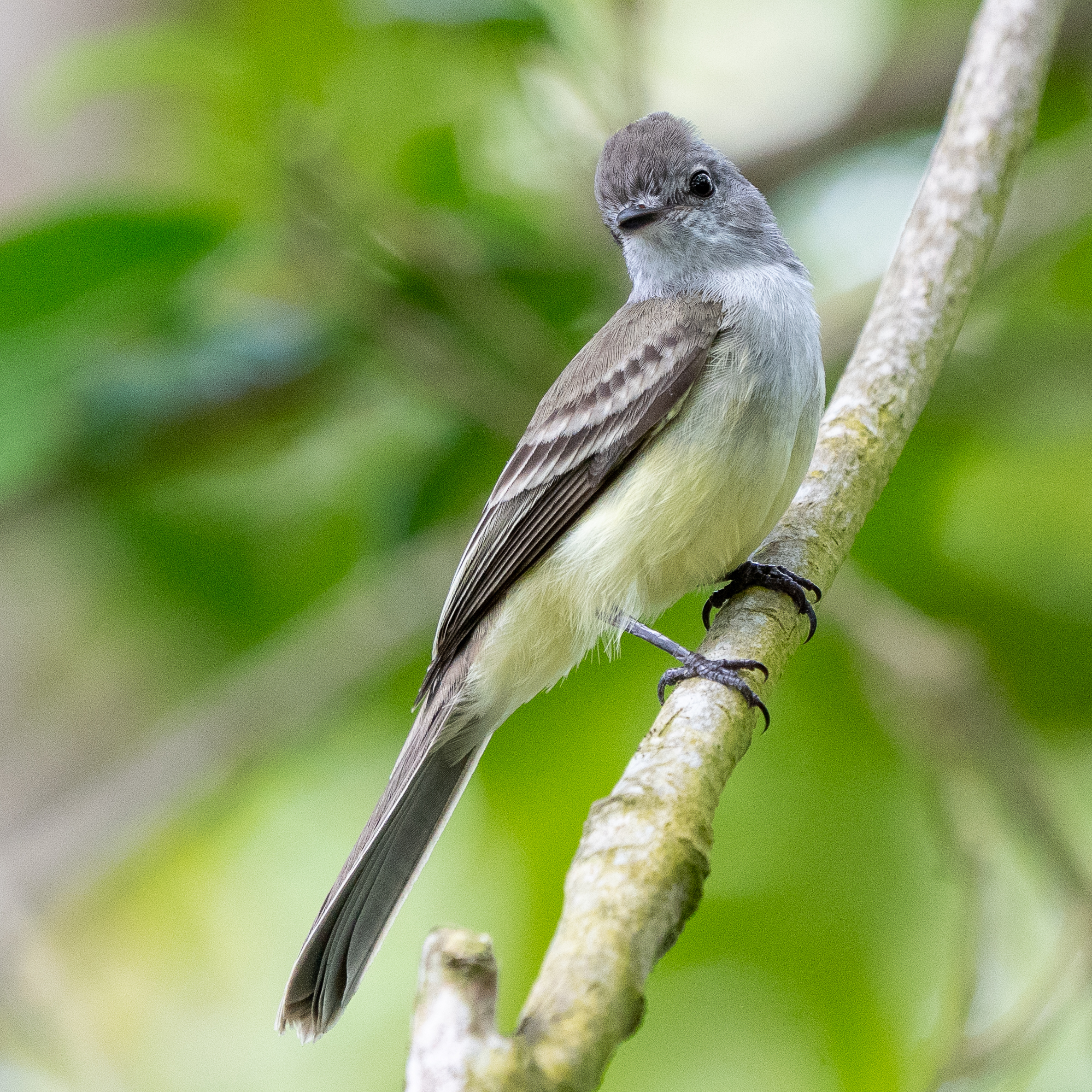
The Northern Scrub Flycatcher is a small, grey-and-yellow flycatcher of mangroves and dry scrub along the coasts of northern South America. In the guide area it lives in northern Venezuela and along the coast of the Guianas. It was formerly treated as one species with two relatives, including Amazonian Scrub Flycatcher.
Voice
Rather quiet. The commonest calls are an abrupt, rising pweeee or pee-yup, single or double, and a short whistled fyoo-dit.
Recording: Gean Carlo Valdés — CC0 · shortened to the first 60 s, mono · xeno-canto
Identification
13–15 cm. Crown greyish-brown, sometimes raised as a small crest. A pale supercilium and a dark eye-stripe give the face a masked look. Back greyish-brown; wings dark with pale edges and two wing bars. Throat whitish, breast pale grey, and the belly mid-yellow, sharply demarcated from the breast. Tail dark with narrow pale tips. The bill is short and entirely black. The sexes are alike.
Confusion species
Amazonian Scrub Flycatcher Sublegatus obscurior of forest edges in Amazonia and the interior of the Guianas is darker, with a dark grey breast and a less sharp border to the belly. Southern Scrub Flycatcher Sublegatus modestus, a winter visitor from the south, has a paler grey breast and a paler yellow belly. Southern Beardless Tyrannulet Camptostoma obsoletum is smaller, with an erect crest and a bill with a pale base. Yellow-bellied Elaenia Elaenia flavogaster is larger, with a long crest, a pale base to the lower mandible and no sharp border between breast and belly.
Habitat
Mangroves, coastal scrub, thorn and cactus scrub, dry forest, scrub on sand ridges and second growth, from sea level to a few hundred metres. It hunts quietly from a sheltered perch in the scrub for insects, which it takes from leaves with short sallies; it also eats small berries. The nest is a small, shallow cup in a shrub.
Where the bird is most at home, classified by the vegetation units of Amazonia and the Guianas.



Range and movements
Venezuela: in the north, along the Caribbean coast and in dry areas inland, and on Margarita. Guyana, Suriname and French Guiana: local in mangroves and scrub along the coast. Brazil: no confirmed records; the Amazonian species is Amazonian Scrub Flycatcher. Outside the guide area along the coasts of Costa Rica, Panama and Colombia, on Trinidad and the ABC islands.
- Resident
- dark = core range, pale = thinly spread
How and when to look
Along the Caribbean coast of Venezuela, look in mangroves and thorn scrub for a small flycatcher with a short black bill and a sharp border between grey breast and yellow belly. In Suriname and French Guiana it occurs in mangroves and coastal scrub.
Conservation status
Least Concern. The species has a fairly large range; mangrove clearance and coastal development are local threats.
Scientific name
Sublegatus arenarum | (Salvin, 1863)
Salvin described the species in 1863 as Elainea arenarum; because it was later moved to another genus, the author and year stand in brackets. The genus Sublegatus was introduced in 1868 by Sclater & Salvin. Sublegatus is Latin sub 'near to' plus the genus Legatus (Piratic Flycatcher): 'allied to Legatus'. arenarum is Latin for 'of the sands', after the type locality Punta Arenas in Costa Rica. The specimen the first description was based on came from Punta Arenas, Costa Rica.