All species › Passerines › Tyrant flycatchers and allies › Chapman's Bristle Tyrant
Chapman's Bristle Tyrant | Pogonotriccus chapmani
Chapmans looftiran | Orejerito de Chapman | Barbudinho-do-tepui
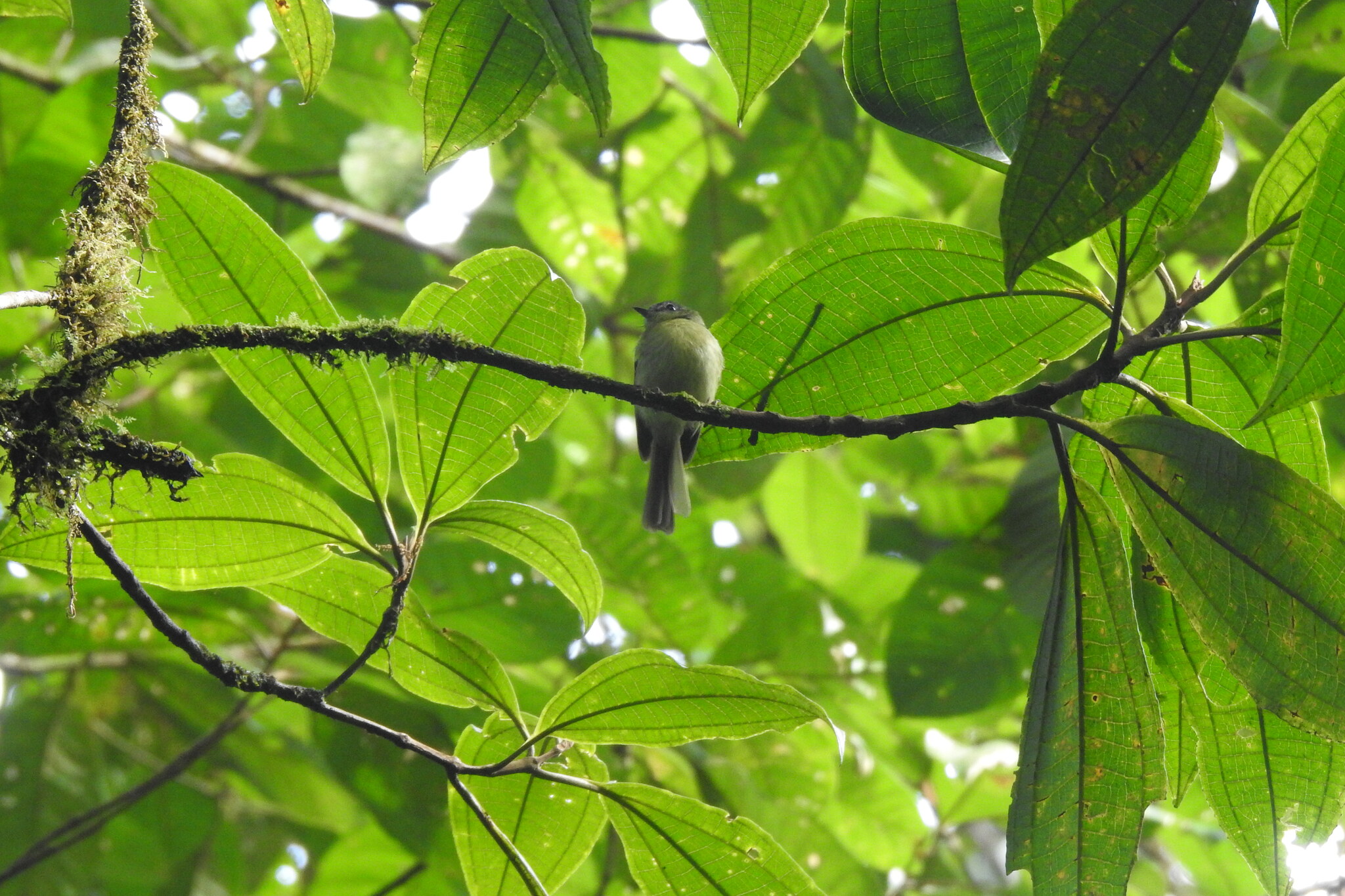
Chapman's Bristle Tyrant is a small olive-green and yellow bristle tyrant of montane forest on the slopes of the tepuis. It has buffy to cinnamon wing-bars and, like its relatives, perches upright on a branch. It does not occur outside the Guiana Highlands.
Voice
High, sharp calls and a short, dry trill, as in related bristle tyrants.
Recording: GABRIEL LEITE — CC BY-NC-SA 4.0 · shortened to the first 60 s, mono · xeno-canto
Identification
11 cm, with a short, narrow bill and a fairly long tail. The upperparts are olive-green, the crown slightly greyer. The face is dull yellowish, with a pale eye-ring and a dark patch on the ear-coverts. The wings are dark with two buffy to cinnamon wing-bars. The underparts are yellow, washed olive on the breast. The sexes are alike.
Confusion species
Slaty-capped Flycatcher Leptopogon superciliaris is larger, with a slate-grey cap, a whitish face with a sharper black ear patch and a longer bill. Sierra de Lema Flycatcher Mionectes roraimae lacks wing-bars and has a cinnamon belly. Small elaenias and tyrannulets in the same forest lack the dark ear patch.
Habitat
The middle storey and lower canopy of humid montane forest and cloud forest on the slopes of the tepuis, roughly between 900 and 2000 m. It perches upright and makes short sallies to pick insects from leaves; often in mixed flocks.
Where the bird is most at home, classified by the vegetation units of Amazonia and the Guianas.

Range and movements
Venezuela: the tepuis of Bolívar and Amazonas, including the Sierra de Lema, the Gran Sabana and Cerro Duida. Guyana: the west, in the Pakaraima Mountains. Brazil: rare and local in the far north, along the borders with Venezuela and Guyana. Absent from Suriname and French Guiana. Does not occur outside the guide area.
- Resident
- dark = core range, pale = thinly spread
How and when to look
Follow mixed flocks in montane forest along the road through the Sierra de Lema (Escalera) in Bolívar, above about 1000 m; look for the dark ear patch and buffy wing-bars.
Conservation status
Least Concern. The montane forest of the tepuis is largely intact and remote; local threats are mining and logging along roads.
Scientific name
Pogonotriccus chapmani | (Gilliard, 1940) (GBIF: Phylloscartes chapmani)
Gilliard described the species in 1940 as Phylloscartes chapmani; because it was later moved to another genus, the author and year stand in brackets. The genus Pogonotriccus was introduced in 1860 by Cabanis & Heine. Pogonotriccus is Greek, from pōgōn 'beard' and trikkos 'small bird', after the bristles around the base of the bill. chapmani honours the American ornithologist Frank Michler Chapman (1864–1945), curator of birds at the American Museum of Natural History. The specimen the first description was based on came from Arabopó (1,280 m), Mount Roraima, Venezuela.