All species › Passerines › Tyrant flycatchers and allies › Venezuelan Bristle Tyrant
Venezuelan Bristle Tyrant | Pogonotriccus venezuelanus
Venezolaanse looftiran | Orejerito venezolano | Barbudinho-da-venezuela
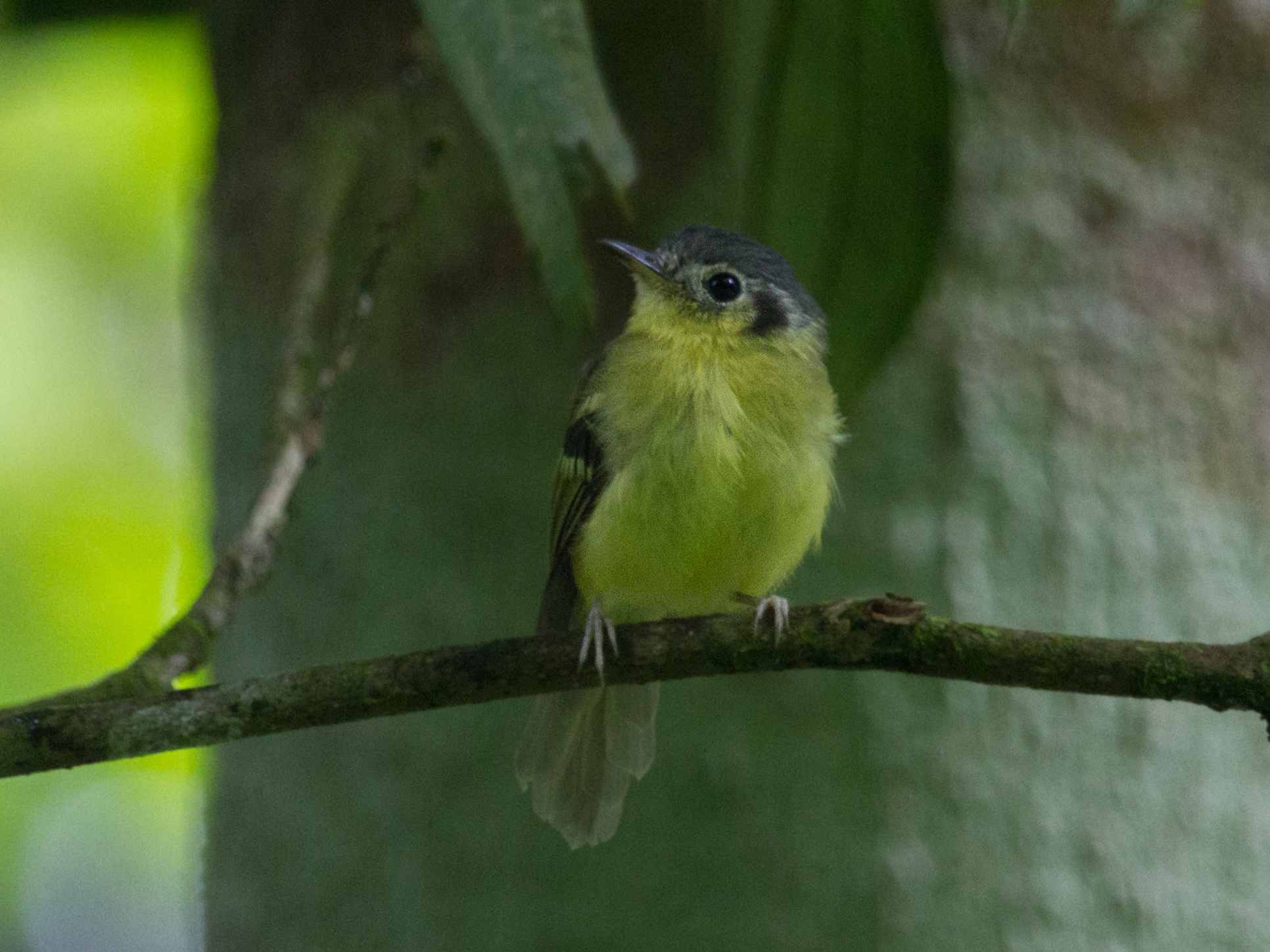
The Venezuelan Bristle Tyrant is a small yellow-and-green bristle tyrant that lives only in the coastal mountains of northern Venezuela. It is tied to mossy cloud forest at middle elevations and therefore has a small, fragmented range.
Voice
The song is a fast trill ending in a sharper, descending note; the call is a soft, two-noted che-dip.
Recording: Francisco contreras @francontreras.80 — CC BY-NC-SA 4.0 · xeno-canto
Identification
11 cm, with a short, narrow bill and a fairly long tail. The crown is grey, the back olive-green. The face is yellowish and mottled, with yellowish-white lores and a distinct yellowish-white eye-ring. The wings are blackish with pale yellow edgings to the flight feathers and coverts. Throat and underparts are bright yellow, washed olive on the breast. The sexes are alike.
Confusion species
Marble-faced Bristle Tyrant Pogonotriccus ophthalmicus lives in the same mountains; it has a more strongly marbled face with a dark ear patch and less conspicuous wing edgings. Slaty-capped Flycatcher Leptopogon superciliaris is larger, with a slate-grey cap, a dark ear patch and buffy wing-bars. Olive-striped Flycatcher Mionectes olivaceus has streaked olive underparts and a small yellow spot behind the eye.
Habitat
The middle storey of humid montane forest, especially mossy cloud forest at middle elevations, roughly between 950 and 1400 m. It perches upright, now and then lifts one wing, and makes short sallies to pick insects from leaves; often in mixed flocks.
Where the bird is most at home, classified by the vegetation units of Amazonia and the Guianas.

Range and movements
Venezuela: endemic to the coastal range of the north, from Carabobo through Aragua to the Distrito Capital, and to the interior range in southern Aragua and Miranda. Absent from the Andes and the Serranía de Perijá, south of the Orinoco and from Brazil, Guyana, Suriname and French Guiana. Does not occur outside the guide area.
- Resident
- dark = core range, pale = thinly spread
How and when to look
Search the cloud forest of Henri Pittier National Park, for example around Rancho Grande; follow mixed flocks at 1000–1400 m and listen for the fast trill.
Conservation status
Near Threatened. The range is small and the montane forest of the coastal range is affected by clearance, agriculture and fire; part of its habitat lies in national parks.
Scientific name
Pogonotriccus venezuelanus | Berlepsch, 1907 (GBIF: Phylloscartes venezuelanus)
Berlepsch described the species in 1907 and placed it straight away in the genus where it still stands. The genus Pogonotriccus was introduced in 1860 by Cabanis & Heine. Pogonotriccus is Greek, from pōgōn 'beard' and trikkos 'small bird', after the bristles around the base of the bill. venezuelanus means 'from Venezuela', the country where the species was described. The specimen the first description was based on came from Puerto Cabello, Carabobo, Venezuela.