All species › Swifts › Hummingbirds › Diamantina Sabrewing
Diamantina Sabrewing | Campylopterus diamantinensis
Diamantinasabelvleugel | Alasable de Diamantina | Asa-de-sabre-do-espinhaço
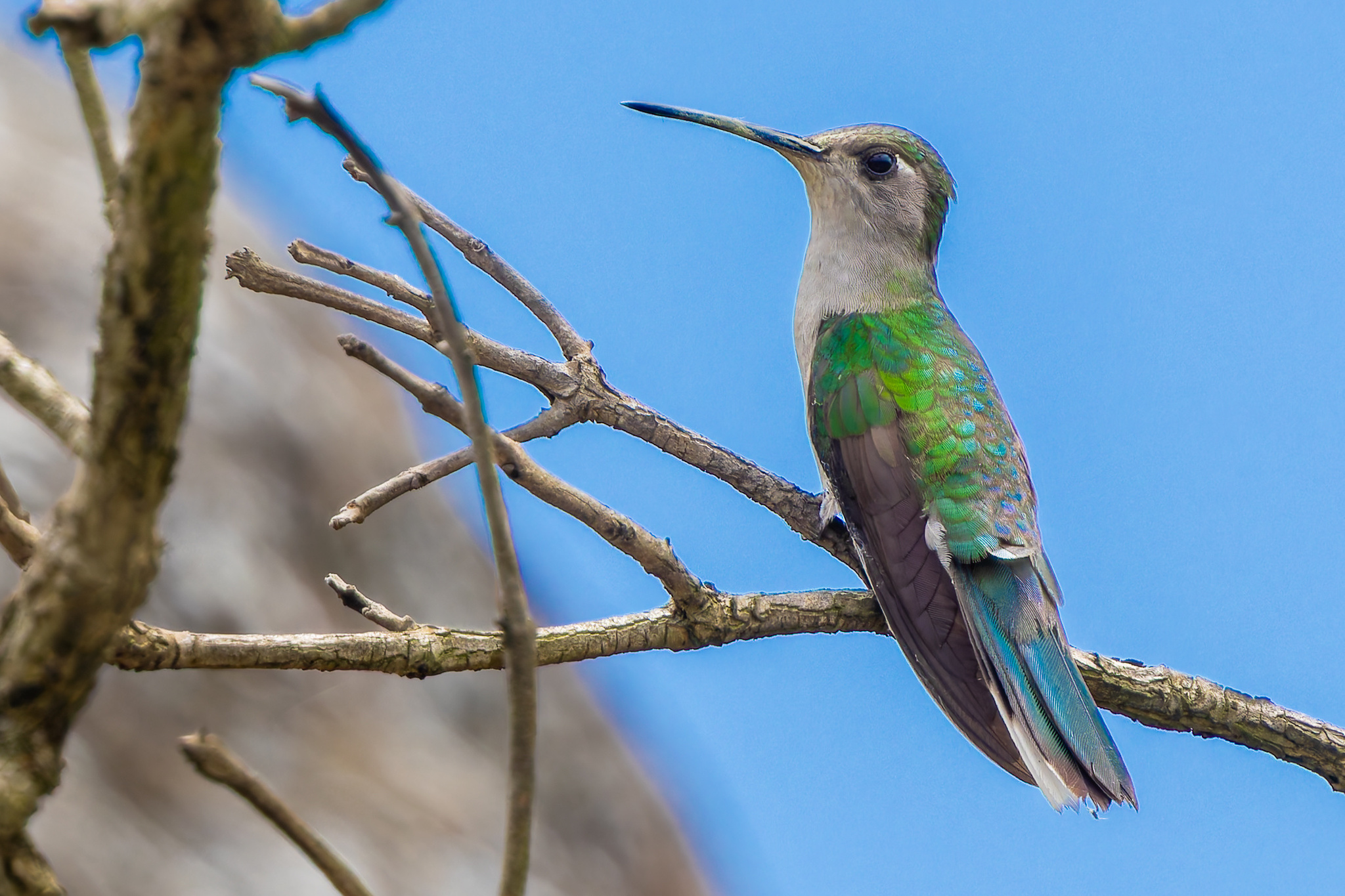
The Diamantina Sabrewing is a large grey and green hummingbird of the rocky uplands of eastern Brazil. It was long regarded as a subspecies of Grey-breasted Sabrewing, but is now treated as a separate species. The name refers to the Chapada Diamantina in Bahia.
Voice
A loud, sharp chip, often repeated. The song is a series of squeaky and twittering notes from a perch.
Recording: Guilherme de Melo Becher — CC BY-NC-SA 4.0 · xeno-canto
Identification
13–14 cm, with a fairly long, slightly decurved, black bill. The upperparts are glossy green, the underparts plain grey, with a small white spot behind the eye. The central tail feathers are dark green, the outer ones blue-black with pale tips. The sexes are alike; the male has thickened, curved shafts to the outer primaries.
Confusion species
Outcrop Sabrewing Campylopterus calcirupicola closely resembles this species, but is slightly smaller, has longer pale tail tips and lives lower, in dry forest on limestone. Swallow-tailed Hummingbird Eupetomena macroura is glittering blue and green, with a long, deeply forked tail. Female visorbearers, such as Hooded Visorbearer Augastes lumachella in the Chapada Diamantina, are smaller, with a shorter, straight bill and greener underparts.
Habitat
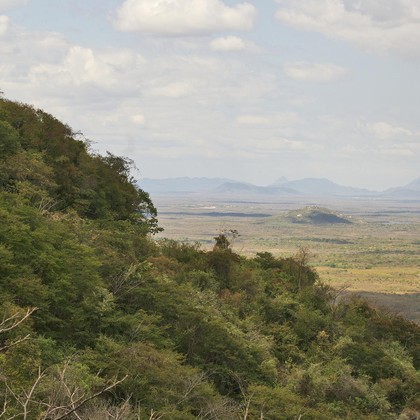
Gallery forest, thickets and scrub in campo rupestre on the rocky uplands, usually above about 1000 m. It forages at flowering plants along streams and forest edges and catches insects. The nest is probably a cup of moss and plant fibres on a branch above a stream, as in related species.
Where the bird is most at home, classified by the vegetation units of Amazonia and the Guianas.


Range and movements
Only in Brazil, in the uplands of the Serra do Espinhaço: the Chapada Diamantina in Bahia and adjacent parts of the Espinhaço in northern Minas Gerais. Absent from Venezuela and the Guianas.
- Resident
- dark = core range, pale = thinly spread
How and when to look
Look along streams with gallery forest in the Chapada Diamantina, for example around Lençóis and Mucugê, at flowering shrubs along the forest edge.
Conservation status
Near Threatened. The range is small; fires, mining and conversion of the uplands to pasture affect its habitat.
Scientific name
Campylopterus diamantinensis | Ruschi, 1963
Ruschi described the species in 1963 and placed it straight away in the genus where it still stands. The genus Campylopterus was introduced in 1827 by Swainson. Campylopterus is Greek, from kampulos 'curved' and pteron 'wing', after the thickened, curved shafts of the outer primaries. diamantinensis refers to Diamantina in Minas Gerais (Brazil), where the species was described. The specimen the first description was based on came from Diamantina, Minas Gerais, Brazil.