All species › Swifts › Hummingbirds › Rufous-breasted Sabrewing
Rufous-breasted Sabrewing | Campylopterus hyperythrus
Roodborstsabelvleugel | Alasable rojizo | Asa-de-sabre-canela
The Rufous-breasted Sabrewing is a sabrewing of the tepuis in the east of the Guiana Highlands, green above and rufous below. It occurs only on and around the sandstone table mountains in the border region of Venezuela, Guyana and Brazil. Along the forest edges on the slopes it is one of the most numerous hummingbirds.

Voice
A dry, repeated chip. The song is a series of squeaky and twittering notes from a perch.
Recording: JAYRSON ARAUJO DE OLIVEIRA — CC BY-NC-SA 4.0 · xeno-canto
Identification
12–13 cm, with a fairly long, slightly decurved, black bill. The upperparts are glossy bronzy green, the underparts plain cinnamon to rufous, with a small white spot behind the eye. The central tail feathers are bronzy green, the outer ones largely rufous. The sexes are alike; the male has thickened, curved shafts to the outer primaries.
Confusion species
Buff-breasted Sabrewing Campylopterus duidae on the tepuis further west and south is paler buff below and has broad pale tips to the outer tail feathers. Grey-breasted Sabrewing Campylopterus largipennis of the lowlands is grey below, with white tail corners. Hermits Phaethornis have a long, strongly decurved bill, a striped head and elongated central tail feathers.
Habitat
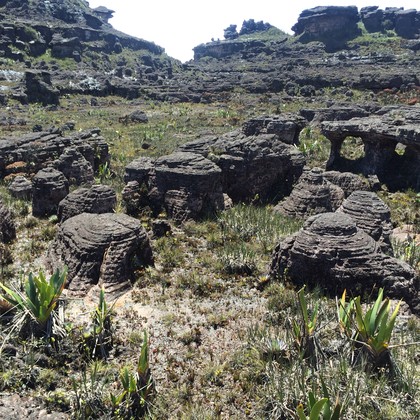
Edges and clearings of humid montane forest, scrub and elfin forest on the slopes and summits of the tepuis, from about 1000 to 2600 m. It forages at flowering shrubs and epiphytes, also in the low vegetation on the summits, and catches insects. The nest is a cup of moss and plant fibres on a branch or among roots.
Where the bird is most at home, classified by the vegetation units of Amazonia and the Guianas.

Range and movements
In Venezuela in southeastern Bolívar, on the tepuis of the Gran Sabana and surroundings, such as Roraima, Kukenán, Ptari and Chimantá. In Guyana on the tepuis of the Pakaraima Mountains. In Brazil only in the far north of Roraima, on Mount Roraima. Absent from Suriname and French Guiana.
- Resident
- dark = core range, pale = thinly spread
How and when to look
Look along the forest edges of the higher tepui slopes in the Gran Sabana and on the summits, for example on the ascent of Roraima, especially at flowering shrubs.
Conservation status
Least Concern. The range is small but remote and largely protected; fires on the slopes locally affect the forest.
Scientific name
Campylopterus hyperythrus | Cabanis, 1849
Cabanis described the species in 1849 and placed it straight away in the genus where it still stands. The genus Campylopterus was introduced in 1827 by Swainson. Campylopterus is Greek, from kampulos 'curved' and pteron 'wing', after the thickened, curved shafts of the outer primaries. hyperythrus is Greek, from hupo 'below' and eruthros 'red', after the rufous underparts. The specimen the first description was based on came from Mount Roraima, Guyana.