All species › Passerines › Tanagers and allies › Duida Grass Finch
Duida Grass Finch | Emberizoides duidae
Duidagrasgors | Sabanero del Duida | Canário-do-duida
The Duida Grass Finch is a grass finch known only from the grasslands on the summit of Cerro Duida, a tepui in southern Venezuela. It is sometimes treated as a subspecies of Wedge-tailed Grass Finch. Very little is known about its life history.
No photograph of a living wild bird of this species with a suitable Creative Commons licence exists. Do you have one that meets the rules? Send it in.
Voice
The voice has hardly been described. It is probably similar to the short series of clear whistles of Wedge-tailed Grass Finch.
No recording with a suitable Creative Commons licence is available for this species yet.
Identification
19–20 cm, about half of it tail. Built like Wedge-tailed Grass Finch, with a long, pointed, graduated tail, but darker: the upperparts are dark brown with broad black streaks, the underparts dull white with darker ochre-brown flanks. It has a pale eye-ring, yellow at the bend of the wing and a dark upper mandible with a pale lower mandible. The sexes are alike; young birds have not been described.
Confusion species
Wedge-tailed Grass Finch Emberizoides herbicola lives in lowland savannas and the Gran Sabana, not on the summit of Cerro Duida, and is paler and more ochre. No other birds with such a long, pointed tail occur in the grasslands on the tepui.
Habitat
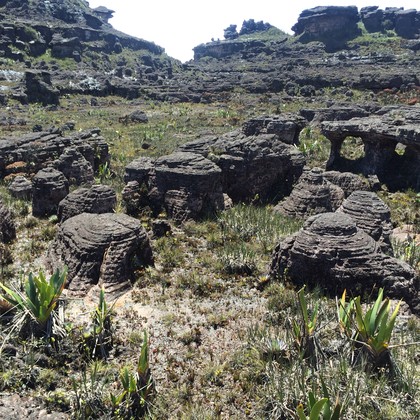
Grassland and open shrubby vegetation on sandstone on the summit and upper slopes of Cerro Duida, from about 1300 to 2100 m. Food and nest have not been described; like related grass finches it probably eats insects and seeds low in the grass.
Where the bird is most at home, classified by the vegetation units of Amazonia and the Guianas.
Range and movements
Known only from Cerro Duida in Amazonas state in southern Venezuela. There are only a few records, mostly from early expeditions. It occurs nowhere outside the guide area.
How and when to look
The summit of Cerro Duida can only be reached by helicopter or on an expedition and lies in a protected area for which a permit is required. A long-tailed grass finch in the grasslands on the summit is almost certainly this species.
Conservation status
Data Deficient. The population size and exact range are unknown. Its habitat on the isolated summit lies far from roads and settlements and as far as known is not directly threatened, but fires may locally damage the grasslands.
Scientific name
Emberizoides duidae | Chapman, 1929
Chapman described the species in 1929 and placed it straight away in the genus where it still stands. The genus Emberizoides was introduced in 1822 by Temminck. Emberizoides is formed from Emberiza (buntings) and Greek -oidēs 'resembling': 'bunting-like', after its bunting-like appearance. duidae refers to Cerro Duida, the tepui in the Venezuelan state of Amazonas where the species was discovered. The specimen the first description was based on came from Cerro Duida, Amazonas, Venezuela.