All species › Passerines › Tanagers and allies › Lesser Grass Finch
Lesser Grass Finch | Emberizoides ypiranganus
Kleine grasgors | Coludo chico | Canário-do-brejo
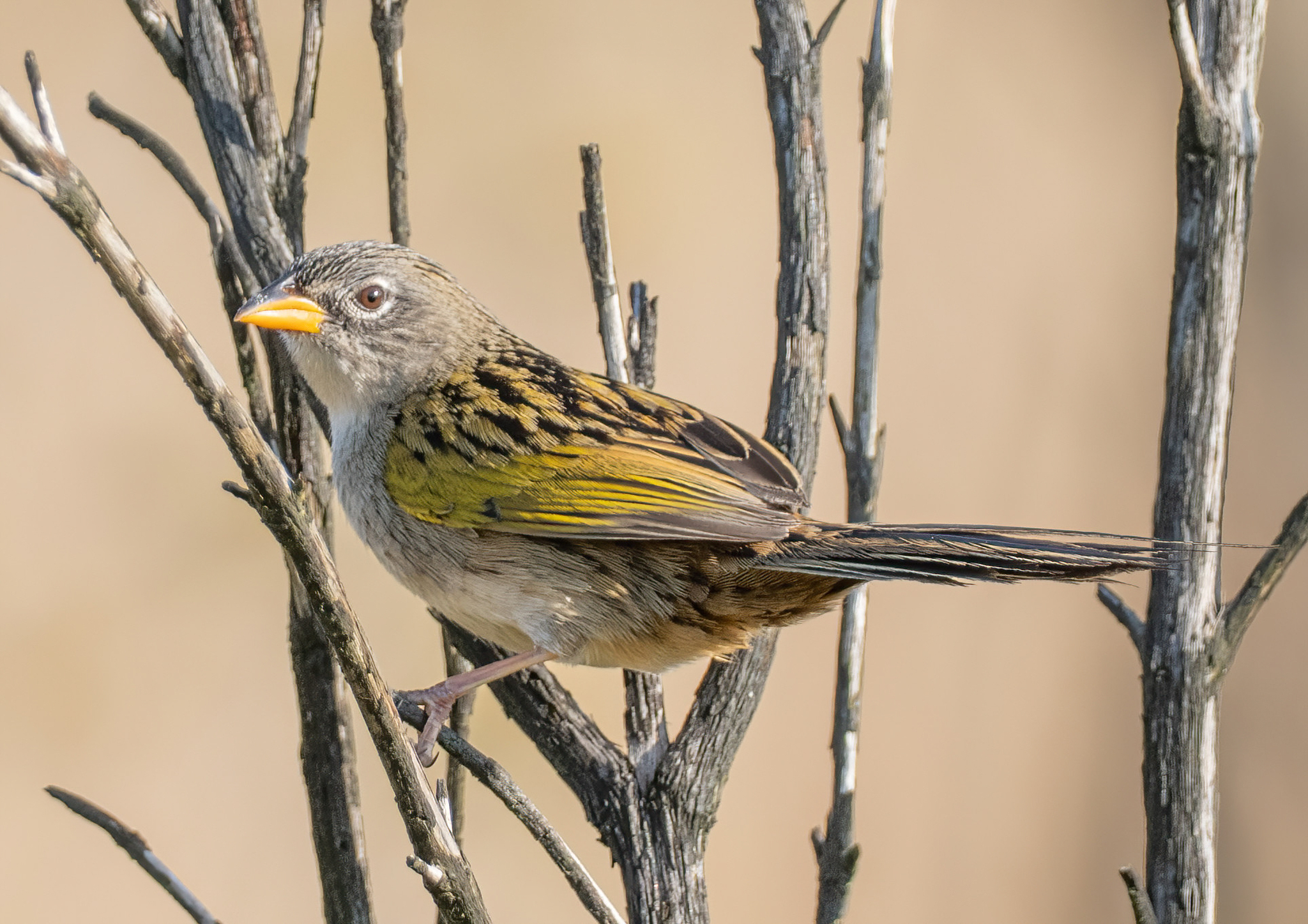
The Lesser Grass Finch is the smallest grass finch, a streaked bird with a long, pointed tail of wet grassland and marsh edges in southern and south-eastern Brazil. It lives hidden in tall, damp grass and is usually noticed when it sings from a grass stem.
Voice
The song is a short, high series of whistles with a nasal quality, higher and thinner than that of Wedge-tailed Grass Finch. The call is a short tseep.
Recording: Guillermo Treboux — CC BY-NC-SA 4.0 · shortened to the first 60 s, mono · xeno-canto
Identification
17–18 cm, almost half of it tail. The upperparts are brown with broad black streaks, the head greyer than in Wedge-tailed Grass Finch, with dark lores and cheeks and a narrow white eye-ring. The underparts are whitish, with little ochre on breast sides and flanks. Yellow at the bend of the wing. The upper mandible is dark, the lower mandible yellow. The sexes are alike. Young birds are yellower below and lightly streaked.
Confusion species
Wedge-tailed Grass Finch Emberizoides herbicola is larger and more ochre, with a paler head lacking dark cheeks, and lives mainly in drier savannas; where both occur, habitat and song help with identification. Pampa Finch Embernagra platensis is much bulkier and olive-green, with a heavy orange-yellow bill. Grassland Sparrow Ammodramus humeralis has a short tail and a yellow loral spot.
Habitat
Wet grassland, marsh edges and damp tall grass along streams and in hollows, also in upland grasslands of the south, from the lowlands up to about 1200 m. It forages low in the grass for insects and seeds. The nest is a cup of grass in a tussock.
Where the bird is most at home, classified by the vegetation units of Amazonia and the Guianas.




Range and movements
In Brazil from Rio Grande do Sul, Santa Catarina and Paraná to São Paulo, and locally further north in the south-east, including the high-altitude grasslands of Minas Gerais and Rio de Janeiro. Not in Amazonia, Venezuela or the Guianas. Outside the guide area in eastern Paraguay and north-eastern Argentina.
- Resident
- dark = core range, pale = thinly spread
How and when to look
Search the wet grasslands and marsh edges of the uplands of Paraná, Santa Catarina and Rio Grande do Sul, for example around the Campos Gerais, early in the morning for birds singing on grass stems. Check every grass finch for the grey head with dark cheeks.
Conservation status
Least Concern. Drainage of wet grassland and conversion to cropland and tree plantations reduce its habitat locally.
Scientific name
Emberizoides ypiranganus | Ihering & Ihering, 1907
Ihering & Ihering described the species in 1907 and placed it straight away in the genus where it still stands. The genus Emberizoides was introduced in 1822 by Temminck. Emberizoides is formed from Emberiza (buntings) and Greek -oidēs 'resembling': 'bunting-like', after its bunting-like appearance. ypiranganus refers to Ypiranga (Ipiranga) in southern Brazil, the locality from which the species was described. The specimen the first description was based on came from Ypiranga, given as São Paulo (according to Jobling = Ipiranga, Paraná), southern Brazil.