All species › Passerines › Tyrant flycatchers and allies › Eastern Wood Pewee
Eastern Wood Pewee | Contopus virens
Oostelijke bospiewie | Pibí oriental | Piuí-verdadeiro
Eastern Wood Pewee breeds in deciduous and mixed forest in eastern North America and winters from Central America to western Amazonia. In the guide area it is a passage migrant in western Venezuela and a winter visitor to south-western Amazonia in Brazil. It perches upright on an open branch at the forest edge or in the canopy.
Voice
The song is a clear, whistled, drawn-out pee-a-wee with a rising final note, alternating with a descending pee-yoo; also heard on the wintering grounds and in spring away from the breeding range. The call is a dry chip or a short, rising pweet.
Recording: Rory Nefdt — CC BY-NC-SA 4.0 · xeno-canto
Identification
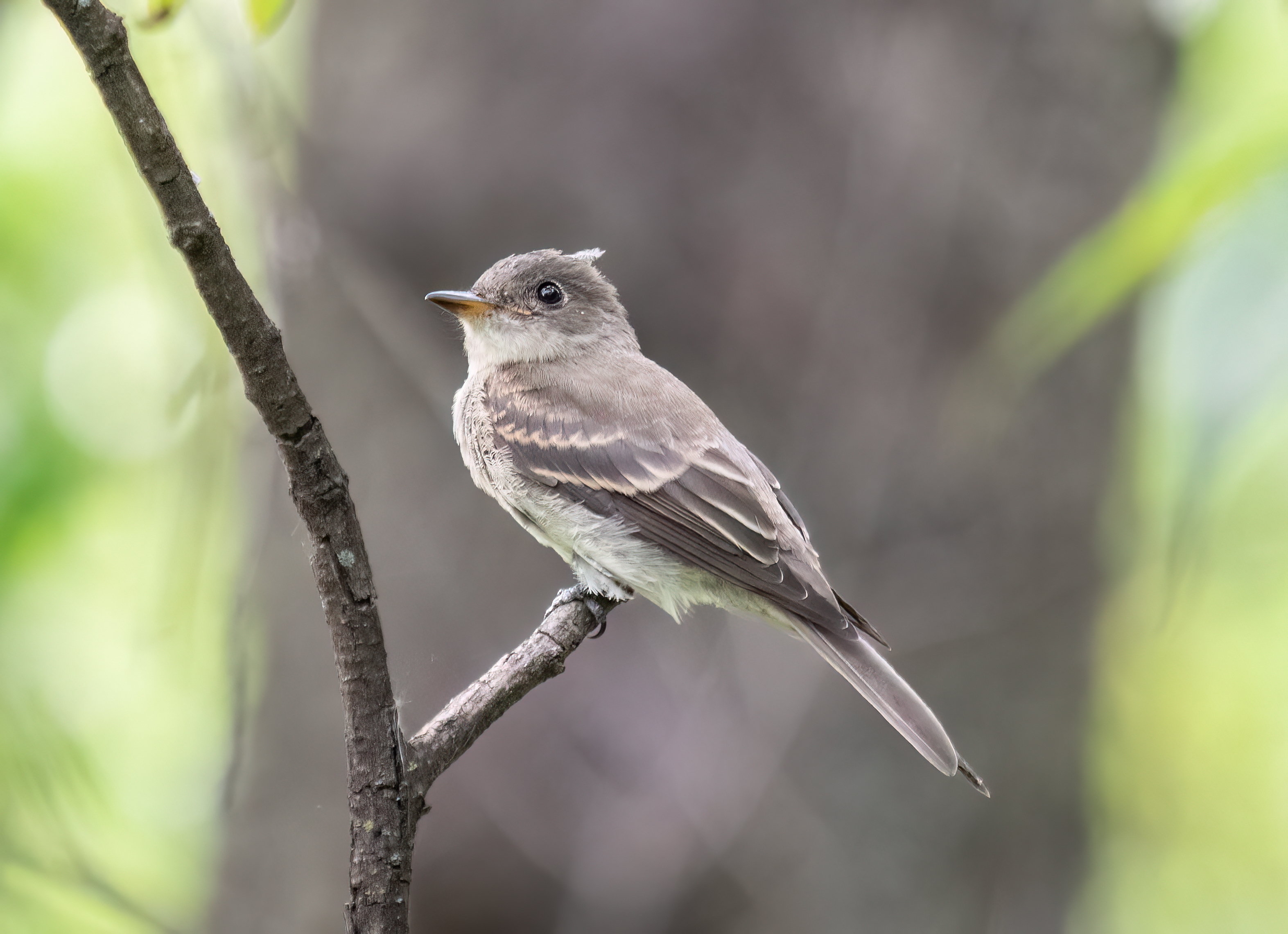
13.5–15 cm, slender, with long, pointed wings, a long primary projection, a slight crest and a fairly long tail. The upperparts are greyish olive. The breast is greyish with an olive wash, forming a vest that is paler in the middle; throat and belly are white to yellowish white. The wings have two distinct whitish wing bars. The upper mandible is dark, the lower mostly orange or yellowish, sometimes with a dark tip. Young birds have paler yellow to buff wing bars.
Confusion species
Western Wood Pewee Contopus sordidulus is almost identical but averages darker and more uniform on the breast, with a darker lower mandible; it can only be separated with certainty by call. Southern Tropical Pewee Contopus cinereus has pale lores, a darker crown and shorter wings. Olive-sided Flycatcher Contopus cooperi is larger, with a white central strip between dark flanks. Empidonax flycatchers are smaller, with an eye-ring and shorter wings.
Habitat
On the wintering grounds forest edges, clearings, riverside forest and várzea along rivers, secondary forest and tall trees in semi-open country, mainly in the lowlands and at the foot of the mountains up to about 1500 m. It perches on an open branch in the middle or upper storey, sallies after flying insects and often returns to the same perch.
Where the bird is most at home, classified by the vegetation units of Amazonia and the Guianas.




Range and movements
Venezuela: passage migrant and scarce winter visitor, mainly in the west and north (Zulia, Falcón, the foot of the Andes in Táchira and Mérida), also in Bolívar; mainly in September–November and March–April. Brazil: winter visitor to south-western Amazonia, mainly Acre, Rondônia, western Amazonas and northern Mato Grosso; further east and south only scattered records. French Guiana: a few records. Guyana and Suriname: no confirmed records. Outside the guide area it breeds from south-eastern Canada to the Gulf Coast and Florida and winters from Costa Rica to northern Bolivia.
- Winter visitor (c. Oct–Mar)
- Passage (Mar–Apr, Oct–Nov)
- dark = core range, pale = thinly spread
How and when to look
Search from November to March at forest edges and along rivers in Acre and Rondônia for a pewee on an open branch in the canopy; in western Venezuela during migration. A slender pewee with distinct wing bars and long wings giving a clear pee-a-wee is this species.
Conservation status
Least Concern (IUCN). The species is common on its breeding grounds, but has gradually declined there in recent decades; on the wintering grounds deforestation in western Amazonia plays a role.
Scientific name
Contopus virens | (Linnaeus, 1766)
Linnaeus described the species in 1766 as [Muscicapa] virens; because it was later moved to another genus, the author and year stand in brackets. The genus Contopus was introduced in 1855 by Cabanis. Contopus is Greek, from kontos 'pole, shaft' and pous 'foot', after the short legs. virens is Latin for 'green', after the olive tinge of the upperparts. The specimen the first description was based on came from Carolina (USA).