All species › Passerines › Tyrant flycatchers and allies › Northern Tropical Pewee
Northern Tropical Pewee | Contopus bogotensis
Noordelijke Spix' piewie | Pibí tropical norteño | Piuí-tropical-do-norte
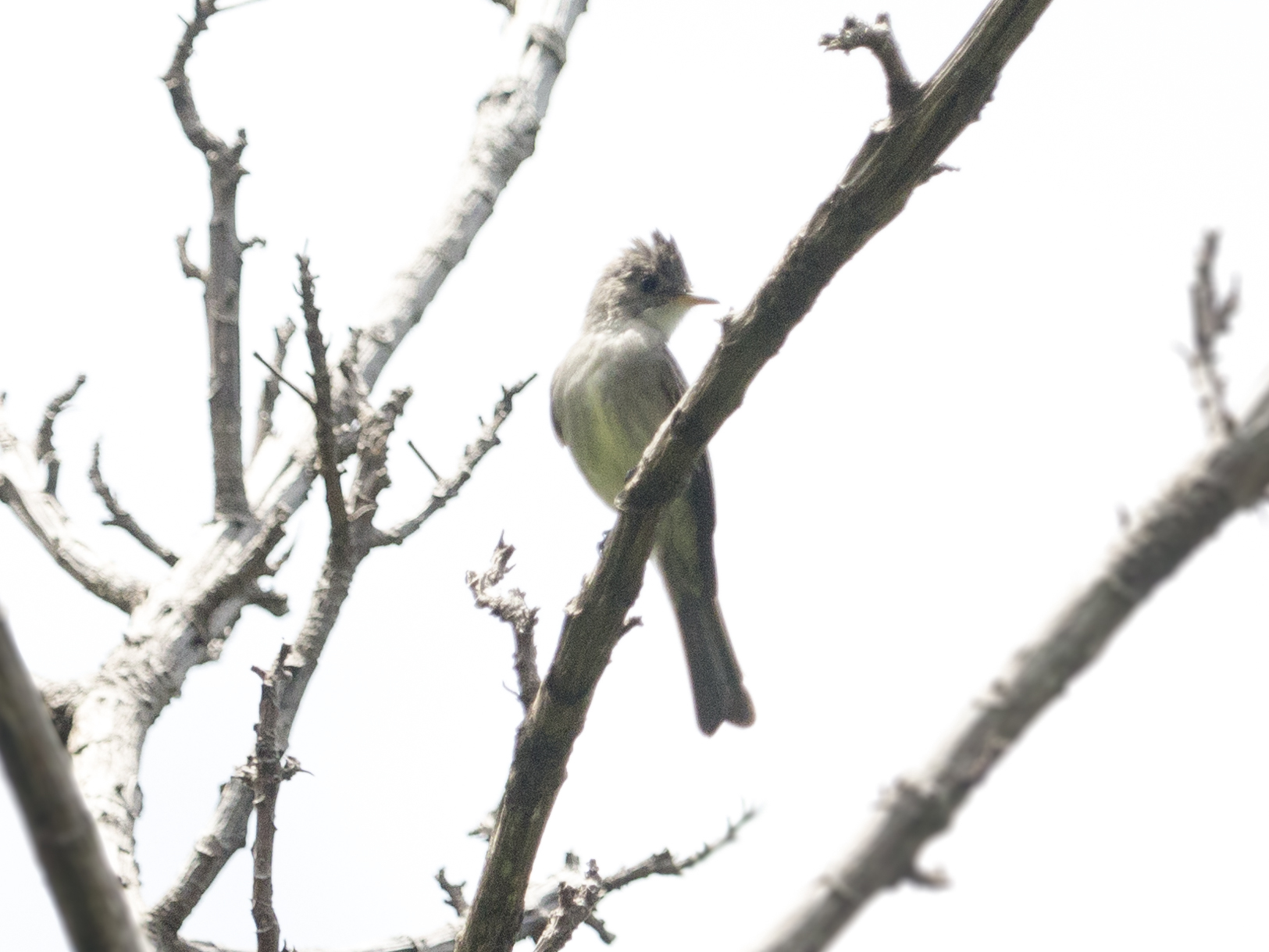
The Northern Tropical Pewee is a small, greyish olive pewee of forest edges, gallery forest and semi-open country with trees. In the guide area it occurs in Venezuela, the Guianas and northern Brazil. It perches low to mid-level on an open branch and sallies from there after insects. It has been split from the more southerly Southern Tropical Pewee Contopus cinereus.
Voice
Calls with a sharp peet and a quick, dry trill, pree-ee-ee, often repeated at dawn.
No recording with a suitable Creative Commons licence is available for this species yet.
Identification
14–15 cm, with a slightly peaked crown and a fairly long tail. Upperparts dark greyish olive, crown darker. Lores pale grey to whitish. Throat pale grey; breast greyish olive, belly pale yellowish white. Wings fairly short for a pewee, with dull greyish wing bars. Lower mandible yellow to orange-yellow, upper mandible dark. Male and female are alike.
Confusion species
Southern Tropical Pewee Contopus cinereus is very similar but lives further south, in southern and south-eastern Brazil; the two do not overlap in the guide area. Eastern Wood Pewee Contopus virens and Western Wood Pewee Contopus sordidulus (winter visitors from the north) are slightly larger, with longer wings that extend further beyond the upper tail coverts and dark lores. Euler's Flycatcher Lathrotriccus euleri has an eye-ring, buffy wing bars and a yellowish belly; Fuscous Flycatcher Cnemotriccus fuscatus is browner, with a pale supercilium.
Habitat
Forest edges, clearings and secondary woodland, gallery forest, savanna and pasture with scattered trees, mangrove edges and shade plantations, mainly in the lowlands and foothills up to about 1200 m. It perches fairly low on an open branch and often returns to the same spot after a sally.
Where the bird is most at home, classified by the vegetation units of Amazonia and the Guianas.






Range and movements
Venezuela: in the north in the coastal range, around Lake Maracaibo, at the foot of the Andes and in the Llanos, and in the south in Bolívar and Amazonas. Guyana, Suriname and French Guiana: mainly in the coastal region and the savannas. Northern Brazil: Roraima, northern Amazonas, Pará and Amapá. Not in southern and south-eastern Brazil, where Southern Tropical Pewee lives. Outside the guide area in Colombia, on Trinidad and from south-eastern Mexico through Central America.
- Resident
- dark = core range, pale = thinly spread
How and when to look
Found along forest edges and in gallery forest in the Llanos and the savannas of Roraima and the Guianas; it often perches in the open on a low dead branch. A small pewee with pale lores and short wings is this species; a pewee with dark lores and long wings between October and April is more likely a wood pewee.
Conservation status
Least Concern (IUCN). Fairly common in semi-open lowlands; benefits partly from clearings and forest edges.
Scientific name
Contopus bogotensis | (Bonaparte, 1850) (GBIF: Contopus cinereus)
Bonaparte described the species in 1850 as Tyrannula bogotensis; because it was later moved to another genus, the author and year stand in brackets. The genus Contopus was introduced in 1855 by Cabanis. Contopus is Greek, from kontos 'pole, shaft' and pous 'foot', after the short legs. bogotensis refers to Bogotá in Colombia, the source of the type specimen (a trade 'Bogotá' skin). The specimen the first description was based on came from Bogotá, Colombia.