All species › Passerines › Ovenbirds and woodcreepers › Elegant Woodcreeper
Elegant Woodcreeper | Xiphorhynchus elegans
Druppelmuisspecht | Trepatroncos elegante | Arapaçu-elegante
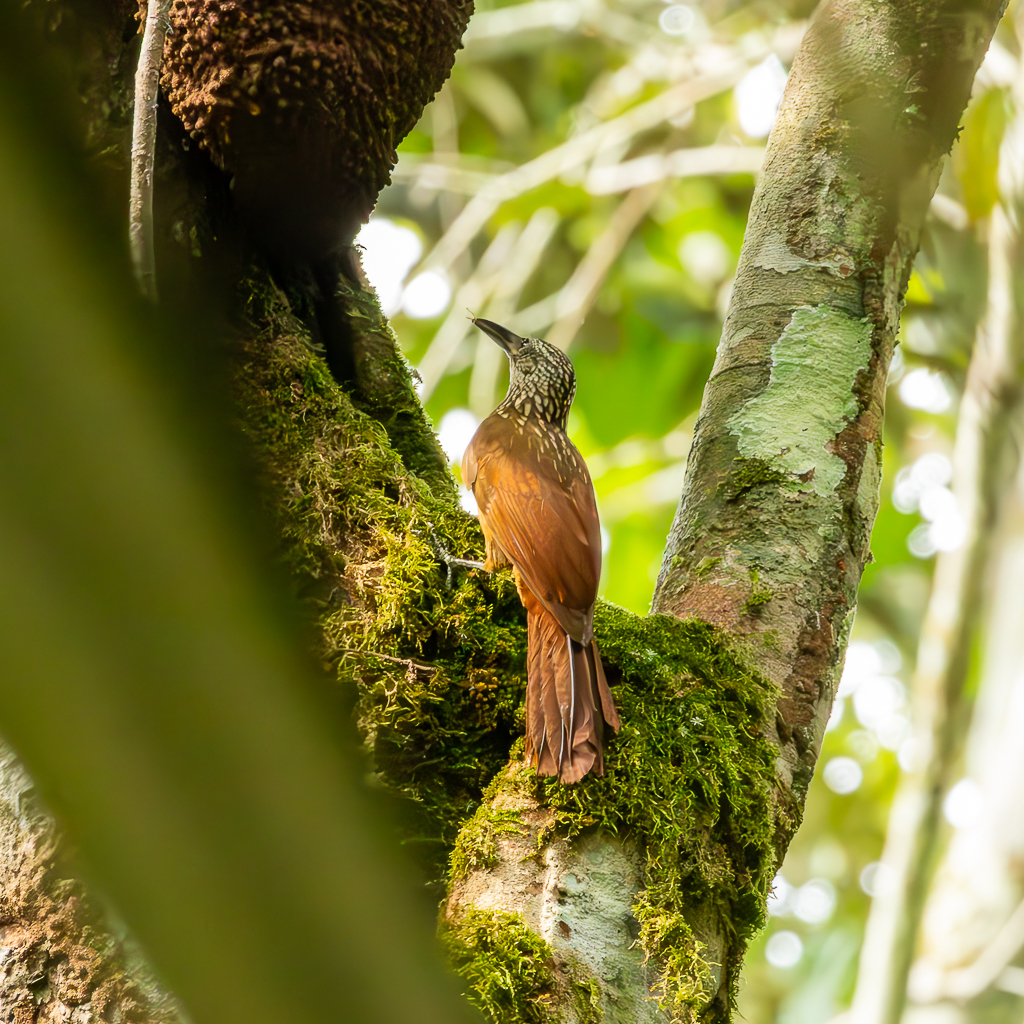
This medium-sized woodcreeper, Xiphorhynchus elegans, lives in rainforest in the west and south of the Amazon Basin. It differs from related species in having pale drops and streaks not only on the breast but also on the mantle. In the guide area it lives mainly south of the Amazon, west of the Rio Tapajós.
Voice
The song is a descending series of about thirty clear, ringing whistles that starts softly and slows at the end, mainly in the morning and evening twilight. The call consists of sharp chip notes followed by a whining sound.
Recording: JAYRSON ARAUJO DE OLIVEIRA — CC BY-NC-SA 4.0 · xeno-canto
Identification
19–22 cm, with a fairly slender, slightly decurved bill: the upper mandible dark, the lower paler. The upperparts are olive-brown; crown, nape and mantle have buff drops and short streaks with dark edges. Rump, wings and tail are rufous. The throat is buff. Breast and upper belly show buff, dark-edged drops. The sexes are alike.
Confusion species
Spix's Woodcreeper Xiphorhynchus spixii is almost identical in appearance but lives east of the Rio Tapajós; voice and range separate the two. Ocellated Woodcreeper Xiphorhynchus ocellatus has an almost plain mantle and pale drops mainly on crown and nape. Buff-throated Woodcreeper Xiphorhynchus guttatus is larger, with a long, paler bill. Striped Woodcreeper Xiphorhynchus obsoletus is streaked rather than spotted and lives in flooded forest.
Habitat
The interior and edges of humid evergreen rainforest, mainly terra firme, locally in várzea, igapó and bamboo forest, also in mature secondary forest. In the lowlands, mostly below 600 m. It climbs trunks in the lower and middle strata and searches bark, moss and dead leaves for insects and spiders. It follows mixed flocks and sometimes army ants. The nest is in a cavity in a trunk.
Where the bird is most at home, classified by the vegetation units of Amazonia and the Guianas.




Range and movements
Brazil: in the west and south of the Amazon region, mainly south of the Amazon, from Acre and western Amazonas east to the Rio Tapajós, and south into Rondônia and northern Mato Grosso. Absent from Venezuela, Guyana, Suriname and French Guiana. Outside the guide area in south-eastern Colombia, eastern Ecuador and Peru, and northern Bolivia.
- Resident
- dark = core range, pale = thinly spread
How and when to look
Look in terra firme rainforest in Rondônia, Acre or along the west bank of the Tapajós for mixed flocks in the understorey, and check the mantle of every medium-sized woodcreeper: pale drops there point to this species. The descending series of whistles is heard mainly at twilight.
Conservation status
Least Concern. The species has a large range but depends on unbroken forest and declines where the Amazon forest is cleared, as in Rondônia and northern Mato Grosso.
Scientific name
Xiphorhynchus elegans | (Pelzeln, 1868)
Pelzeln described the species in 1868 as Dendrornis elegans; because it was later moved to another genus, the author and year stand in brackets. The genus Xiphorhynchus was introduced in 1827 by Swainson. Xiphorhynchus is Greek, from xiphos 'sword' and rhunkhos 'bill', after the long, straight bill. elegans is Latin for 'elegant, fine', after the neatly spotted plumage. The specimen the first description was based on came from Engenho do Gama, Mato Grosso, Brazil.