All species › Passerines › Ovenbirds and woodcreepers › Spix's Woodcreeper
Spix's Woodcreeper | Xiphorhynchus spixii
Spix' muisspecht | Trepatroncos de Spix | Arapaçu-de-spix
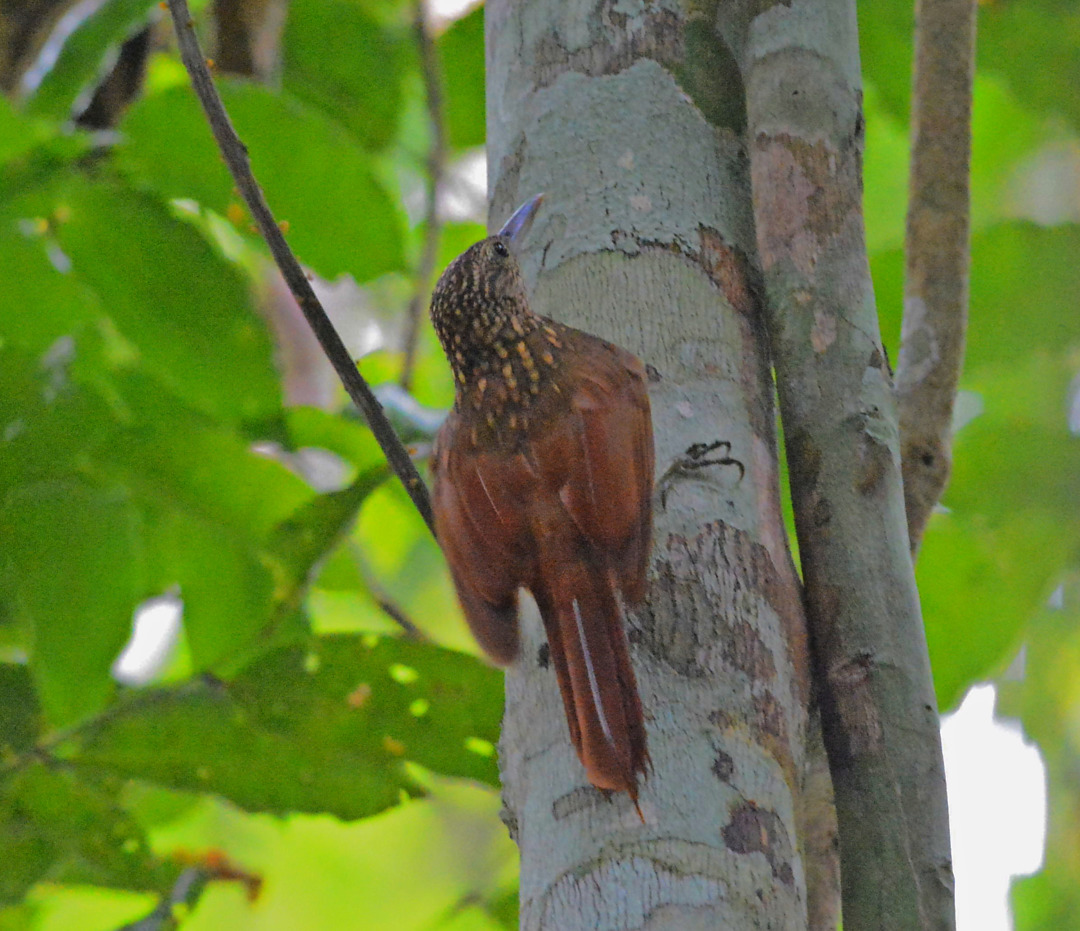
Spix's Woodcreeper is a medium-sized, spotted woodcreeper of rainforest in the eastern Brazilian Amazon, south of the Amazon. It occurs only in Brazil. Xiphorhynchus elegans used to be treated as a subspecies of this species; the two are very similar and replace each other on either side of the Rio Tapajós.
Voice
The song is a high, very fast trill, faster than the song of Xiphorhynchus elegans, mainly at twilight. The call consists of sharp chip notes followed by a whining sound.
Recording: JAYRSON ARAUJO DE OLIVEIRA — CC BY-NC-SA 4.0 · xeno-canto
Identification
19–21 cm, with a slender, slightly decurved bill: the upper mandible dark, the lower paler. The upperparts are olive-brown; crown, nape and mantle have buff drops and streaks with dark edges. Rump, wings and tail are rufous. The throat is buff; the breast has pale, dark-edged drops. The sexes are alike. It differs from Xiphorhynchus elegans mainly in voice and range.
Confusion species
Xiphorhynchus elegans is almost identical in appearance and lives west of the Rio Tapajós; its song is a slower, descending series of whistles. Buff-throated Woodcreeper Xiphorhynchus guttatus is larger, with a long, heavy bill; birds in this part of Amazonia have a dark bill. Striped Woodcreeper Xiphorhynchus obsoletus is streaked rather than spotted and lives in flooded forest. Wedge-billed Woodcreeper Glyphorynchus spirurus is much smaller, with a very short bill.
Habitat
The interior of humid terra firme rainforest, locally also flooded forest and mature secondary forest, in the lowlands. It climbs trunks in the lower and middle strata and searches bark, moss and dead leaves for insects and spiders, often in mixed flocks. The nest is in a cavity in a trunk.
Where the bird is most at home, classified by the vegetation units of Amazonia and the Guianas.



Range and movements
Brazil: only in the Amazon region south of the Amazon, from the Rio Tapajós east to the Rio Tocantins and western Maranhão, south into northern Mato Grosso. Absent from Venezuela, Guyana, Suriname and French Guiana. Does not occur outside the guide area.
- Resident
- dark = core range, pale = thinly spread
How and when to look
Look in the rainforest of the Floresta Nacional do Tapajós near Santarém or around Carajás in Pará for mixed flocks in the understorey. A medium-sized woodcreeper with a spotted mantle east of the Tapajós is this species; a sound recording confirms the identification.
Conservation status
Least Concern, but the species is losing habitat to large-scale deforestation in the eastern Brazilian Amazon, especially in Pará and Maranhão, where forest gives way to pasture and fields.
Scientific name
Xiphorhynchus spixii | (Lesson, 1830)
Lesson described the species in 1830 as Picolaptes Spixii; because it was later moved to another genus, the author and year stand in brackets. The genus Xiphorhynchus was introduced in 1827 by Swainson. Xiphorhynchus is Greek, from xiphos 'sword' and rhunkhos 'bill', after the long, straight bill. spixii honours the German naturalist Johann Baptist von Spix (1781–1826), who travelled through Brazil in 1817–1820. The specimen the first description was based on came from Pará, Brazil.