All species › Passerines › Tanagers and allies › Greater Flowerpiercer
Greater Flowerpiercer | Diglossa major
Grote berghoningkruiper | Pinchaflor grande | Fura-flor-grande
The Greater Flowerpiercer is the largest flowerpiercer and lives only on the tepuis of southeastern Venezuela and adjacent parts of Guyana and Brazil. It is endemic to the guide area and one of the characteristic birds of the scrub on tepui summits. On Roraima it also forages around the campsites.
Voice
The song is a long, high, squeaky and twittering series of notes, often long sustained; the call is a sharp tsit.
Recording: JAYRSON ARAUJO DE OLIVEIRA — CC BY-NC-SA 4.0 · xeno-canto
Identification
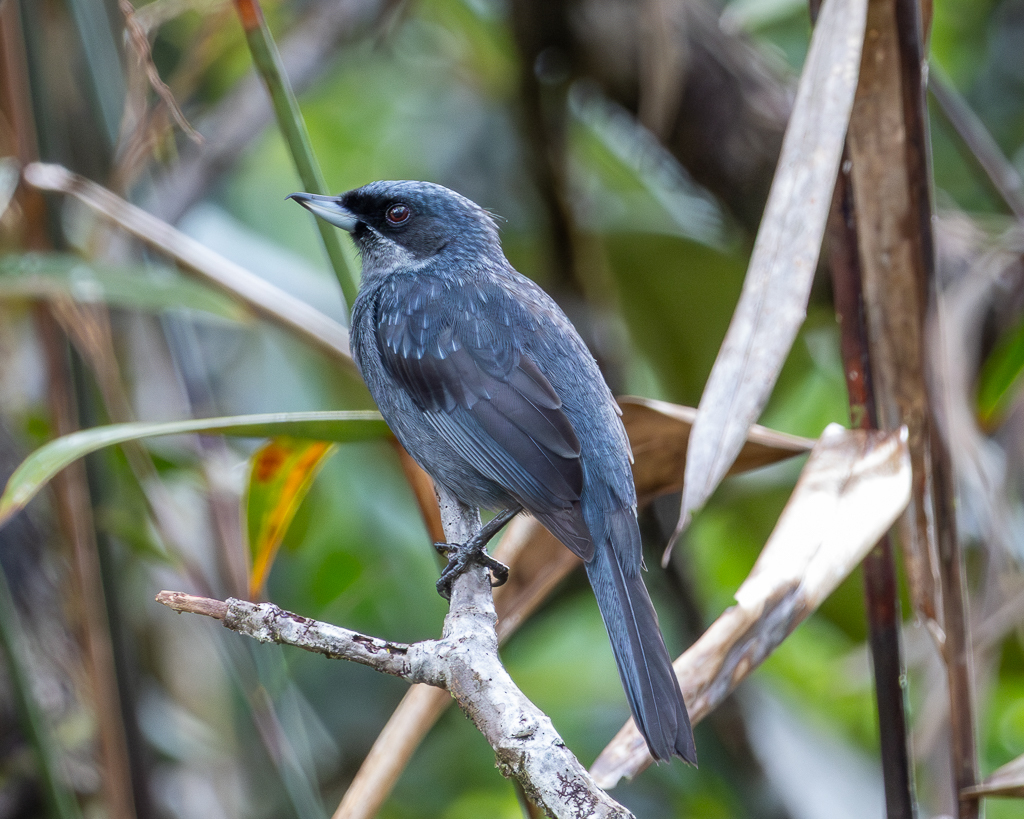
16–17 cm, with a strong, upturned black bill with a small hook at the tip. The plumage is dark blue-grey, with fine silvery-white streaks on the crown and back, a black mask around bill and eye and a white moustachial stripe. The undertail coverts are chestnut. The sexes are alike; juveniles are duller and browner, with less streaking.
Confusion species
Scaled Flowerpiercer Diglossa duidae of the western tepuis is smaller and darker, without a white moustachial stripe and without chestnut undertail coverts. The male Paramo Seedeater Catamenia homochroa is smaller, uniform grey, with a thick pink bill.
Habitat
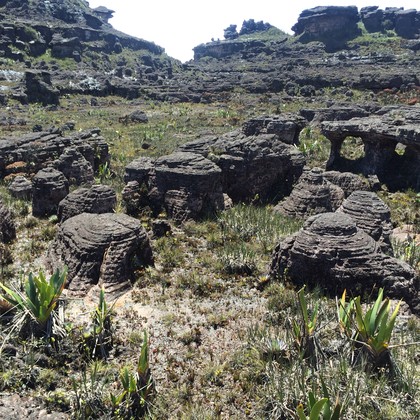
Scrub, elfin forest and the edges of montane forest on the summits and upper slopes of the tepuis, roughly between 1300 and 2800 m. It takes nectar from flowering shrubs, partly by piercing corollas at the side, and also eats insects and berries. The nest is a cup in a shrub.
Where the bird is most at home, classified by the vegetation units of Amazonia and the Guianas.

Range and movements
A resident of the tepuis of eastern Bolívar in Venezuela, such as Roraima, Kukenán, Ptari, Chimantá and Auyán-tepui. In Guyana on Roraima and the tepuis of the adjacent Pakaraima Mountains. In Brazil only on Monte Roraima and the border mountains of northern Roraima. Absent from Suriname and French Guiana. The species does not occur outside the guide area.
- Resident
- dark = core range, pale = thinly spread
How and when to look
The trek to the summit of Roraima from Paraitepui in the Gran Sabana is the usual way to see it. On the summit it forages in the low scrub between the rocks and is often the bird seen most.
Conservation status
Least Concern. The range is small, but the habitat on the tepui summits is largely intact. Fires on the slopes and increasing visitor numbers on Roraima are local concerns.
Scientific name
Diglossa major | Cabanis, 1849
Cabanis described the species in 1849 and placed it straight away in the genus where it still stands. The genus Diglossa was introduced in 1832 by Wagler. Diglossa is Greek, from diglōssos 'double-tongued' (di- 'double', glōssa 'tongue'), after the split tongue of these nectar-feeders. major is Latin for 'greater', as it is the largest flowerpiercer. The specimen the first description was based on came from Mount Roraima, Bolívar, Venezuela.