All species › Passerines › Tanagers and allies › Scaled Flowerpiercer
Scaled Flowerpiercer | Diglossa duidae
Schubborstberghoningkruiper | Pinchaflor del Duida | Fura-flor-escamado
The Scaled Flowerpiercer is a dark flowerpiercer that lives only on the tepuis of southern Venezuela and adjacent northern Brazil. It is endemic to the guide area and owes its name to the pale scaling on the throat and breast. The scientific name refers to Cerro Duida in Amazonas.
No photograph of a living wild bird of this species with a suitable Creative Commons licence exists. Do you have one that meets the rules? Send it in.
Voice
The song is a rapid, high, twittering series of notes; the call is a short tsit. The voice is poorly described.
No recording with a suitable Creative Commons licence is available for this species yet.
Identification
14 cm, with an upturned black bill with a small hook at the tip. The plumage is dark slate-grey to sooty black, with a blackish head; throat and breast have pale grey feather edges that give a scaled pattern. The belly is greyer and less marked. The sexes are nearly alike; juveniles are browner and plainer.
Confusion species
Greater Flowerpiercer Diglossa major is larger, blue-grey, with a white moustachial stripe and chestnut undertail coverts, and lives mainly on the eastern tepuis. The male Paramo Seedeater Catamenia homochroa is uniform grey, with a thick pink bill and a chestnut vent.
Habitat
Forest edges, elfin forest and scrub on the slopes and summits of the tepuis, roughly between 1300 and 2600 m. It searches flowering shrubs for nectar, which it steals by piercing corollas at the side, and also eats insects. Little is known about the nest.
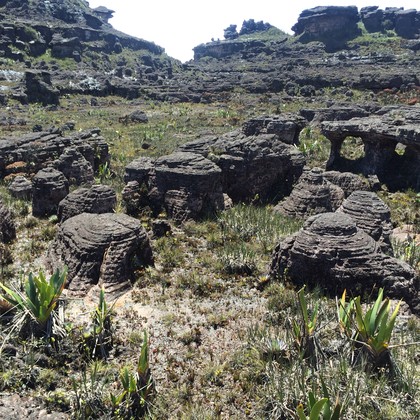
Where the bird is most at home, classified by the vegetation units of Amazonia and the Guianas.

Range and movements
A resident of the tepuis of Amazonas in southern Venezuela, such as Duida, Marahuaca, Parú, Yaví and Sipapo, and locally in western Bolívar. In Brazil only on Pico da Neblina and in the border mountains of northern Amazonas state. Absent from the Guianas. The species does not occur outside the guide area.
- Resident
- dark = core range, pale = thinly spread
How and when to look
The tepuis where it lives can be reached only by helicopter or on a long expedition. Pico da Neblina can be climbed from Brazil with permission from the national park authorities and the indigenous communities.
Conservation status
Least Concern. Its habitat on the remote tepuis is hardly affected by people.
Scientific name
Diglossa duidae | Chapman, 1929
Chapman described the species in 1929 and placed it straight away in the genus where it still stands. The genus Diglossa was introduced in 1832 by Wagler. Diglossa is Greek, from diglōssos 'double-tongued' (di- 'double', glōssa 'tongue'), after the split tongue of these nectar-feeders. duidae refers to Cerro Duida, a tepui in southern Venezuela where the species was discovered. The specimen the first description was based on came from Cerro Duida, Amazonas, Venezuela.