All species › Swifts › Hummingbirds › Green-tailed Emerald
Green-tailed Emerald | Chlorostilbon alice
Groenstaartsmaragdkolibrie | Esmeralda coliverde | Esmeralda-de-cauda-verde
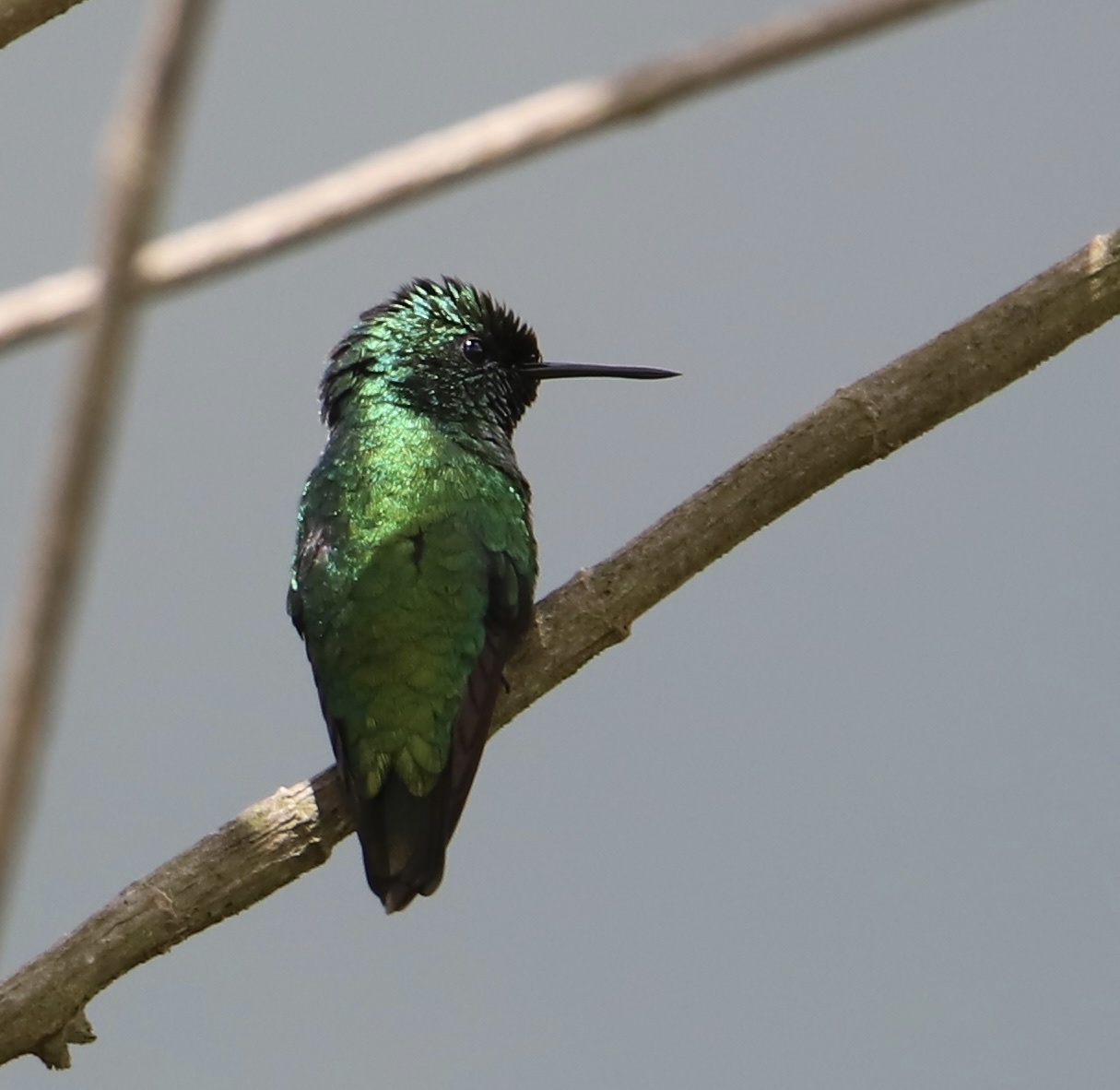
The Green-tailed Emerald is a small green hummingbird found only in the mountains of northern Venezuela. The male differs from related emeralds in its bronzy green, not blue, tail. The species lives along forest edges and also occurs in coffee plantations, parks and gardens.
Voice
A dry, short chik or tik, often in series. The song is a soft, twittering series from a perch.
No recording with a suitable Creative Commons licence is available for this species yet.
Identification
7–8.5 cm, the female slightly smaller, with a short, straight, black bill and a slightly forked tail. The male is bronzy green above with a dark green crown, glittering grass-green below and has a bronzy green tail. The female is bronzy green above and pale grey below, with a white streak behind the eye, dark grey undertail coverts and a tail with green central feathers and outer feathers with a blackish band and grey tips. Young birds resemble the female.
Confusion species
Blue-tailed Emerald Chlorostilbon mellisugus has a steel-blue tail and lives mainly lower, in the lowlands and foothills. Short-tailed Emerald Chlorostilbon poortmani in the Andes of Táchira, Mérida and Trujillo has a clearly shorter tail, which in the male does not reach beyond the wingtips. Females of these species are very similar; check the tail colour and the habitat.
Habitat
Edges of humid and semi-humid montane forest, cloud forest, secondary forest, coffee plantations, parks, gardens and roadsides, locally also drier forest, from about 700 to 1800 m, sometimes higher. It often perches alone at mid-height near small flowers and defends flowering shrubs. The nest is a small cup of plant down and moss, low in a shrub.
Where the bird is most at home, classified by the vegetation units of Amazonia and the Guianas.




Range and movements
Only in Venezuela, in the mountains of the north: the northern part of the Andes and the Cordillera de la Costa from Falcón and Lara east to Miranda, and also in the mountains of the northeast (Sucre, Monagas). Absent from Brazil and the Guianas.
- Resident
- dark = core range, pale = thinly spread
How and when to look
Look along forest edges and in coffee plantations in the coastal range, for example in Henri Pittier and around Colonia Tovar, or in the mountains of Lara and Trujillo. Males often sit on a regular branch near flowering shrubs.
Conservation status
Least Concern. The range is small, but the species tolerates human-modified land; conversion of montane forest locally affects its habitat.
Scientific name
Chlorostilbon alice | (Bourcier & Mulsant, 1848)
Bourcier & Mulsant described the species in 1848 as Trochilus Alice; because it was later moved to another genus, the author and year stand in brackets. The genus Chlorostilbon was introduced in 1853 by Gould. Chlorostilbon is Greek, from khlōros 'green' and stilbōn 'shining', after the glittering green plumage. alice honours a certain Alice; Bourcier and Mulsant did not say whom they meant. The specimen the first description was based on came from Caracas, Venezuela.