All species › Swifts › Hummingbirds › Narrow-tailed Emerald
Narrow-tailed Emerald | Chlorostilbon stenurus
Smalstaartsmaragdkolibrie | Esmeralda colifina | Esmeralda-de-cauda-estreita
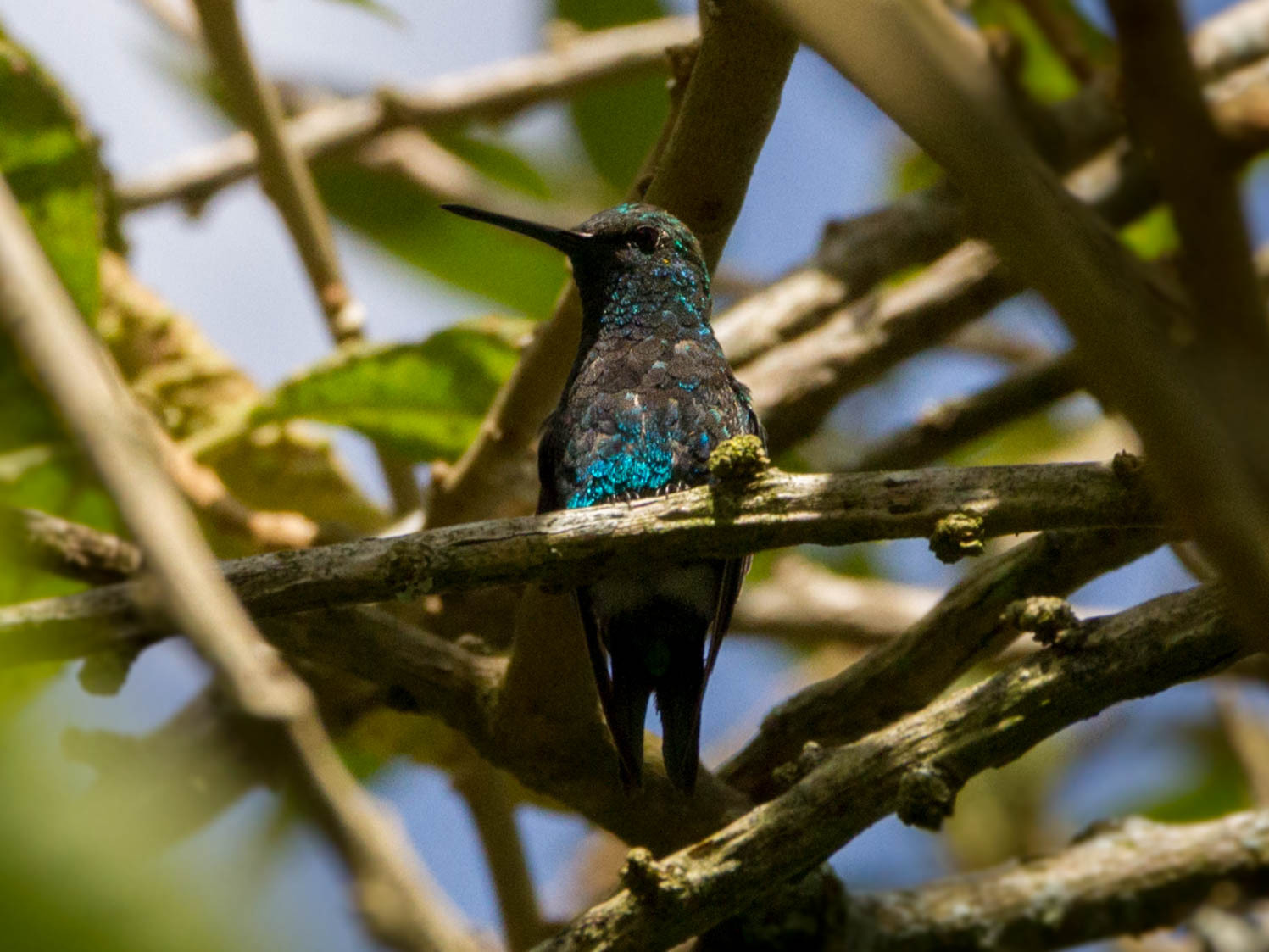
The Narrow-tailed Emerald is an emerald of the mountains of western Venezuela and adjacent eastern Colombia. The name refers to the very narrow, pointed outer tail feathers of the male. Little is known of its habits; sound recordings are scarce.
Voice
Hardly documented; presumably dry, short calls like those of other emeralds.
No recording with a suitable Creative Commons licence is available for this species yet.
Identification
7–9 cm; the male is larger than the female. The bill is short and black, slightly decurved in the female. The male is grass green above and glittering green below; the forked tail is dark green, with very narrow, dagger-shaped outer feathers. The female is dark green above, with a dull bronzy crown, and pale grey to whitish below; the central tail feathers are blue-green, the outer ones grey to dark blue with broad white tips.
Confusion species
Short-tailed Emerald Chlorostilbon poortmani has a shorter tail without narrow outer feathers; in the male it is bronzy green. Green-tailed Emerald Chlorostilbon alice in the Coastal Cordillera has a green tail with normally shaped outer feathers; some authors include it in the same species. Blue-tailed Emerald Chlorostilbon mellisugus lives lower, in open lowlands, and has a blue-black tail.
Habitat
Humid montane forest, forest edges, scrub and secondary forest, between about 1000 and 3000 m. It forages low, up to about 4 m above the ground, at small flowers, and catches small insects. It locally makes seasonal elevational movements. Little is known about the nest.
Where the bird is most at home, classified by the vegetation units of Amazonia and the Guianas.


Range and movements
In Venezuela in the Andes from Táchira to Trujillo and, as the form ignotus, in Lara and the adjoining mountains of the north-west; scarce and rarely reported. Absent from Brazil and the Guianas. Outside the guide area only on the east side of the Eastern Andes of Colombia, south to Meta.
- Resident
- dark = core range, pale = thinly spread
How and when to look
In montane forest and scrub in the Venezuelan Andes, look for emeralds with a forked, green tail and check the shape of the outer tail feathers.
Conservation status
Least Concern. The species also lives in secondary forest and scrub; little is known about the size and trend of the population.
Scientific name
Chlorostilbon stenurus | (Cabanis & Heine, 1860)
Cabanis & Heine described the species in 1860 as Panychlora stenura; because it was later moved to another genus, the author and year stand in brackets. The genus Chlorostilbon was introduced in 1853 by Gould. Chlorostilbon is Greek, from khlōros 'green' and stilbōn 'shining', after the glittering green plumage. stenurus is Greek, from stenos 'narrow' and oura 'tail', after the narrow tail feathers. The specimen the first description was based on came from Mérida, Venezuela.