All species › Passerines › Shrike-babblers, Erpornis and vireos › Grey-chested Greenlet
Grey-chested Greenlet | Hylophilus semicinereus
Grijsnekvireo | Verdillo pechigrís | Verdinho-da-várzea
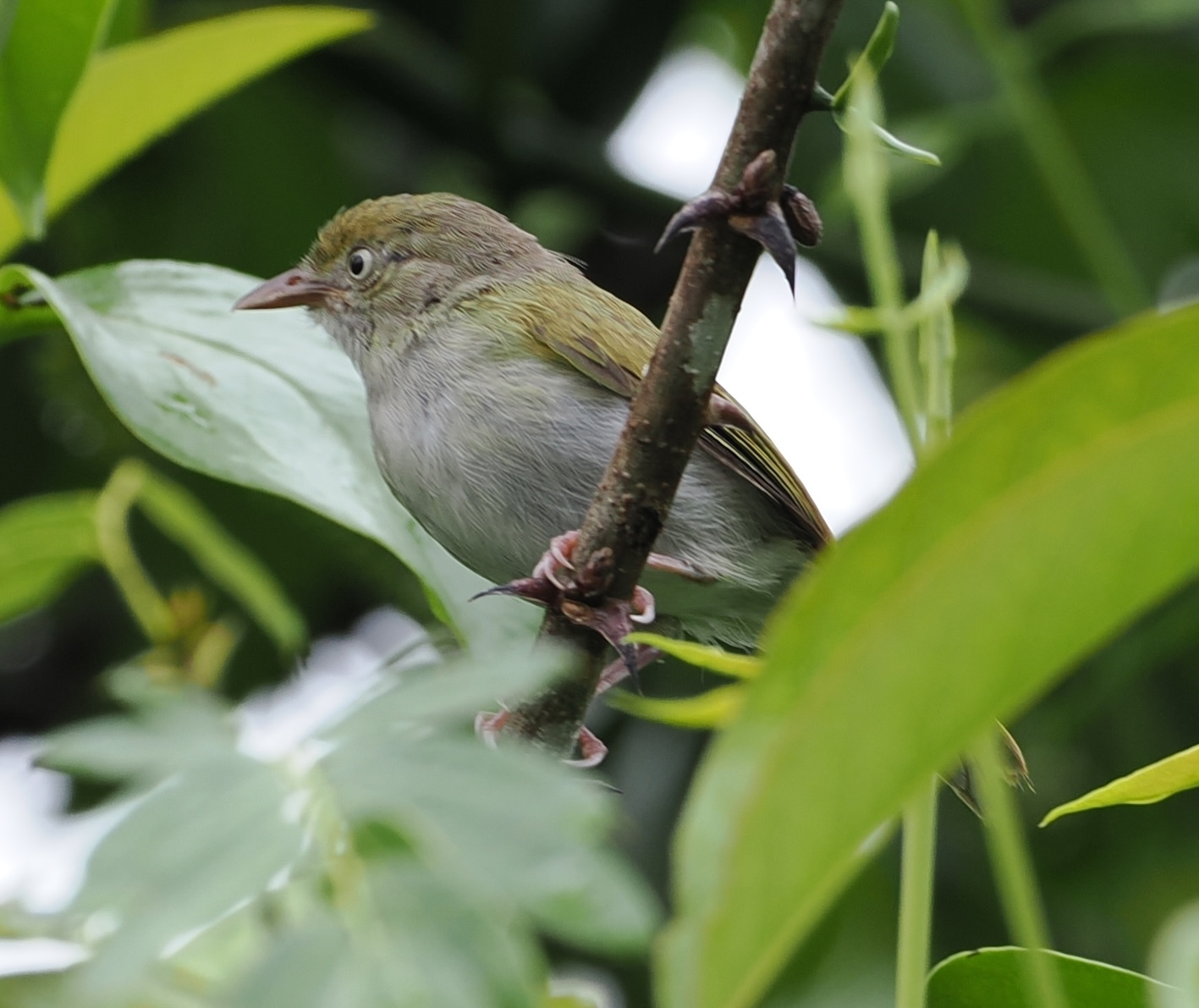
The Grey-chested Greenlet is a small vireo of the canopy of flooded forest and forest edges in Amazonia. A grey nape and breast and a pale iris characterise it. It is heard more often than seen: the song is a very rapid, high series of notes from the treetops.
Voice
The song is a very high, rapid series of identical notes, a hurried wee-wee-wee-wee, often too fast to count.
Recording: JAYRSON ARAUJO DE OLIVEIRA — CC BY-NC-SA 4.0 · xeno-canto
Identification
12 cm, small, with a fairly long, pointed bill: upper mandible grey, lower mandible pink with a grey tip. Forecrown greyish green, hindcrown and nape grey; rest of the upperparts green, wings grey-black with green edges, tail dull olive-green. Underparts largely grey, with a yellowish wash on the breast and lower belly. The iris is whitish to grey, the legs are grey-brown. The sexes are alike. Birds from the north of the range have less grey on the crown and paler underparts; those from the west have an olive-brown wash on the head and nape.
Confusion species
Ashy-headed Greenlet Hylophilus pectoralis has a dark iris, an all-grey head, a whitish throat and a greenish-yellow breast band. Lemon-chested Greenlet Hylophilus thoracicus has a bright yellow breast band, sharply set off from throat and belly. Brown-headed Greenlet Hylophilus brunneiceps of blackwater areas has a brown crown and dirty-white underparts.
Habitat
The canopy, edges and clearings of humid forest, especially várzea, permanently flooded forest and secondary forest, with a preference for forest with a fairly low canopy; from sea level to about 400 m. It forages in pairs, often with mixed flocks, in the canopy, searching leaves for insects. As in related species, the nest is a hanging cup in a fork of a branch.
Where the bird is most at home, classified by the vegetation units of Amazonia and the Guianas.




Range and movements
In the guide area in northern Brazil, on both sides of the Amazon, east to Pará, Maranhão and western Tocantins and south to northern Mato Grosso; in southern Venezuela, in Amazonas and Bolívar; and in eastern French Guiana. No certain records are known from Guyana and Suriname. Outside the guide area in northeastern Peru and northeastern Bolivia, and possibly in Colombia.
- Resident
- dark = core range, pale = thinly spread
How and when to look
Found at the edges of várzea and on river islands along the Amazon and its tributaries, for example around Manaus and Santarém, where the song rings out from low treetops in the early morning. At forest edges and clearings the bird sometimes comes lower, so that the grey nape and pale eye can be seen.
Conservation status
Least Concern. Widespread in Amazonia and locally common, and the species also occurs in secondary forest.
Scientific name
Hylophilus semicinereus | Sclater & Salvin, 1867
Sclater & Salvin described the species in 1867 and placed it straight away in the genus where it still stands. The genus Hylophilus was introduced in 1822 by Temminck. Hylophilus is Greek, from hulē 'woodland' and philos 'loving': 'woodland-lover'. semicinereus is Latin, from semi- 'half' and cinereus 'ash-grey', after the partly grey head and breast. The specimen the first description was based on came from Belém (Pará), Brazil.