All species › Passerines › Shrike-babblers, Erpornis and vireos › Scrub Greenlet
Scrub Greenlet | Hylophilus flavipes
Struikvireo | Verdillo matorralero | Verdinho-do-matagal
The Scrub Greenlet is a small, plainly coloured vireo of dry scrub and forest edges in southern Central America and northern South America. In the guide area it lives only in Venezuela, north of the Orinoco. A long series of identical, clear notes usually gives it away before its appearance does.
Voice
The song is a rapid series of four to more than twenty identical, clear notes on one pitch, such as chee-chee-chee-chee, often repeated. Also a nasal, scolding nyeh-nyeh. It sings mainly in the morning.
Recording: Johan Chaves — CC BY-NC-SA 4.0 · shortened to the first 60 s, mono · xeno-canto
Identification
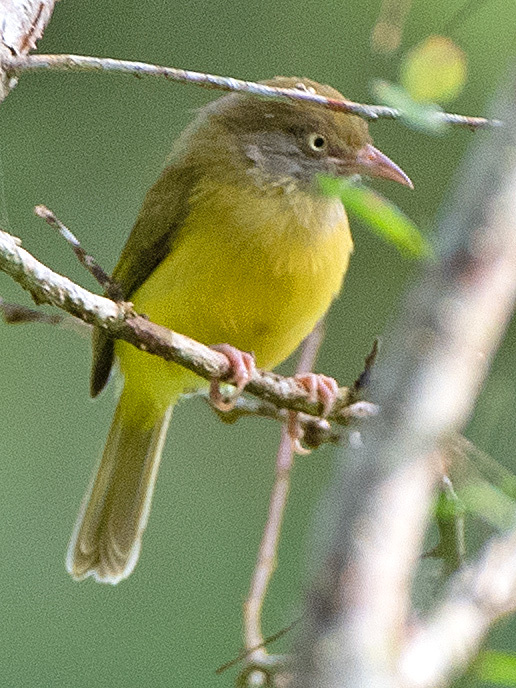
11–12 cm, small and slim, with a fairly long, pointed bill that is pink to horn-coloured below. Crown and upperparts olive-green, slightly browner on the crown; sides of the head without a clear pattern. Wings grey-black with greenish edges, without wing bars. Throat pale grey to whitish, breast and belly pale yellow with an olive to buff wash on the breast. In most birds the iris is pale yellow to whitish, and the legs are pale pink. The sexes are alike.
Confusion species
Golden-fronted Greenlet Pachysylvia aurantiifrons, in the same area, has a dark iris, a shorter bill, an ochre-yellow forehead and a yellower belly, and more often forages higher in the trees. Red-eyed Vireo Vireo olivaceus is larger, with a grey crown, a black-bordered white eyebrow and a red iris. Female American Yellow Warblers Setophaga aestiva are more uniformly yellow, with a short, sharp bill and yellow edges to the wing feathers.
Habitat
Low, dense scrub, dry and semi-deciduous secondary forest, thorn scrub, forest edges, gallery forest in the Llanos, overgrown pastures and gardens with shrubs, from the lowlands to about 1000 m. It forages in pairs or small groups, often with other species, in the lower and middle levels, searching twigs and leaves for small insects and spiders. The nest is a hanging cup in a fork of a branch.
Where the bird is most at home, classified by the vegetation units of Amazonia and the Guianas.



Range and movements
In the guide area only in Venezuela, where it is widespread in the dry north and in the Llanos, north of the Orinoco, from Zulia and Falcón east to Sucre. The species is absent from Brazil, Guyana, Suriname and French Guiana. Outside the guide area in Costa Rica, Panama, northern Colombia and on Tobago.
- Resident
- dark = core range, pale = thinly spread
How and when to look
Found in almost any patch of dry scrub and secondary forest in northern Venezuela, for example along roads in Falcón and Lara and around the Llanos. The series of identical notes is the best clue; the bird then reveals itself by its movement in the bushes, when the pale eye stands out.
Conservation status
Least Concern. Common in northern Venezuela, and the species tolerates disturbed, secondary scrub well.
Scientific name
Hylophilus flavipes | de Lafresnaye, 1845
De Lafresnaye described the species in 1845 and placed it straight away in the genus where it still stands. The genus Hylophilus was introduced in 1822 by Temminck. Hylophilus is Greek, from hulē 'woodland' and philos 'loving': 'woodland-lover'. flavipes is Latin, from flavus 'yellow' and pes 'foot', after the pale yellowish legs. The specimen the first description was based on came from Bogotá, Colombia.