All species › Passerines › Shrike-babblers, Erpornis and vireos › Grey-eyed Greenlet
Grey-eyed Greenlet | Hylophilus amaurocephalus
Grijsoogvireo | Verdillo ojigrís | Vite-vite-de-olho-cinza
The Grey-eyed Greenlet is a small, olive-green and grey vireo found only in eastern Brazil. It was long treated as a subspecies of Rufous-crowned Greenlet and differs from it mainly in its pale grey iris and plainer head. It lives in drier forest and scrub than its sister species and tolerates heavily modified landscapes.

Voice
The song is a short series of high, rather harsh notes, such as see-see-see, often repeated; several variants exist. In small groups it also gives short contact calls such as chek.
Recording: João Capurucho — CC BY-NC-SA 4.0 · converted to mono · xeno-canto
Identification
12 cm, small, with a fairly long, pointed bill: upper mandible dark, lower mandible paler. Forehead and crown chestnut-brown, sides of the head fairly plain brownish grey without a dark ear patch. Upperparts olive-green, wings dark grey with green edges, without wing bars. Chin dull white, throat grey, rest of the underparts brownish grey with yellowish flanks. The iris is pale to mid grey, the legs are pink. The sexes are alike.
Confusion species
Rufous-crowned Greenlet Hylophilus poicilotis, in the Atlantic Forest to the south and east of this species, has a dark, reddish-brown iris, grey-black mottled ear coverts and a yellower belly; where the two meet, the eye is the best feature. Lemon-chested Greenlet Hylophilus thoracicus in the southeast has a grey nape, a bright yellow breast band and a white iris. Golden-crowned Warbler Basileuterus culicivorus has a striped head and yellow underparts.
Habitat
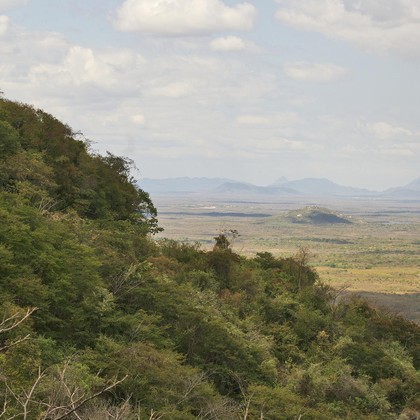
Wooded caatinga, dry and semi-deciduous forest, cerradão, forest edges, scrub, overgrown pastures and secondary forest, from the lowlands to about 1800 m. It forages in pairs or small groups, often with mixed flocks, in the lower and middle levels, searching leaves and twigs for insects and spiders. As in related species, the nest is a hanging cup in a fork of a branch.
Where the bird is most at home, classified by the vegetation units of Amazonia and the Guianas.




Range and movements
Endemic to Brazil and therefore found only there in the guide area: in the east and northeast, from Piauí and Ceará south through Bahia, Goiás and Minas Gerais to São Paulo, in the Caatinga, the eastern Cerrado and the drier edges of the Atlantic Forest. The species is absent from Venezuela, Guyana, Suriname and French Guiana. Old reports from northern Bolivia are unconfirmed.
- Resident
- dark = core range, pale = thinly spread
How and when to look
Found in dry forest and forest edges in the interior of Bahia and Minas Gerais, for example in the lower parts of the Chapada Diamantina and in the Serra do Cipó. Listen for the repeated high notes in mixed flocks in the middle level; a good view of the grey eye separates it from Rufous-crowned Greenlet.
Conservation status
Least Concern. The species is fairly common in much of its range and persists in disturbed and secondary forest, although dry forest and caatinga are declining through clearance.
Scientific name
Hylophilus amaurocephalus | (Nordmann, 1835)
Nordmann described the species in 1835 as Sylvia amaurocephala; because it was later moved to another genus, the author and year stand in brackets. The genus Hylophilus was introduced in 1822 by Temminck. Hylophilus is Greek, from hulē 'woodland' and philos 'loving': 'woodland-lover'. amaurocephalus is Greek, from amauros 'dark' and -kephalos '-headed': 'dark-headed', after the greyish head. The specimen the first description was based on came from border of Bahia and Minas Gerais, Brazil.