All species › Passerines › Shrike-babblers, Erpornis and vireos › Rufous-crowned Greenlet
Rufous-crowned Greenlet | Hylophilus poicilotis
Roestkruinvireo | Verdillo coronado | Verdinho-coroado
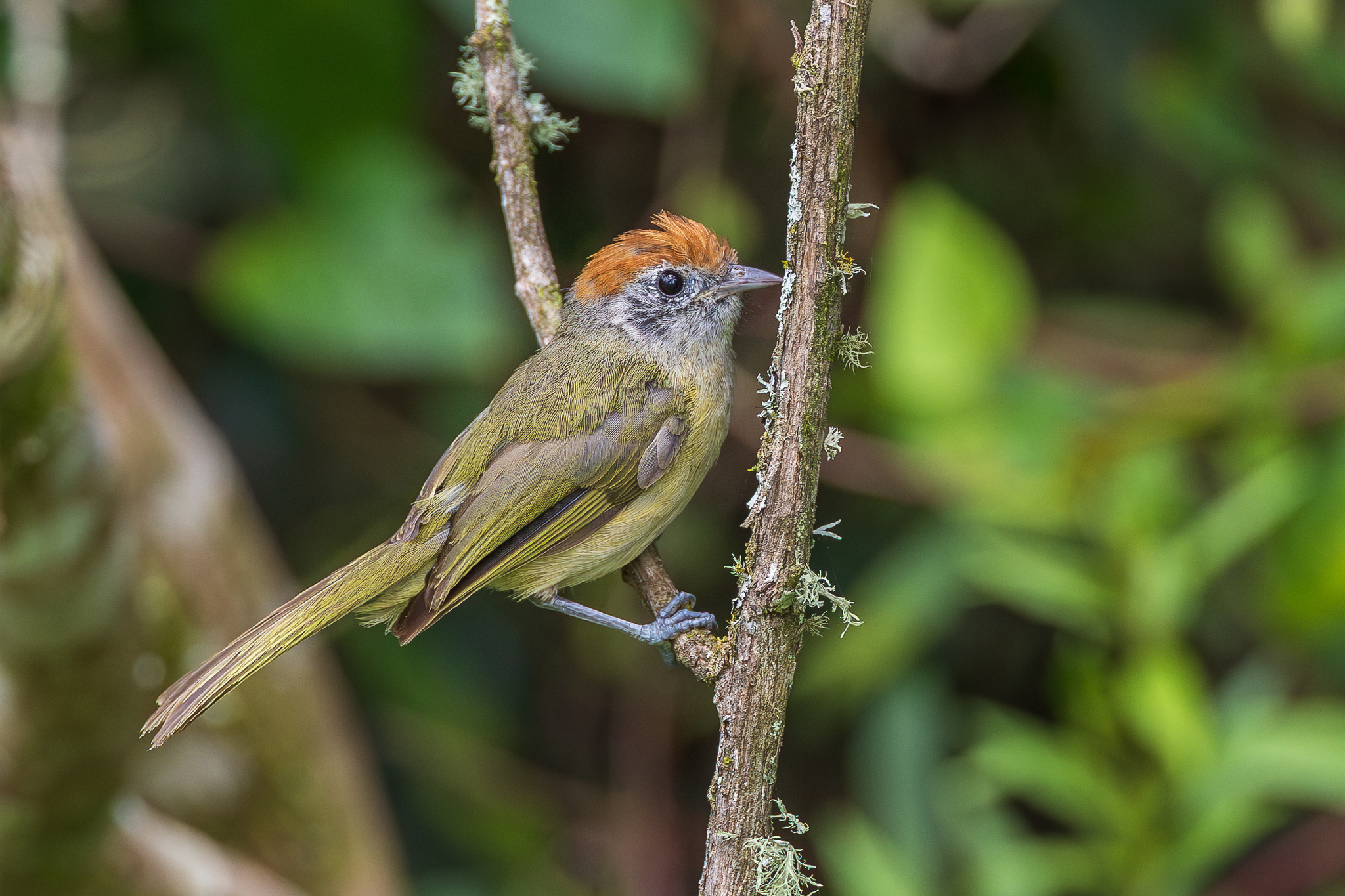
The Rufous-crowned Greenlet is a small vireo of the Atlantic Forest of southeastern Brazil and adjacent parts of Paraguay and Argentina. The chestnut crown and grey-black mottled ear coverts give the head a distinctive pattern. It often travels with mixed flocks through the middle level of the forest.
Voice
The song is a rapid, high series, such as tuweet repeated three to six times or swee four or five times, varying somewhat by region. In groups, short contact calls such as chek or chi-chek.
Recording: Faustino Hollmann — CC BY-NC-SA 4.0 · xeno-canto
Identification
12–13 cm, small, with a fairly long, pointed bill. Forehead and crown bright chestnut; ear coverts mottled grey-black, surrounded by paler grey areas. Upperparts olive-green, brighter green on the lower back and rump; wings dark grey with green edges, without wing bars. Throat dull grey, breast yellowish grey, flanks and belly brighter yellow. The iris is dark reddish brown, the legs are pink. The sexes are alike.
Confusion species
Grey-eyed Greenlet Hylophilus amaurocephalus, in drier forest to the north and west of this species, has a pale grey iris, a plainer head without a dark ear patch and more brownish-grey underparts. Lemon-chested Greenlet Hylophilus thoracicus has a grey nape, an olive-green crown, a bright yellow breast band and a white iris. Golden-crowned Warbler Basileuterus culicivorus has a black-and-yellow striped crown and entirely yellow underparts.
Habitat
Humid forest, forest edges, mature secondary forest and scrub, in the lowlands and in the mountains to about 1800 m, also in inland seasonal forest and araucaria forest. It forages in pairs or small groups, often with mixed flocks, in the middle level and lower canopy, searching leaves and twigs for insects and spiders. As in related species, the nest is a hanging cup in a fork of a branch.
Where the bird is most at home, classified by the vegetation units of Amazonia and the Guianas.




Range and movements
In the guide area only in southeastern and southern Brazil, from Minas Gerais, Rio de Janeiro and southern Mato Grosso do Sul through São Paulo, Paraná and Santa Catarina to Rio Grande do Sul. The species is absent from Venezuela, Guyana, Suriname and French Guiana. Outside the guide area in eastern Paraguay and in Misiones, Argentina.
- Resident
- dark = core range, pale = thinly spread
How and when to look
Found in almost any larger tract of Atlantic Forest in Paraná, São Paulo and Minas Gerais, for example at Intervales and in the forests around Iguaçu. Listen for the rapid high series from mixed flocks in the middle level; the bird keeps moving, and the rufous crown stands out when it shows between the leaves.
Conservation status
Least Concern. Fairly common in the Atlantic Forest, and the species persists in secondary forest, although much of its habitat has been fragmented by deforestation.
Scientific name
Hylophilus poicilotis | Temminck, 1822
Temminck described the species in 1822 and placed it straight away in the genus where it still stands. He introduced the genus Hylophilus in that same work. Hylophilus is Greek, from hulē 'woodland' and philos 'loving': 'woodland-lover'. poicilotis is Greek, from poikilos 'spotted, variegated' and -ōtis '-eared', after the mottled ear-coverts. The specimen the first description was based on came from Ipanema (São Paulo), Brazil.