All species › Passerines › Ovenbirds and woodcreepers › Para Foliage-Gleaner
Para Foliage-Gleaner | Automolus paraensis
Parábladspeurder | Ticotico de Pará | Barranqueiro-do-pará
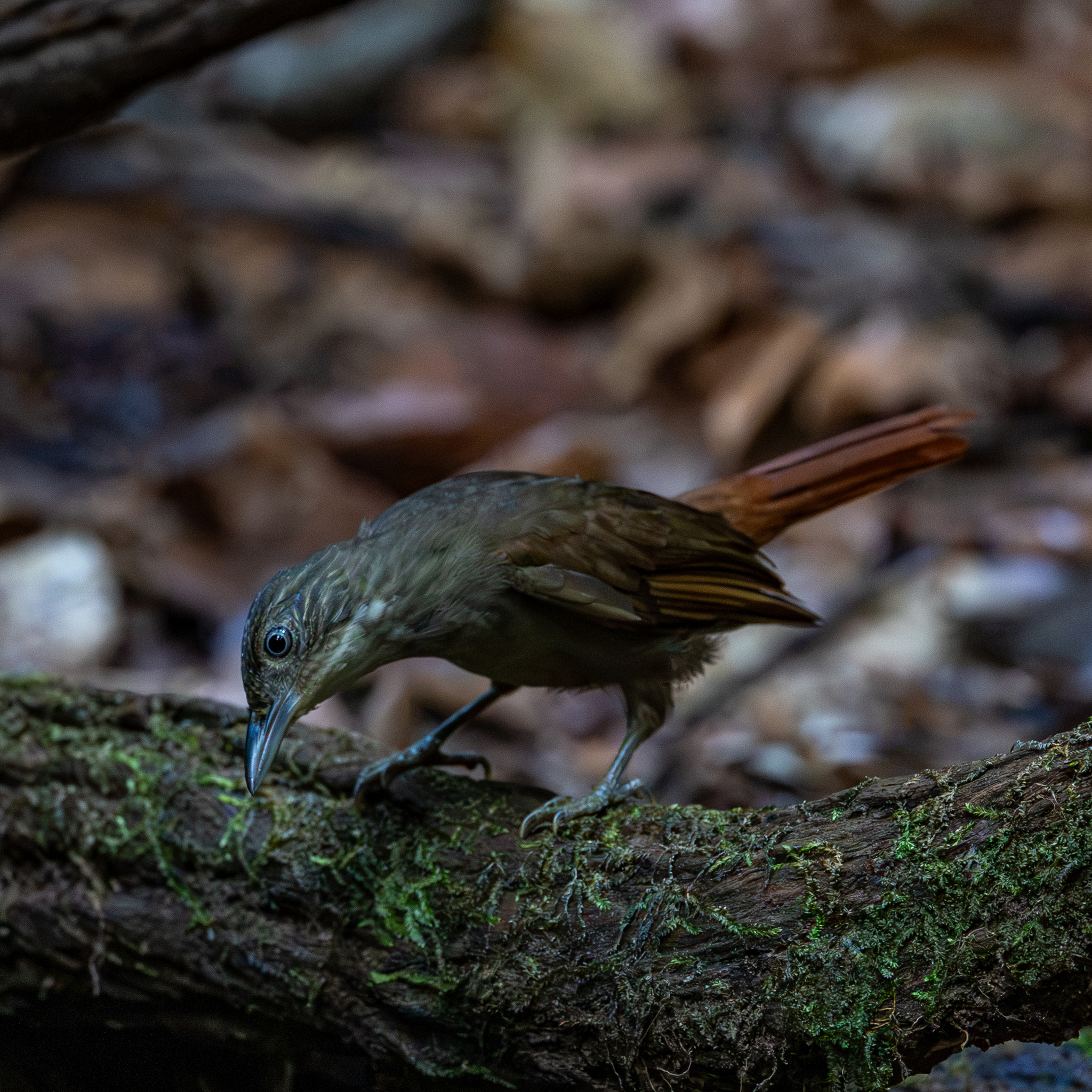
The Para Foliage-Gleaner is a brown foliage-gleaner with a white throat from the understorey of lowland forest south of the Amazon. It was long treated as a subspecies of Olive-Backed Foliage-Gleaner and is now regarded as a separate species on the basis of differences in song. It occurs only in Brazil, largely in the zone where deforestation of Amazonia is advancing fastest.
Voice
The song is a short, rapid series of dry, rattling notes, mainly at dawn and dusk; it differs from the song of Olive-Backed Foliage-Gleaner. The call is a short, nasal chek.
Recording: Felipe Arantes — CC BY-NC-SA 4.0 · xeno-canto
Identification
18–19 cm, with a fairly strong, straight bill. Upperparts plain olive-brown, rump and tail rufous. A narrow, pale supercilium. Throat white, contrasting with the greyish olive-brown breast; belly slightly paler. Iris dark. Male and female alike.
Confusion species
Olive-Backed Foliage-Gleaner Automolus infuscatus is very similar, but lives north of the Amazon and in western Amazonia; the ranges do not overlap and the song differs. Ochre-Throated Foliage-Gleaner Automolus ochrolaemus has an ochre-buff throat and eye-ring. Chestnut-Crowned Foliage-Gleaner Automolus rufipileatus has an orange eye and a rufous crown. Eastern Woodhaunter Automolus subulatus is finely streaked on the head and breast.
Habitat
Understorey and lower mid-storey of humid terra firme forest, also old secondary forest and forest edges with many vines, in the lowlands up to about 600 m. It forages alone or in pairs in clusters of dead leaves, vines and palm fronds for insects and spiders, often with mixed flocks. Like other species of the genus, it nests in a burrow in an earth bank.
Where the bird is most at home, classified by the vegetation units of Amazonia and the Guianas.



Range and movements
Brazil: endemic south of the Amazon, from the Madeira east through Pará to western Maranhão, south to Rondônia, northern Mato Grosso and western Tocantins. Not in Venezuela, Guyana, Suriname or French Guiana. Does not occur outside the guide area.
- Resident
- dark = core range, pale = thinly spread
How and when to look
In terra firme forest in Pará or northern Mato Grosso, join mixed flocks in the understorey and look for a brown foliage-gleaner with a white throat pulling at dead leaves. At dawn and dusk the song is the best clue.
Conservation status
Least Concern (IUCN). Fairly common in continuous forest, but the range lies largely in the arc of deforestation in southern and eastern Amazonia, where the forest is becoming fragmented.
Scientific name
Automolus paraensis | Hartert, 1902
Hartert described the species in 1902 and placed it straight away in the genus where it still stands. The genus Automolus was introduced in 1853 by Reichenbach. Automolus is Greek, from automolos 'deserter, defector'; why Reichenbach chose the name is unclear. paraensis refers to the Brazilian state of Pará, where the species was collected. The specimen the first description was based on came from Benevides near Belém, Pará, Brazil.