All species › Passerines › Ovenbirds and woodcreepers › Pernambuco Foliage-Gleaner
Pernambuco Foliage-Gleaner | Automolus lammi
Pernambucobladspeurder | Ticotico de Pernambuco | Barranqueiro-do-nordeste
The Pernambuco Foliage-Gleaner is a rufous-brown foliage-gleaner with a white eye and a white throat that lives only in the remnants of the Atlantic Forest in north-eastern Brazil. It was split from White-Eyed Foliage-Gleaner in 2008 on the basis of differences in song. Because of forest loss in this part of Brazil the species is threatened.

Voice
The song is a rapid, dry, rattling series of notes, mainly in the early morning; according to sound recordings it differs clearly from the song of White-Eyed Foliage-Gleaner. The call is a sharp, short chek.
Recording: Dante Buzzetti — CC BY-NC-SA 4.0 · shortened to the first 60 s, mono · xeno-canto
Identification
19–20 cm, with a fairly strong, straight bill. Upperparts warm brown, rump and tail bright rufous. Iris white to yellowish white. Throat white, sharply set off from the ochre-brown breast and belly. Male and female alike.
Confusion species
White-Eyed Foliage-Gleaner Automolus leucophthalmus is almost identical in plumage, but lives further south, from southern Bahia, and has a different song. Rufous-Breasted Leaftosser Sclerurus scansor lives on the forest floor and has a dark eye, a rufous breast and a blackish tail. Other brown foliage-gleaners in this part of the Atlantic Forest lack the combination of white eye and white throat.
Habitat
Understorey of humid lowland forest and of the montane forest of the brejos in the north-eastern part of the Atlantic Forest, also old secondary forest and larger forest fragments, from the lowlands up to about 1000 m. It searches dead leaves, vines and epiphytes for insects, often with mixed flocks. It nests in a burrow in an earth bank, fairly close to the ground.
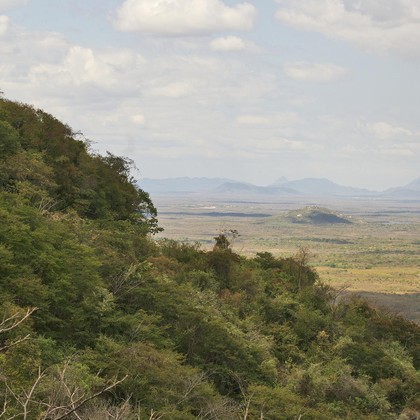
Where the bird is most at home, classified by the vegetation units of Amazonia and the Guianas.

Range and movements
Brazil: endemic to the north-eastern Atlantic Forest, from south-eastern Rio Grande do Norte through Paraíba, Pernambuco and Alagoas to Sergipe and north-eastern Bahia. Not in Venezuela, Guyana, Suriname or French Guiana. Does not occur outside the guide area.
- Resident
- dark = core range, pale = thinly spread
How and when to look
Visit larger forest reserves in Alagoas, Pernambuco or Paraíba, such as the forests of Murici in Alagoas, and listen in the early morning for the rattling song in the understorey. Look for the white eye and white throat, even in the half-light of the forest.
Conservation status
Endangered (IUCN). The north-eastern Atlantic Forest has largely been cleared for sugar cane and pasture; the species lives in fragmented, often small forest remnants.
Scientific name
Automolus lammi | Zimmer, 1947
Zimmer described the species in 1947 and placed it straight away in the genus where it still stands. The genus Automolus was introduced in 1853 by Reichenbach. Automolus is Greek, from automolos 'deserter, defector'; why Reichenbach chose the name is unclear. lammi honours the American diplomat and ornithologist Donald Wakeham Lamm (1914–1996), who served in Brazil among other countries. The specimen the first description was based on came from Recife, Pernambuco, Brazil.