All species › Passerines › Ovenbirds and woodcreepers › Peruvian Recurvebill
Peruvian Recurvebill | Syndactyla ucayalae
Ucayalikrombekbladspeurder | Ticotico picolezna peruano | Limpa-folha-de-bico-virado
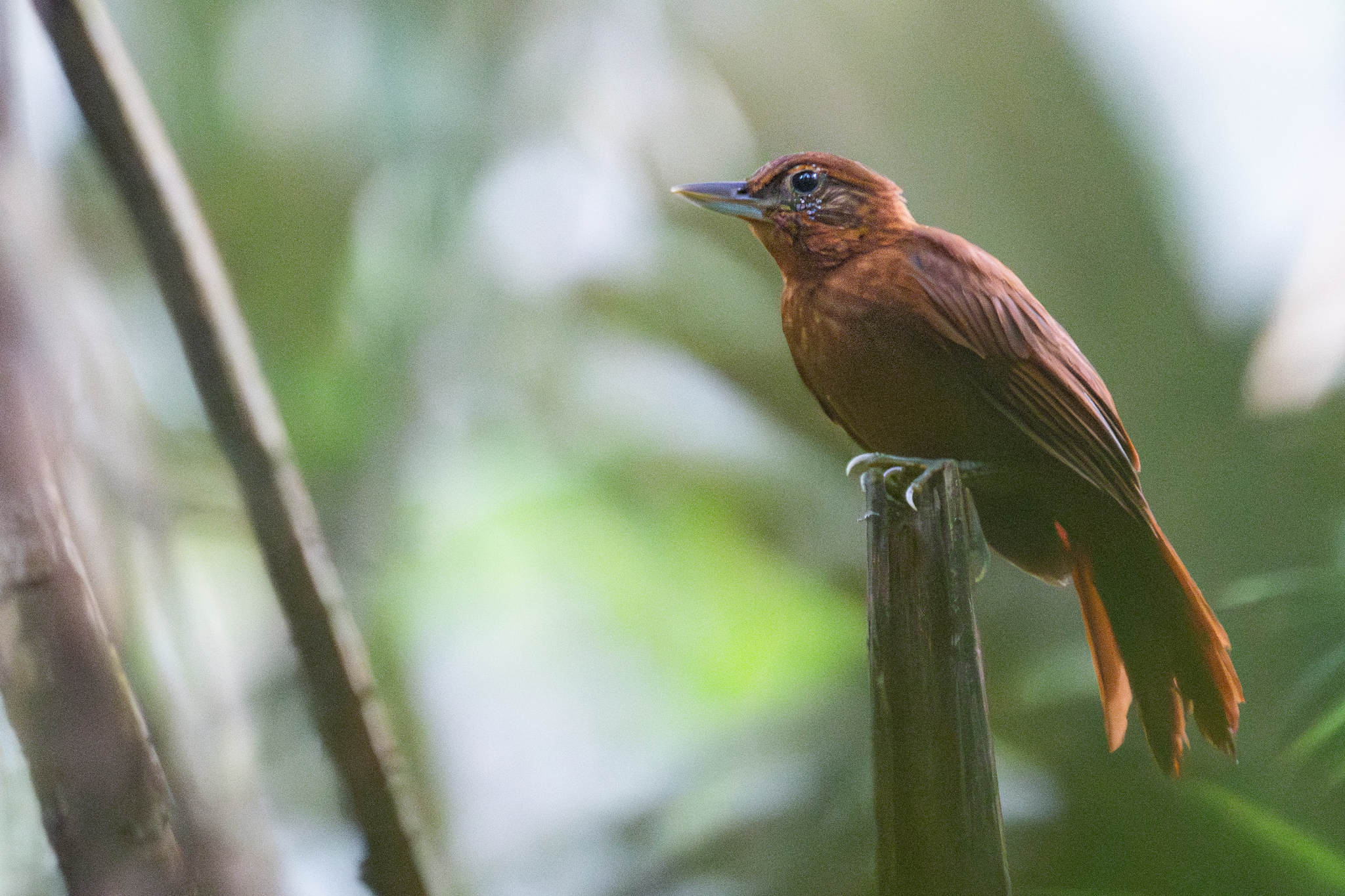
The Peruvian Recurvebill is a sturdy, rufous-brown foliage-gleaner with a heavy, wedge-shaped, slightly upturned bill, specialised in bamboo. In the guide area it reaches only the west of Brazilian Amazonia, where it lives in dense bamboo of the genus Guadua.
Voice
The song is a short, loud, harsh, rising rattle, sometimes ending in a few lower notes. The call is a loud, hoarse, low chack.
Recording: Jacob Wijpkema — CC BY-NC-SA 4.0 · converted to mono · xeno-canto
Identification
19–20 cm, with a heavy, wedge-shaped bill whose lower mandible angles upwards, so that the bill looks slightly upturned. The plumage is almost entirely rufous-brown, with an orange-rufous throat and breast. The sexes are alike. Juveniles have a brighter supercilium and a black scalloped pattern on the underparts.
Confusion species
Bamboo Foliage-Gleaner Anabazenops dorsalis lives in the same bamboo, but is slimmer, with a straight bill, a pale supercilium and a whitish throat. Brown-rumped Foliage-Gleaner Automolus melanopezus, also a bamboo dweller, has a slim, straight bill and a dark brown rump. The shape of the bill separates the species from all other foliage-gleaners in the area.
Habitat
Evergreen lowland and riverside forest with dense Guadua bamboo, locally also cane-like Gynerium along rivers; in the guide area in the lowlands. It forages singly or in pairs in dense understorey, sometimes with mixed flocks. It hammers, hacks and splits open bamboo stems and dead plant material to find spiders, beetle larvae and earwigs. Nothing is known about its breeding.
Where the bird is most at home, classified by the vegetation units of Amazonia and the Guianas.



Range and movements
In Brazil in western Amazonia, mainly in Acre and adjacent southwestern Amazonas, the area of the bamboo forest of southwestern Amazonia; also locally in isolated areas farther east. Not in Venezuela or the Guianas. Outside the guide area in southeastern Peru and northern Bolivia.
- Resident
- dark = core range, pale = thinly spread
How and when to look
In Acre, for example around Rio Branco, listen in dense bamboo for the harsh rattle. It usually stays low in the bamboo; a hacking or tapping sound from the stems can give it away.
Conservation status
Least Concern (IUCN). It is rare to locally fairly common and tolerates some selective logging, but its habitat is fragmented and declining as new roads and clearing open up the forest.
Scientific name
Syndactyla ucayalae | (Chapman, 1928)
Chapman described the species in 1928 as Anachilus ucayalae; because it was later moved to another genus, the author and year stand in brackets. The genus Syndactyla was introduced in 1853 by Reichenbach. Syndactyla is Greek, from sun 'together' and daktulos 'toe', after the outer toe being fused to the middle toe up to the first joint. ucayalae refers to the Ucayali River in Peru, where the species was collected. The specimen the first description was based on came from Lagarto, upper Ucayali River, Peru.