All species › Passerines › Ovenbirds and woodcreepers › Tepui Foliage-Gleaner
Tepui Foliage-Gleaner | Syndactyla roraimae
Witkeelbladspeurder | Ticotico gorjiblanco | Barranqueiro-de-roraima
The Tepui Foliage-Gleaner is a dark foliage-gleaner with a white throat and a white supercilium that lives only in the montane forests of the tepuis. It is restricted to the Guiana Highlands, with four subspecies on separate table mountains.

Voice
The song is a long, accelerating series of harsh, guttural notes rising in pitch, usually preceded by a few single short notes. The call is a short, harsh chek or tzik.
Recording: GABRIEL LEITE — CC BY-NC-SA 4.0 · converted to mono · xeno-canto
Identification
18 cm; the smallest species of the genus Syndactyla. The face is blackish-brown with a prominent white supercilium, the crown dark greyish-brown and the back dark rufescent brown. The rump, uppertail coverts and tail are chestnut-rufous. The throat and malar area are white, contrasting with the medium brown breast and belly. The sexes are alike. Juveniles have an ochre supercilium and more rufous underparts with dusky fringes on the breast and belly.
Confusion species
Ochre-throated Foliage-Gleaner Automolus ochrolaemus has an ochre rather than a white throat, lacks the contrast between white supercilium and dark face, and lives mainly lower down, in lowland forest. Chestnut-crowned Foliage-Gleaner Automolus rufipileatus is more uniformly rufous-brown, with a rufous crown, an orange iris and no white throat, and also lives in the lowlands.
Habitat
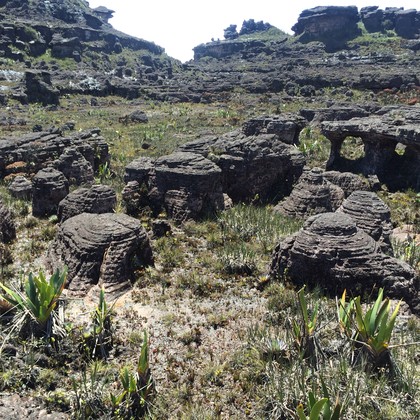
Humid evergreen montane forest, wind-stunted woodland and the transition between them on the slopes and summits of the tepuis, mostly between 1100 and 2500 m. It searches the understorey and mid-storey among mosses, dead leaves and epiphytes for arthropods, often with mixed flocks. Almost nothing is known about its breeding; in Guyana the breeding season apparently ends in March or April.
Where the bird is most at home, classified by the vegetation units of Amazonia and the Guianas.

Range and movements
In Venezuela on the tepuis of Bolívar and Amazonas, among them Duida, Cerro Paraque, Roraima and the tepuis of southeastern Bolívar. In Guyana on the tepuis of the Pakaraima Mountains in the west. In Brazil only along the border with Venezuela, on Roraima and Pico da Neblina. Not in Suriname or French Guiana. The species does not occur outside the guide area.
- Resident
- dark = core range, pale = thinly spread
How and when to look
Search the cloud forest on the tepuis of southeastern Bolívar, where it moves with mixed flocks through the understorey, and listen for the accelerating, harsh song. Look for the white throat and the white supercilium in the dark face.
Conservation status
Least Concern (IUCN). Its habitat is largely remote and little affected. Because of its small, fragmented distribution on separate tepuis, the species is nonetheless sensitive to local damage such as mining and fires at the foot of the mountains.
Scientific name
Syndactyla roraimae | (Hellmayr, 1917) (GBIF: Automolus roraimae)
Hellmayr described the species in 1917 as Automolus roraimae; because it was later moved to another genus, the author and year stand in brackets. The genus Syndactyla was introduced in 1853 by Reichenbach. Syndactyla is Greek, from sun 'together' and daktulos 'toe', after the outer toe being fused to the middle toe up to the first joint. roraimae refers to the tepui Mount Roraima on the border of Venezuela, Guyana and Brazil, where the species was discovered. The specimen the first description was based on came from Mount Roraima, Guyana–Venezuela border.