All species › Passerines › Ovenbirds and woodcreepers › Planalto Foliage-Gleaner
Planalto Foliage-Gleaner | Syndactyla dimidiata
Roestrugbladspeurder | Ticotico del Planalto | Limpa-folha-do-brejo
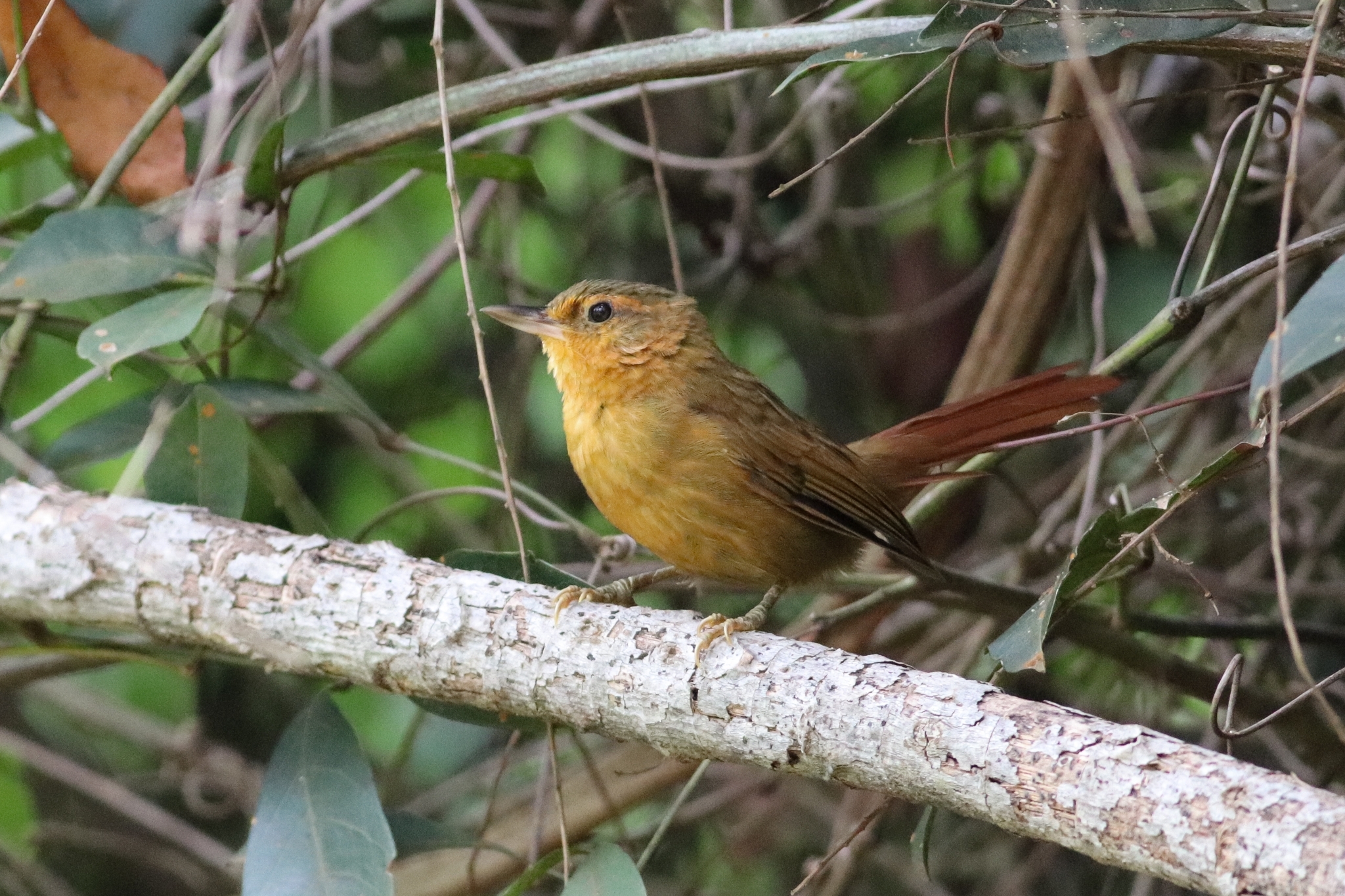
The Planalto Foliage-Gleaner is a warm rufous-brown foliage-gleaner of the gallery forests and dry forests of the Brazilian planalto. It occurs only in the cerrado region of central Brazil and adjacent northeastern Paraguay, and lives hidden in the mid-storey and understorey of the forest.
Voice
The song is a series of rising chek notes that stutter at the start and the end, likened to a small motorbike slowly starting up. The contact call is a loud, nasal cheh, given singly or in pairs.
Recording: Douglas Meyer — CC BY-NC-SA 4.0 · shortened to the first 60 s, mono · xeno-canto
Identification
17 cm, with a long, pointed bill. The upperparts are bright rufous-brown with a cinnamon tinge, the tail rufous-chestnut. The face is orange-rufous, strongest on the supercilium. The underparts are mostly unmarked rufous, with faint pale streaks on the breast. The sexes are alike. Juveniles have a shorter bill, a whitish throat and brown barring on the breast.
Confusion species
Buff-browed Foliage-Gleaner Syndactyla rufosuperciliata, found in the south and east of the range, is more olive-brown, with a buff supercilium and distinct pale streaks on the breast. Henna-capped Foliage-Gleaner Clibanornis rectirostris often shares the same gallery forest, but is larger, with a straight bill, a rufous cap and an orange-rufous tail, and stays closer to the ground.
Habitat
Gallery forest along streams and rivers, semi-deciduous seasonal forest and taller woodland in the cerrado landscape, from about 100 to 1200 m. It searches the mid-storey and understorey among dead leaves, mosses and epiphytes for insects and other arthropods, often with mixed flocks. It avoids heavily disturbed forest. Nothing is known about its breeding.
Where the bird is most at home, classified by the vegetation units of Amazonia and the Guianas.



Range and movements
In Brazil on the planalto of central and southwestern Brazil: Mato Grosso, Mato Grosso do Sul, Goiás and the Distrito Federal, east to western Minas Gerais and Bahia and south to São Paulo and Paraná. Not in Venezuela or the Guianas. Outside the guide area only in northeastern Paraguay (Concepción and Amambay).
- Resident
- dark = core range, pale = thinly spread
How and when to look
Search well-developed gallery forest in the cerrado, for example in the protected areas around Brasília and in the Chapada dos Guimarães, and listen for the stuttering song. It often joins mixed flocks moving through the mid-storey.
Conservation status
Least Concern (IUCN). The population is thought to be declining as cerrado and gallery forest are converted to fields and pasture. The species tolerates heavily disturbed forest poorly, is scarce throughout and occurs in only a few protected areas.
Scientific name
Syndactyla dimidiata | (Pelzeln, 1859)
Pelzeln described the species in 1859 as Anabates dimidiatus; because it was later moved to another genus, the author and year stand in brackets. The genus Syndactyla was introduced in 1853 by Reichenbach. Syndactyla is Greek, from sun 'together' and daktulos 'toe', after the outer toe being fused to the middle toe up to the first joint. dimidiata is Latin for 'halved, divided in two', after the two-toned plumage of russet upperparts against paler underparts. The specimen the first description was based on came from Sangrador and Rio Manso, Mato Grosso, Brazil.