All species › Swifts › Swifts › Pygmy Palm Swift
Pygmy Palm Swift | Tachornis furcata
Dwerggierzwaluw | Vencejillo venezolano | Andorinhão-pigmeu
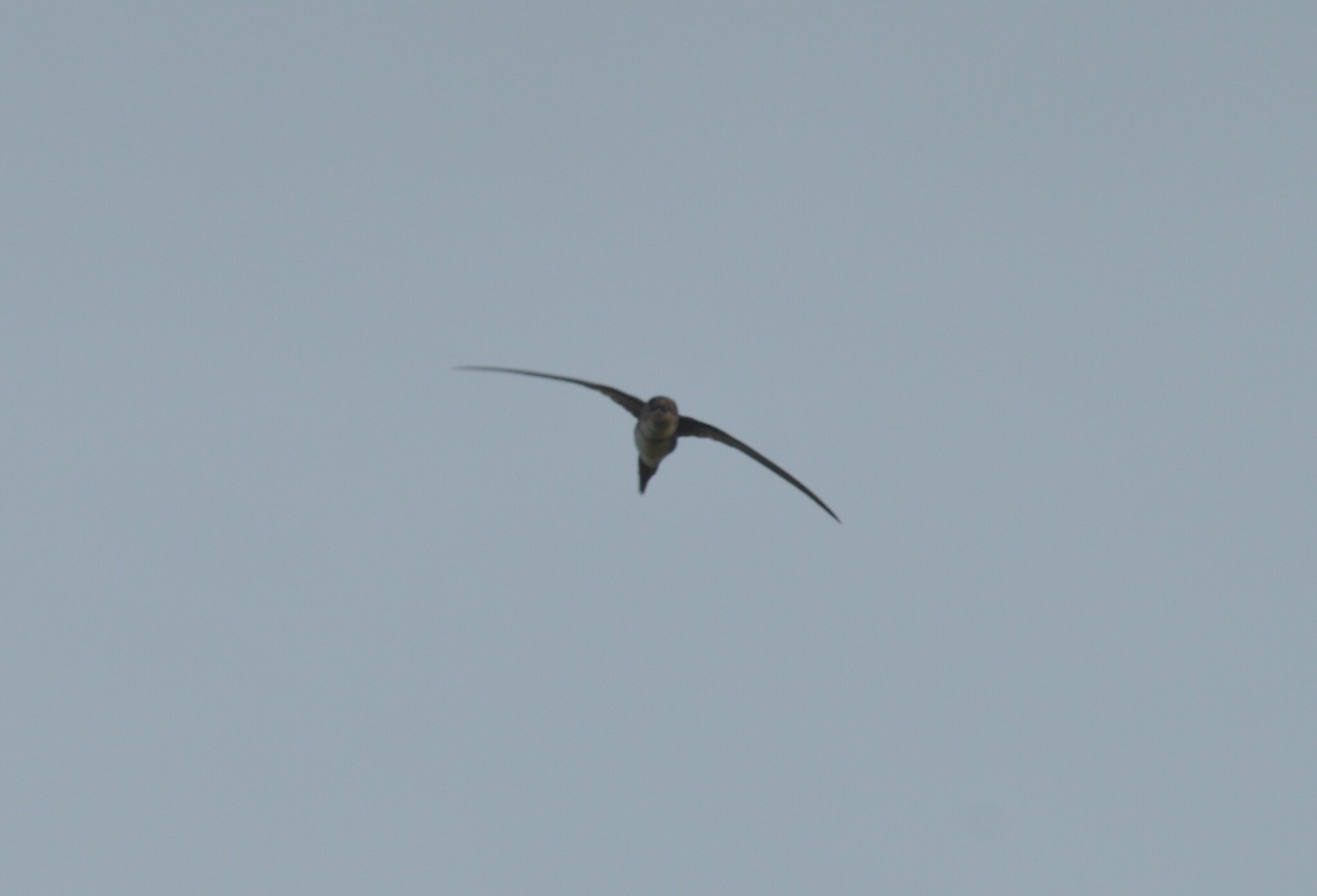
Pygmy Palm Swift is a very small, slender palm swift with a small range around the Maracaibo basin in north-western Venezuela and adjacent north-eastern Colombia. With a length of about 10 cm and a weight of 6 to 7 g it is one of the smallest swifts. It resembles Fork-tailed Palm Swift but is smaller and has a shorter tail.
Voice
High, thin, buzzy chirps and short trills in flight.
Recording: Iván Lau — CC BY-NC-SA 4.0 · converted to mono · xeno-canto
Identification
10 cm, with narrow wings and a deeply forked tail that is usually held closed in a point. The upperparts are blackish brown. Throat and centre of the belly are greyish white, the flanks and undertail coverts dark. The sexes are alike.
Confusion species
Fork-tailed Palm Swift Tachornis squamata is larger and slimmer, with a much longer tail and finely scaled upperparts; it lives east of the Andes and is absent from the Maracaibo basin. Short-tailed Swift Chaetura brachyura and other swifts of the genus Chaetura are stockier, with a short, square tail.
Habitat
Open, hot lowlands with palms, forest edges, pastures and villages, below about 500 m. It hunts small insects low in the air, often in small groups. As far as known it nests mainly in palms.
Where the bird is most at home, classified by the vegetation units of Amazonia and the Guianas.



Range and movements
In the guide area only in Venezuela, in the lowlands of the Maracaibo basin in Zulia and adjacent parts of Táchira, Mérida and Trujillo. Not known from Brazil, Guyana, Suriname and French Guiana. Outside the guide area only in north-eastern Colombia, in the Catatumbo region.
- Resident
- dark = core range, pale = thinly spread
How and when to look
In the lowlands around Lake Maracaibo watch for very small swifts with a pointed tail hunting low over palms, pastures and villages.
Conservation status
Least Concern. The range is small, but the species tolerates open, man-made landscapes.
Scientific name
Tachornis furcata | (Sutton, 1928)
Sutton described the species in 1928 as Micropanyptila furcata; because it was later moved to another genus, the author and year stand in brackets. The genus Tachornis was introduced in 1847 by Gosse. Tachornis is Greek, from takhus 'fast' and ornis 'bird': 'fast bird'. furcata is Latin for 'forked', from furca 'fork', after the deeply forked tail. The specimen the first description was based on came from Guachí, Zulia, Venezuela.